AI suggests why the Philadelphia medevac crash happened

Can artificial intelligence (AI) provide the factors behind aviation accidents? Maybe we should find out, because people can suddenly believe they are experts as a result of using it.

A reader contacted me on February 1st with the answer that an AI app provided when he asked it what caused the 31 January fatal Learjet air ambulance crash in Philadelphia.

Before discussing the AI’s verdict, here is what we actually know about the short flight: the Learjet 55 took off in the evening dusk (18:06:10 local time) from Philadelphia Northeast Airport runway 24, bound for Springfield, Missouri, with a stretchered patient and five other people on board. The temperature and dew point were both 9deg, the cloud-base was at 400-500ft, light wind and reasonable visibility.

When airborne the aircraft was told to turn right onto heading 290deg, and the pilot received an instruction from Tower to change frequency to Philadelphia Departure Control. He read the new frequency back correctly, and bid the Tower controller a good day.

According to ADS-B data, the Learjet had climbed rapidly to a maximum 1,650ft by about a minute after take-off (18:06:56) , then the aircraft entered a steep, uninterrupted descent to impact with the ground. The impact point was in a suburban area about 2.5nm from the airport, close to the runway extended centreline. The pilot never did make contact with Departure Control, and broadcast messages addressed to the flight by Departure did not receive a response.

According to initial reports by Philadelphia police, no-one on board survived the Learjet crash, one person on the ground was killed and 19 were injured, That is my summary of the basic known facts of what happened.

Meanwhile my reader who asked AI to provide him with an explanation for the crash told me he had, in his question, given the AI app (which he didn’t name) all the facts known at that point.

The executive summary part of the AI answer said this: “Preliminary data from ADS-B tracking, witness reports, and aviation system analysis suggest that Learjet 55 XA-UCI suffered a catastrophic runaway trim event (nose-down), leading to an unrecoverable dive and high-speed impact.” It also supplied what I would describe as cogent arguments to back this verdict up, but no actual evidence for the alleged runaway trim or the electrical fault that it proposed was the reason for it. The whole proposal, however, was delivered in a decidedly confident style.

I decided to take a different approach to test AI on the same subject. Given what we know happened, I asked Chat GPT whether the pilot suffering spatial disorientation as a result of somatogravic illusion could be the explanation for the Learjet accident? ChatGPT’s response first explained what somatogravic illusion is, then responded that, yes, it could indeed be a plausible explanation, but advised me to wait for the National Transportation Safety Board’s report.

Somatogravic illusion is an illusion generated by the delicate human inner ear balance organs when they are subjected to acceleration, linear or rotational. For example, passengers seated in the cabin of an aircraft beginning its acceleration along the runway for take-off can feel that the whole aircraft has tilted slightly nose-up, especially if they are looking straight ahead. But a glance out of the cabin window during the take-off run will prove that no such upward tilt has taken place.

Pilots experience the same somatogravic effect during take-off that passengers do, but since they are looking ahead out the cockpit windscreen – and providing the external visibility is good – their powerful visual sense will overcome the misleading feedback from their balance sensors.

If, however, the acceleration continues after take-off and the crew lose sight of the outside world because of darkness or entering cloud, the misleading feedback from their balance sensors returns. And the natural reaction to believing the aircraft’s nose is higher than it should be is to push forward on the control column, pushing the nose down. The physical feeling that a nose-down push is demanded can entirely overcome the intellectual information presented by the pilots’ flight instruments, because the latter is artificial, unlike powerful instinctive feelings or sight of a natural external horizon.

The Learjet series has a reputation for sporty performance. Its take-off acceleration and rate of climb when airborne are impressive. And the point in this short flight where it all appears to have gone wrong happens to occur at the moment when the pilot is likely to have taken his eyes off the flight instruments for a moment to change the radio frequency. The latter may be just coincidence, however.

There is no data here that could be regarded as evidence about the reasons for the Philadelphia crash, but I do know that the runaway trim explanation is plausible, and so is the pilot spacial disorientation theory.

There could be other reasons, however, and I know well after 45 years in this business that listing “what if” explanations is a waste of time because there are too many. The truth will out, via actual evidence. These days it does not take long, because investigators now strive to provide periodic interim factual reports which signpost the emerging truth.

But full understanding – and thus the ability confidently to act to prevent repetition – only comes with the full facts.
Jeju Air – the missing four minutes

Birdstrikes on airliners are not rare, but they don’t usually cause crashes, let alone fatal ones.

The most famous birdstrike accident before the Jeju Air crash at Muan, Korea a little more than a month ago was the “Miracle on the Hudson”, in which a US Airways Airbus A320 climbing away from take-off at New York LaGuardia airport in January 2009 hit a flock of large geese that disabled both engines. What followed captured the public’s imagination to the extent that Hollywood made a movie about it.

When the geese collided with his aircraft, Captain “Sully” Sullenberger made the decision not to attempt a turn-back to land on the runway, but to glide down for a ditching in the Hudson River. All 155 passengers and crew survived the ditching in the river’s freezing water.

Moving forward 15 years, the Korean aviation and railway and accident investigation board (ARAIB) interim report on the 29 December 2024 Jeju Air crash at Muan International Airport has now confirmed that the chain of events leading to the accident also started with a birdstrike on both engines. The Boeing 737-800, on final approach to runway 01 at Muan, ran into a flock of small ducks which caused the engines and the aircraft extensive damage. Details of the extent and nature of the damage have not been established, but it is clear that some of the aircraft’s electrical systems stopped working.

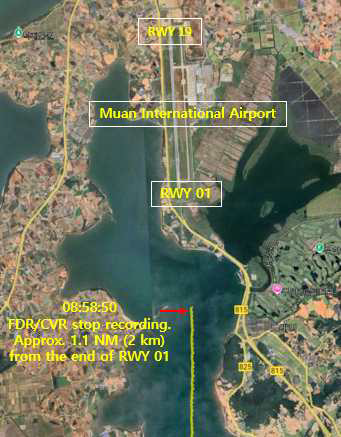
Much more would normally be known at this stage, but the flight data recorder (FDR) and cockpit voice recorder (CVR) stopped operating at the time of the birdstrike (08:58:50 local time), depriving the investigators of extensive data about the last four minutes of the flight that would otherwise have been captured. Simultaneously the aircraft’s ADS-B transmissions that enable the its three-dimensional trajectory to be tracked in real time also stopped, so it will be more difficult to establish the precise course the crew flew in order to line up for the emergency landing they chose to make.

It was at 08:54:43 that Jeju Flight 7C2216, inbound from Bangkok, Thailand, had first contacted Muan Control Tower and received clearance to land on runway 01. If they had not already done so, at that point they would have selected the undercarriage down and set the flaps for landing.

The first hint of the problems the flight was about to face came four minutes later when the Tower warned the Jeju pilots of bird activity ahead (08:57:50). At that point they were about 3nm from their anticipated landing. The electrical failure that stopped the two recorders occurred a minute later at 08:58:50, at which time the aircraft was still 1.1nm away from the threshold of runway 01, according to the ARAIB report.

The crew saw the flock of ducks ahead and below them just before the birdstrike, it seems, so they decided to abandon the approach and carry out a go-around, increasing engine power and starting to climb away. Six seconds later, at 08:58:56 local time, they declared a Mayday emergency, citing a birdstrike, and announcing their go-around, which had now become far more difficult to carry out because of reduced power from the damaged engines.

The report emphasizes that recordings during the last 4min 7sec of the flight are missing. That is the time that elapsed between the electrical failure that stopped the recorders and the moment of the 737’s violent collision with the earth and concrete mound beyond the end of the landing runway in which the ILS localizer antenna array was embedded (09:02:57).

Image from ARAIB interim report

As they initiated their go-around, the pilots felt – and heard – the birdstrike and witnessed a loss of engine thrust just after they had advanced the throttles to climb away. As a part of the go-around drill the crew retracted the undercarriage and selected the flap fully up. There is no recording to confirm this, but they must have done so, as events in the next few minutes make clear.

The attempt to save the flight

The crew knew they had to get the aircraft on the ground fast in case the damaged engines failed completely, but by this time they were losing sight of the runway 01 threshold below the nose as they initiated their go-around, so landing ahead on 01 was no longer an option. Circling back to set up a new approach to the same runway was risky because they might not have sufficient power to maintain height for that long. The ARAIB report says that the last pressure altitude recorded was effectively 500ft (498ft to be precise), and indicated airspeed was 161kt.

At such a point the pilots would want to gain any height and speed they could with the remaining engine power so as to increase their gliding range in the event of total engine failure, and to stay withing gliding range of the runway. So their decision was to fly ahead, then turn through 180deg to land on the same runway but in the opposite direction – that is designated runway 19. Because, during the go-around, they were positioned to the left of runway 01 and parallel to it, they were committing to a right turn to reverse their heading and line up for the approach to 19.

The workload and stress on the pilots at that moment were massive. They did not know how much engine power they would have, or how long they would still have it, so the temptation to turn early to line up on the runway was high. Video of the aircraft’s arrival on runway 19 at Muan shows the aircraft touching down gently with its wings perfectly level, but nearly 2/3rds of the way along the tarmac, travelling very fast with no flaps set, the undercarriage still retracted, and no spoilers deployed.

With the data available at present there is no way of knowing whether the crew failed to get the flap and gear down because of hydraulic problems, or whether the high workload and lack of time made them forget to deploy them. Apart from the failure of electric power to the flight recorders, the investigators don’t know what other problems the pilots faced.

It’s even difficult to work out why an external collision with relatively small birds (Baikal Teals, average weight given as 400g) would cause an electrical supply to fail, unless the undercarriage was still down at the point of birdstrike, leaving electrical wiring and hydraulic tubing in the gear bay vulnerable to impact damage.

Almost all the 181 people on board the Jeju 737 were killed, the only survivors being two cabin crew strapped into their seats in the tail of the aircraft. Everyone on board would still have been alive until the high speed impact with the solid foundations for the ILS localiser antenna array about 200m into the runway overrun, which caused the aircraft to break up and catch fire.

Suddenly I see…

Today, air traffic control officers (ATCOs) on each side of the North Atlantic can see the aircraft they are controlling as they fly between Europe and North America.

It is almost impossible to convey the huge significance of this boring and apparently obvious piece of information, because most people don’t know that – yesterday – the same ATCOs couldn’t see the aircraft they were responsible for. They never had been able to see them, because the machines were outside radar range.

When flying between North American and Europe, until now aircraft of all kinds have always been invisible to air traffic control from the time they were about 350km off the coast on either side.

Under yesterday’s system, ATCOs knew approximately where each aircraft was because the pilots reported their position, their height and an estimate for the next reporting point every 15min or so. This worked safely because aircraft were painstakingly released into their pre-cleared, one-way oceanic tracks at specific heights, time intervals, and speeds, so they would maintain separation vertically and horizontally.

That system is a well-tried air traffic management (ATM) technique known as procedural control, and most of the world will continue to control air traffic procedurally over almost all oceanic and wilderness areas for some years yet.

In fact only 30% of the earth’s surface has radar coverage enabling aircraft surveillance for air traffic management (ATM) purposes.

But now, a new global constellation of 66 low-earth-orbit smart satellites – launched over the last decade by satcoms company Iridium Communications – each carries a device that links aircraft ADS-B datalink signals to ATM centres. Aircraft-mounted ADS-B (automatic dependent surveillance – broadcast) streams information about the aircraft’s position, height and much more. This enables ATCOs to track the aircraft in real time, with a radar-like update rate of 8 seconds.

Here’s the history (this announcement should really be preceded by a trumpet fanfare!): US-headquartered communications technology company Aireon yesterday announced that its space-based air traffic surveillance system was switched on, and active surveillance trials involving ANSPs (air navigation service providers) Nav Canada and UK NATS have begun on the busy North Atlantic routes that each manages from its respective oceanic base either side of the sea.

Aireon CEO Don Thoma was able to boast that “For the first time in history, we can surveil all ADS-B-equipped aircraft anywhere on Earth.”

Well, it’s true that they are set up to do so, but not all the world’s ANSPs are ready for it yet. Those who are ready include Nav Canada and NATS, but also the Irish Aviation Authority, Italy’s Enav, and Denmark’s Naviair.

The European Aviation Safety Agency (EASA) is in the process of certificating the provision – by Aireon – of space-based surveillance over the whole continent. That will be another first: the provision of surveillance capability by an organisation that is not an ANSP nor the military.

Others will follow.