Trump rides to the rescue of US ATC

“The ancient infrastructure is buckling,” says the President of the USA, Donald J Trump.

His subject is the state of America’s air traffic control (ATC) services, but he does have a solution: “We’d like to give out one big, beautiful contract, where they are responsible for everything from digging ditches to the most-complicated stuff”.

Trump has casually tossed a simple solution to a serious national infrastructure problem into someone else’s in-tray. But is this even in his gift?

The political in-tray belongs to Transportation Secretary Sean Duffy, who agrees with Trump about the state of the air traffic management (ATM) system. Needing somebody to blame after the 29 January fatal mid-air collision between an army helicopter and a PSA Airlines Bombardier CRJ700 that was on final approach to land at Washington DC’s Reagan airport, Duffy attributed the crash to “our outdated, World War II-era air traffic control system”. Having delivered that verdict, he named his predecessor, President Joe Biden’s Transportation Secretary, Pete Buttigieg as the man responsible for the state of US ATM.

Meanwhile, taking Trump at his word when he said “We’d like to give out one big, beautiful contract…”, the chief executive of a major US electronics company is – surely – soon going to feel the thud of a massive Concept of Operations document landing in his in-tray. So will Chris Rocheleau, the Trump-appointed Acting Administrator of the Federal Aviation Administration. Rocheleau, an experienced FAA man, was given the job in January, but so far no actual Administrator has been appointed.

In the USA, the FAA is responsible for providing ATM. The Administration’s two main tasks are the safety oversight and regulation of the entirety of the USA’s aerospace and air transport industry, plus the provision of ATM and its operating infrastructure. Unusually, therefore, the FAA oversees the safety of its own ATM system.

Finance for the FAA comes from the Airport and Airways Trust Fund (AATF), financed in turn by the users of the system who are charged taxes on domestic passenger tickets, freight carriage charges, fuel, and international departures and arrivals. These proceeds, which fund nearly 90% of the FAA’s costs, don’t go direct to the FAA: congress annually appropriates funds from the AATF for the FAA – but in practice it quite often delays the appropriation, bringing aviation to a halt for a few days. The reality is that the FAA is a state-owned utility.

Returning again to Trump’s stated plan for “one big, beautiful contract” to upgrade America’s ATM and air navigation services, unless the President has the FAA in mind as contractor (unlikely), he must be referring to private industry.

So who are the industry candidates to take the lead in this “big, beautiful contract”? If Trump’s plan goes ahead, one company will lead, and the others will contribute. The line-up looks something like this: Raytheon, Thales, Adacel Technologies, L3 Harris, Honeywell, IBM, SpaceX (Starlink), and Verizon (telecomms). Trump’s “America First” policy might rule out Thales for being French, although it is huge, global, and has a big US division.

What will Duffy require of this agglomeration of US industrial expertise? Here are some extracts from public statements of intent he has made in the last few months about ATM modernisation: “Rebuilding some ATC towers, control centres and Terminal Radar Approach Control (TRACON) facilities; new telecom, new fibre… We are going to have brand new radios in our towers, new radar for the ground, and new sensors on our tarmacs; all the front-facing equipment for controllers, all the back-end systems for controllers – all brand new; all new hardware… All new software… A new flight management system that will support flights of future air taxies – the electric vertical take-off and vertical landing aircraft now under development by numerous firms.”

What is more, all of this will be accomplished within four years, says Duffy. A bill to approve funding to the tune of $12.5 billion is working its way through the House of Representatives.

The sheer size of the task of raising this system from its current state of repair can be gauged from a recent event. On 28 April, controllers at the Philadelphia TRACON “temporarily lost radar and communications with the aircraft under their control, unable to see, hear or talk to them”. That summary of the event was provided by the National Air Traffic Controllers Association (NATCA). Controllers at that facility are responsible for “separating and sequencing” jets flying to and from Newark airport, New Jersey, one of the three main airports serving New York city.

In the last few days the Philadelphia TRACON problems have recurred, according to Duffy, who resorts again to blaming Buttigieg. Meanwhile Newark airport is talking to airlines about reducing the flow-rate of traffic there for safety reasons. And the whole problem is exacerbated by a shortage of air traffic control officers (ATCO), which Duffy has acknowledged is nation-wide, and which the National Transportation Safety Board is examining as a possible contributory factor in the Washington DC collision.

Good luck to the FAA and its partner companies in this massive endeavour. They’ll need it!

Musk’s DOGE starts chopping at the FAA

The Professional Aviation Safety Specialists (PASS) union says 133 of its members at the Federal Aviation Administration (FAA) have just been fired following a review of the agency by the new Department of Government Efficiency (DOGE). They include aeronautical information managers, who update domestic and international information about the whole aviation environment, including routes, charts, procedures and flight paths, and maintenance mechanics, who maintain air traffic control facilities.

Others sacked include aviation safety assistants, who maintain office records, and environmental protection specialists, who evaluate environmental impacts, ensure compliance with environmental requirements and monitor environmental protection plans. The latter are believed to be particularly threatened by DOGE.

In the case of the FAA, Elon Musk, appointed by president Trump as head of the DOGE, is responsible for finding areas where he believes efficiency can be improved or costs cut, and for reporting these to the Transportation Secretary Sean Duffy. Duffy has since commented, in response to the PASS report on dismissals, that the FAA employs 45,000 people, and those few dismissed were all staff on probation.

As for the acknowledged long-term shortage of air traffic controllers, he blames this on his predecessor at the DoT, Pete Buttigieg, whom Duffy also blamed for doing nothing about “our outdated, World War II-era air traffic control system”. Finally, he alleges that the FAA’s budget is being used as “a slush fund for the green new scam and environmental justice nonsense”.

Duffy did not mention any remedies for President Donald Trump’s publicly stated theory as to why a mid-air collision recently took place over the Potomac River.

The glamorous ghosts of early air travel

Now called Airport House, this building was one of the world’s first purpose-built air terminals/air traffic control towers. It is on this Croydon site that – until the 1950s – London’s main commercial airport used to be. It now houses a museum full of fascinating artifacts that evoke the exciting – and rather dangerous – adventure that was air travel 100 years ago.

The very first commercial airline flights in Britain – just after the First World War – took place in noisy, uncomfortable aircraft, carrying between two and four passengers in machines converted from their wartime role as bombers.

But toward the 1930s, when Croydon’s new, modern airport terminal was built, things got a lot better, and the glamorous and wealthy flocked to be among the first to fly to Paris in the promised three hours.

Ordinary people could mostly only afford to watch, which they eagerly did from the observation deck on the roof of the terminal, overlooking the grassy aerodrome and watching film stars and royalty walk out to their aircraft.

Everything about aviation then was still so new, so experimental, and the public attended air shows in huge numbers, watching daredevil aviators carry out gravity-defying feats in their flying machines.

The Historic Croydon Airport Trust does an excellent job in bringing all this aviation history to life.

For those curious about how early aviation – and particularly early air traffic control (ATC) – actually worked, this is the place to discover it. As it happens, just a few years ago – in February 2020 – Croydon airport celebrated a century of ATC, because this is the place where it was invented and developed.

Indeed, ATC is something about which even today’s frequent flyers know very little, and learning about its origins – the very basics of early air navigation – will serve to bring to life the essential aspects of modern ATC, because the essentials never change.

In the 1920s the aircraft flew very low by today’s standards – only a couple of thousand feet above ground level. At that height, geographical features like rivers and coastlines, or man-made features like railway lines, could easily be seen if the weather and visibility was good, making navigation by map-reading possible. But if it wasn’t, help from ATC following the advent of radio-direction-finding (see link above to “A century of ATC”) was very welcome to the crews. In marginal visibility, getting lost was quite common, because it was easier than you might think to end up following the wrong railway line!

Pilots now are still expected to do their own navigation, and abide by the rules of the air. ATC’s task is principally to ensure that the flow of air traffic proceeds in an orderly fashion in today’s much busier skies, and that conflicts between aircraft are avoided.

But if pilots do need assistance, ATC is there to help them. Indeed it was at Croydon Airport that the international emergency call “Mayday Mayday Mayday” was first proposed and adopted.

ATC is 100

The world’s first civil aerodrome control tower was opened 100 years ago this month at London’s Croydon airport

Early in 1920 the UK Air Ministry decided that, with an average of 12 air movements a day, the air traffic at London’s main airport – Croydon – needed organising.

The ministry had no template for such a task, but issued a specification for a building they believed would do the job. It was to be called an aerodrome control tower, and the working part of it was to be “15ft above ground level, with large windows to be placed on all four walls”.

Radio communication was already in use, but even primitive radar would not be developed for another 20 years.

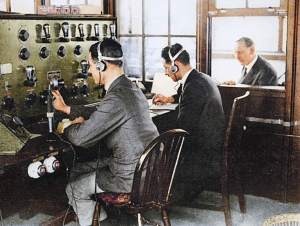
CATOs in radio communication with aircraft. Picture taken 1927

Radio direction-finding (RDF), however, provided the Civil Aviation Traffic Officers (CATOs) with the bearing from the airport of any aircraft transmitting a radio message, thus they could provide the crew with a course to fly to arrive overhead the aerodrome. Indeed two other RDF stations in England’s south-east (Lympne, Kent and Pulham, eastern Norfolk) would pick up the same transmission from the aircraft and send to Croydon the machine’s bearing from each, so its location could be determined by triangulation in the Croydon tower, using large charts. They could also provide the pilots with weather information, including visibility, wind speed and direction, but also the approximate position of other traffic in the area so the crew could keep their eyes out for it.

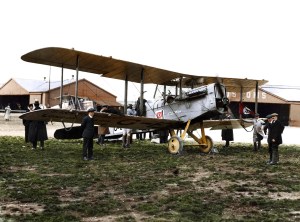
Airline travel in 1920. An Airco de Havilland DH-4 plied the London Croydon – Paris Le Bourget route

Navigation was primitive in aviation’s early years. Clearly identifying the destination aerodrome so the crew landed at the right one was important. The pilots were helped to find the aerodrome by a bright, strobing “lighthouse” beam – green alternating with white – which was located on a high point. When control towers came in, the light was above the tower.

Croydon airport from above, 1925

Positive airfield identification was provided by very large lettering spelling out the airport name, either on the ground, or on the roof of a large hangar.

Separation between aircraft, if there was more than one near the aerodrome at any time, was assured visually by pilots looking out for other aeroplanes, with advice from the tower if necessary as to the position of potentially conflicting traffic.

Protocols about which of any two aircraft has the right to hold course and which should give way are set in the rules of the air, similar to the rules which mariners follow on the sea, and a disciplined circuit pattern over an aerodrome was a system with which pilots were familiar.

Permission to land or take off could be signalled by radio, or by a CATO shining a green aldis lamp toward the aircraft cockpit. Similarly, a red lamp would refuse permission. Firing off a green or red Verey flare from the tower was an alternative.

The UK’s principal air traffic management provider NATS is somewhat more sophisticated today! But its daily traffic tally is nearly 9,000 movements across the country, so it rather has to be.

P.S. Thanks to NATS for providing the colourised old photographs and historical detail from their archives