Ladies and gentlemen, your pilot is unconscious

An official incident report has confirmed that a Lufthansa Airbus A321 flight from Frankfurt, Germany to Seville, Spain on 17 February last year flew for 10min without any pilot supervision because the copilot, alone on the flight deck at the time, suffered a “sudden and severe incapacitation” which was defined in the report as a “seizure”.

An experience of my own many years ago was strikingly similar to this, so we will return to that subject in a moment after examining the events on Lufthansa’s Frankfurt – Seville flight last year.

Once Flight LH77X was established in the cruise over northern Spain at flight level 350 (35,000ft), carrying six crew and 199 passengers, the captain discussed pertinent weather conditions on the route with the copilot, who was the pilot flying, and then left the flight deck for a toilet break at 10:31:00 (UTC). Exactly 36 seconds after the captain had left the flight deck, the copilot suffered an epilepsy-like seizure, according to the Spanish accident investigation authority CIAIAC.

There was no immediate indication to the absent captain that anything was wrong, because the autopilot and autothrust remained engaged, despite some inadvertent switch selections by the copilot, and the fact that his right foot was pressing the rudder pedal hard – but fortunately not hard enough to cause the autopilot to trip out.

Meanwhile the sector controller for Spain’s Pau ATC region attempted three times to establish radio contact with LH77X, but received no reply.

At 10:39:00 the captain was ready to return to the flight deck, and he attempted a standard entry procedure, but there was no response from the copilot who would have had to approve it. After three further attempts he decided to employ the flight deck emergency access code, but while he was doing that the copilot, “pale, sweating and moving strangely”, opened the door from the inside.

The captain took control of the aircraft at 10:42:00, and at his request the cabin crew helped the copilot into the forward galley area, administered first aid, and obtained the help of a doctor from among the passengers. Meanwhile the captain decided to divert the aircraft to Madrid, the nearest airport, rather than continuing to Seville. The A321 landed safely and the copilot was taken to hospital, but released after examination.

The CIAIAC report quotes the definition of a “seizure” under these circumstances as “an abnormal paroxysmal excessive discharge of cerebral cortical neurons”. The copilot had no medical record of any such event previously, and said he had not experienced anything like it before. The medical judgement as reported by the CIAIAC is that, even had the copilot been tested specifically for such a condition, it would not have been detectable unless he had suffered a seizure in the presence of a medical observer.

The report’s main recommendation for the future is that, any time one of the pilots has to leave the flight deck, a member of the cabin crew should join the remaining pilot in the cockpit until the absent pilot returns. This is actually a previously established procedure which had fallen into disuse simply because incapacitation is so rare. But if it had been applied in this case, the cabin crew would have been able to alert the captain immediately about the copilot’s condition, and help him re-enter the flight deck quickly.

Meanwhile here is an account of my personal experience of airborne seizure – and precursors to it – that is highly relevant to cases like this one.

During my time as a qualified flying instructor (QFI) in the RAF I had gradually developed a condition which caused me to suffer minor seizures which, at the time, I did not recognise. They just felt like momentary mental “absences” that I attributed – for example – to having had a few drinks too many in the Officers Mess the night before. At the time I was in my late 20s, and had been flying pressurized jets and turboprops for eight years,

But my wife noticed these “absences”, and reported them to an RAF doctor who then approached me about them. I dismissed the matter as unimportant, and he did not pursue the issue further.

I recall having an “absence” while on short final approach to land a Jet Provost, solo, at RAF Linton on Ouse. I can’t actually remember the touchdown itself, but can remember rolling out at the end of the runway and turning onto a taxiway back to the pan, by which time I felt fine. But the thought of this event – now that I know more about my condition at that time – chills me.

Some months later I suffered a fully-fledged seizure during my sleep, and my wife called the doctor, who attended immediately. When I awoke I felt as if I had been beaten up.

I was taken to an RAF hospital and tested via electro encephalograph (ECG), and underwent brain scans. The diagnosis – given the evidence of the seizure – was that I was “probably” prone to epilepsy, but the condition was defined as “idiopathic”, meaning there was no medically detectable sign of it.

Continuing to fly professionally after that was not an option, so I left the RAF and became an aviation journalist.

At the time I believed my symptoms might have been caused by an sudden and unexpected application of quite high negative G during a practice aerobatic sequence flown by one of my student pilots. But the medics could find no sign of brain damage.

Over the decades since that time, in my job as an aviation journalist, I learned about “Aerotoxic Syndrome”, the name given to a condition caused by damage to the brain and nervous system by neurotoxic chemicals from aero engine lubricants and hydraulic fluids. High doses, gained via a “fume event” in the cockpit or cabin, can cause instant cognitive problems, although these may fade with time. But in other individuals, regular exposure to low doses of neurotoxins over a long time can gradually build up in the body, degrading the nervous systems of pilots and cabin crew.

These organophosphate chemicals, containing known neurotoxins, are delivered to the cockpit and cabin by aircraft air conditioning and pressurization systems, where the air is sourced directly from jet or turboprop engine compressors. Engine oil seals constantly leak fluid at low levels, so when the highly compressed – and therefore hot – air is delivered to the air conditioning system, it contains pyrolized neurotoxic aerosols. This is the air that the crew breathe.

In some individuals, that constant low-level poisoning builds up in their system until it causes visible symptoms of neurological damage. In other individuals, their systems gradually purge the chemicals, making symptoms last only a short time. But so far there is no way of knowing in advance which kind of system individual aircrew have.

In my case, today I no longer have even slight seizures, neither do I have to take any medication which, for more than 25 years, I had to do constantly to keep the symptoms at bay. Neurologists say, nonetheless, that they cannot declare me free of epilepsy or related neurological conditions because they still do not know enough about the subject to be certain. I suspect what has happened is that, since I left the RAF, I fly only occasionally, so my system has had time to purge itself of the neurotoxins that regular flying delivered to me.

I wish the Lufthansa copilot of flight LH77X on 17 February 2024 well, and hope he gets all the support he needs to continue his career, if that is deemed possible.

Meanwhile for him, and all those who want to know more about Aerotoxic Syndrome, FlightGlobal has a useful account here.

Trump rides to the rescue of US ATC

“The ancient infrastructure is buckling,” says the President of the USA, Donald J Trump.

His subject is the state of America’s air traffic control (ATC) services, but he does have a solution: “We’d like to give out one big, beautiful contract, where they are responsible for everything from digging ditches to the most-complicated stuff”.

Trump has casually tossed a simple solution to a serious national infrastructure problem into someone else’s in-tray. But is this even in his gift?

The political in-tray belongs to Transportation Secretary Sean Duffy, who agrees with Trump about the state of the air traffic management (ATM) system. Needing somebody to blame after the 29 January fatal mid-air collision between an army helicopter and a PSA Airlines Bombardier CRJ700 that was on final approach to land at Washington DC’s Reagan airport, Duffy attributed the crash to “our outdated, World War II-era air traffic control system”. Having delivered that verdict, he named his predecessor, President Joe Biden’s Transportation Secretary, Pete Buttigieg as the man responsible for the state of US ATM.

Meanwhile, taking Trump at his word when he said “We’d like to give out one big, beautiful contract…”, the chief executive of a major US electronics company is – surely – soon going to feel the thud of a massive Concept of Operations document landing in his in-tray. So will Chris Rocheleau, the Trump-appointed Acting Administrator of the Federal Aviation Administration. Rocheleau, an experienced FAA man, was given the job in January, but so far no actual Administrator has been appointed.

In the USA, the FAA is responsible for providing ATM. The Administration’s two main tasks are the safety oversight and regulation of the entirety of the USA’s aerospace and air transport industry, plus the provision of ATM and its operating infrastructure. Unusually, therefore, the FAA oversees the safety of its own ATM system.

Finance for the FAA comes from the Airport and Airways Trust Fund (AATF), financed in turn by the users of the system who are charged taxes on domestic passenger tickets, freight carriage charges, fuel, and international departures and arrivals. These proceeds, which fund nearly 90% of the FAA’s costs, don’t go direct to the FAA: congress annually appropriates funds from the AATF for the FAA – but in practice it quite often delays the appropriation, bringing aviation to a halt for a few days. The reality is that the FAA is a state-owned utility.

Returning again to Trump’s stated plan for “one big, beautiful contract” to upgrade America’s ATM and air navigation services, unless the President has the FAA in mind as contractor (unlikely), he must be referring to private industry.

So who are the industry candidates to take the lead in this “big, beautiful contract”? If Trump’s plan goes ahead, one company will lead, and the others will contribute. The line-up looks something like this: Raytheon, Thales, Adacel Technologies, L3 Harris, Honeywell, IBM, SpaceX (Starlink), and Verizon (telecomms). Trump’s “America First” policy might rule out Thales for being French, although it is huge, global, and has a big US division.

What will Duffy require of this agglomeration of US industrial expertise? Here are some extracts from public statements of intent he has made in the last few months about ATM modernisation: “Rebuilding some ATC towers, control centres and Terminal Radar Approach Control (TRACON) facilities; new telecom, new fibre… We are going to have brand new radios in our towers, new radar for the ground, and new sensors on our tarmacs; all the front-facing equipment for controllers, all the back-end systems for controllers – all brand new; all new hardware… All new software… A new flight management system that will support flights of future air taxies – the electric vertical take-off and vertical landing aircraft now under development by numerous firms.”

What is more, all of this will be accomplished within four years, says Duffy. A bill to approve funding to the tune of $12.5 billion is working its way through the House of Representatives.

The sheer size of the task of raising this system from its current state of repair can be gauged from a recent event. On 28 April, controllers at the Philadelphia TRACON “temporarily lost radar and communications with the aircraft under their control, unable to see, hear or talk to them”. That summary of the event was provided by the National Air Traffic Controllers Association (NATCA). Controllers at that facility are responsible for “separating and sequencing” jets flying to and from Newark airport, New Jersey, one of the three main airports serving New York city.

In the last few days the Philadelphia TRACON problems have recurred, according to Duffy, who resorts again to blaming Buttigieg. Meanwhile Newark airport is talking to airlines about reducing the flow-rate of traffic there for safety reasons. And the whole problem is exacerbated by a shortage of air traffic control officers (ATCO), which Duffy has acknowledged is nation-wide, and which the National Transportation Safety Board is examining as a possible contributory factor in the Washington DC collision.

Good luck to the FAA and its partner companies in this massive endeavour. They’ll need it!

Question for the Korean authorities: what was that obstruction just beyond the Muan runway end?

It will not be long before accident investigators reveal the reasons why the Jeju Air Boeing 737-800 crew felt they had to commit to a flapless, gearless landing on runway 19 at Muan, South Korea. But the reason so many people died was not the landing as such, but the fact that the aircraft (HL8088) collided with a very hard obstruction just beyond the runway end.

That collision broke up the hull and caused a conflagration. What was the obstruction, and why was it positioned on the runway extended centreline only about 200m beyond the runway threshold?

It looks as if it was a concrete anchorage for the Instrument Landing System (ILS) antenna array. ILS antennae are often just beyond runway ends, but they are normally designed to be frangible so any aircraft that collides with them suffers only minor damage. This was hard. Very, very hard.

The sequence of events that led to this accident began with the aircraft approaching runway 01, cleared to land, but the crew elected to go around just after ATC had warned them of a potential birdstrike. It looks as if a birdstrike did, indeed, take place, and the crew declared a Mayday emergency shortly after that.

The crew then elected to land on the same runway but in the opposite direction – on runway 19. This was not much of an issue because the wind was very slight and the visibility was excellent.

But when they returned for the fatal landing on 19 they touched down with no flaps and no landing gear. Why? Perhaps because the birdstrike caused the right engine to fail, and all or some of the hydraulics with it. And the gear and flaps are hydraulically powered.

We don’t know yet, but we will know soon.

Meanwhile the touchdown was as good as a flapless/gearless touchdown could be: wings level, nose not too high to avoid breaking the tail. But being flapless, the airspeed was very high – probably around 200kt.

Look at the video of the landing run. The aircraft slid the full length of the runway with the fuselage, wings and engines substantially intact, and with no fire. It slid over the end still going fast – maybe 70kt or so, but still with no further substantial damage to the structure and no fire.

Then the aircraft hit the obstruction about 150m beyond the hard runway overrun, but until impact it remained substantially undamaged and fire-free. At impact, the hull buckled and broke up, the wing fuel tanks were ruptured and instantly exploded into flames. The wreckage came to rest just beyond the obstruction, near the wire perimeter fence.

If the obstruction had not been there, the aircraft would have slid through the antenna array, across the level ground beyond it, and through the wire perimeter fence. It would have come to rest with most – possibly all – those on board still alive.

We will soon find out the whole truth about why the landing took place as it did. But because the accident killed all on board except two of the cabin crew, those answers will be almost academic. The question to answer is: what was that obstruction, and why it was there?

The glamorous ghosts of early air travel

Now called Airport House, this building was one of the world’s first purpose-built air terminals/air traffic control towers. It is on this Croydon site that – until the 1950s – London’s main commercial airport used to be. It now houses a museum full of fascinating artifacts that evoke the exciting – and rather dangerous – adventure that was air travel 100 years ago.

The very first commercial airline flights in Britain – just after the First World War – took place in noisy, uncomfortable aircraft, carrying between two and four passengers in machines converted from their wartime role as bombers.

But toward the 1930s, when Croydon’s new, modern airport terminal was built, things got a lot better, and the glamorous and wealthy flocked to be among the first to fly to Paris in the promised three hours.

Ordinary people could mostly only afford to watch, which they eagerly did from the observation deck on the roof of the terminal, overlooking the grassy aerodrome and watching film stars and royalty walk out to their aircraft.

Everything about aviation then was still so new, so experimental, and the public attended air shows in huge numbers, watching daredevil aviators carry out gravity-defying feats in their flying machines.

The Historic Croydon Airport Trust does an excellent job in bringing all this aviation history to life.

For those curious about how early aviation – and particularly early air traffic control (ATC) – actually worked, this is the place to discover it. As it happens, just a few years ago – in February 2020 – Croydon airport celebrated a century of ATC, because this is the place where it was invented and developed.

Indeed, ATC is something about which even today’s frequent flyers know very little, and learning about its origins – the very basics of early air navigation – will serve to bring to life the essential aspects of modern ATC, because the essentials never change.

In the 1920s the aircraft flew very low by today’s standards – only a couple of thousand feet above ground level. At that height, geographical features like rivers and coastlines, or man-made features like railway lines, could easily be seen if the weather and visibility was good, making navigation by map-reading possible. But if it wasn’t, help from ATC following the advent of radio-direction-finding (see link above to “A century of ATC”) was very welcome to the crews. In marginal visibility, getting lost was quite common, because it was easier than you might think to end up following the wrong railway line!

Pilots now are still expected to do their own navigation, and abide by the rules of the air. ATC’s task is principally to ensure that the flow of air traffic proceeds in an orderly fashion in today’s much busier skies, and that conflicts between aircraft are avoided.

But if pilots do need assistance, ATC is there to help them. Indeed it was at Croydon Airport that the international emergency call “Mayday Mayday Mayday” was first proposed and adopted.

ATC is 100

The world’s first civil aerodrome control tower was opened 100 years ago this month at London’s Croydon airport

Early in 1920 the UK Air Ministry decided that, with an average of 12 air movements a day, the air traffic at London’s main airport – Croydon – needed organising.

The ministry had no template for such a task, but issued a specification for a building they believed would do the job. It was to be called an aerodrome control tower, and the working part of it was to be “15ft above ground level, with large windows to be placed on all four walls”.

Radio communication was already in use, but even primitive radar would not be developed for another 20 years.

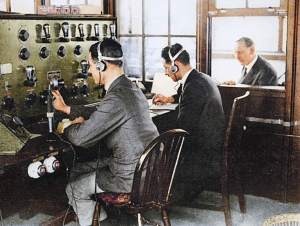
CATOs in radio communication with aircraft. Picture taken 1927

Radio direction-finding (RDF), however, provided the Civil Aviation Traffic Officers (CATOs) with the bearing from the airport of any aircraft transmitting a radio message, thus they could provide the crew with a course to fly to arrive overhead the aerodrome. Indeed two other RDF stations in England’s south-east (Lympne, Kent and Pulham, eastern Norfolk) would pick up the same transmission from the aircraft and send to Croydon the machine’s bearing from each, so its location could be determined by triangulation in the Croydon tower, using large charts. They could also provide the pilots with weather information, including visibility, wind speed and direction, but also the approximate position of other traffic in the area so the crew could keep their eyes out for it.

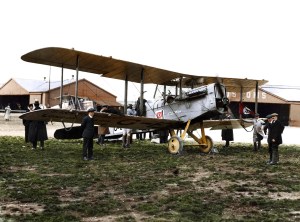
Airline travel in 1920. An Airco de Havilland DH-4 plied the London Croydon – Paris Le Bourget route

Navigation was primitive in aviation’s early years. Clearly identifying the destination aerodrome so the crew landed at the right one was important. The pilots were helped to find the aerodrome by a bright, strobing “lighthouse” beam – green alternating with white – which was located on a high point. When control towers came in, the light was above the tower.

Croydon airport from above, 1925

Positive airfield identification was provided by very large lettering spelling out the airport name, either on the ground, or on the roof of a large hangar.

Separation between aircraft, if there was more than one near the aerodrome at any time, was assured visually by pilots looking out for other aeroplanes, with advice from the tower if necessary as to the position of potentially conflicting traffic.

Protocols about which of any two aircraft has the right to hold course and which should give way are set in the rules of the air, similar to the rules which mariners follow on the sea, and a disciplined circuit pattern over an aerodrome was a system with which pilots were familiar.

Permission to land or take off could be signalled by radio, or by a CATO shining a green aldis lamp toward the aircraft cockpit. Similarly, a red lamp would refuse permission. Firing off a green or red Verey flare from the tower was an alternative.

The UK’s principal air traffic management provider NATS is somewhat more sophisticated today! But its daily traffic tally is nearly 9,000 movements across the country, so it rather has to be.

P.S. Thanks to NATS for providing the colourised old photographs and historical detail from their archives

Suddenly I see…

Today, air traffic control officers (ATCOs) on each side of the North Atlantic can see the aircraft they are controlling as they fly between Europe and North America.

It is almost impossible to convey the huge significance of this boring and apparently obvious piece of information, because most people don’t know that – yesterday – the same ATCOs couldn’t see the aircraft they were responsible for. They never had been able to see them, because the machines were outside radar range.

When flying between North American and Europe, until now aircraft of all kinds have always been invisible to air traffic control from the time they were about 350km off the coast on either side.

Under yesterday’s system, ATCOs knew approximately where each aircraft was because the pilots reported their position, their height and an estimate for the next reporting point every 15min or so. This worked safely because aircraft were painstakingly released into their pre-cleared, one-way oceanic tracks at specific heights, time intervals, and speeds, so they would maintain separation vertically and horizontally.

That system is a well-tried air traffic management (ATM) technique known as procedural control, and most of the world will continue to control air traffic procedurally over almost all oceanic and wilderness areas for some years yet.

In fact only 30% of the earth’s surface has radar coverage enabling aircraft surveillance for air traffic management (ATM) purposes.

But now, a new global constellation of 66 low-earth-orbit smart satellites – launched over the last decade by satcoms company Iridium Communications – each carries a device that links aircraft ADS-B datalink signals to ATM centres. Aircraft-mounted ADS-B (automatic dependent surveillance – broadcast) streams information about the aircraft’s position, height and much more. This enables ATCOs to track the aircraft in real time, with a radar-like update rate of 8 seconds.

Here’s the history (this announcement should really be preceded by a trumpet fanfare!): US-headquartered communications technology company Aireon yesterday announced that its space-based air traffic surveillance system was switched on, and active surveillance trials involving ANSPs (air navigation service providers) Nav Canada and UK NATS have begun on the busy North Atlantic routes that each manages from its respective oceanic base either side of the sea.

Aireon CEO Don Thoma was able to boast that “For the first time in history, we can surveil all ADS-B-equipped aircraft anywhere on Earth.”

Well, it’s true that they are set up to do so, but not all the world’s ANSPs are ready for it yet. Those who are ready include Nav Canada and NATS, but also the Irish Aviation Authority, Italy’s Enav, and Denmark’s Naviair.

The European Aviation Safety Agency (EASA) is in the process of certificating the provision – by Aireon – of space-based surveillance over the whole continent. That will be another first: the provision of surveillance capability by an organisation that is not an ANSP nor the military.

Others will follow.