The glamorous ghosts of early air travel

Now called Airport House, this building was one of the world’s first purpose-built air terminals/air traffic control towers. It is on this Croydon site that – until the 1950s – London’s main commercial airport used to be. It now houses a museum full of fascinating artifacts that evoke the exciting – and rather dangerous – adventure that was air travel 100 years ago.

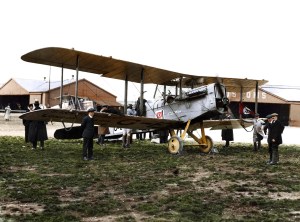
The very first commercial airline flights in Britain – just after the First World War – took place in noisy, uncomfortable aircraft, carrying between two and four passengers in machines converted from their wartime role as bombers.

But toward the 1930s, when Croydon’s new, modern airport terminal was built, things got a lot better, and the glamorous and wealthy flocked to be among the first to fly to Paris in the promised three hours.

Ordinary people could mostly only afford to watch, which they eagerly did from the observation deck on the roof of the terminal, overlooking the grassy aerodrome and watching film stars and royalty walk out to their aircraft.

Everything about aviation then was still so new, so experimental, and the public attended air shows in huge numbers, watching daredevil aviators carry out gravity-defying feats in their flying machines.

The Historic Croydon Airport Trust does an excellent job in bringing all this aviation history to life.

For those curious about how early aviation – and particularly early air traffic control (ATC) – actually worked, this is the place to discover it. As it happens, just a few years ago – in February 2020 – Croydon airport celebrated a century of ATC, because this is the place where it was invented and developed.

Indeed, ATC is something about which even today’s frequent flyers know very little, and learning about its origins – the very basics of early air navigation – will serve to bring to life the essential aspects of modern ATC, because the essentials never change.

In the 1920s the aircraft flew very low by today’s standards – only a couple of thousand feet above ground level. At that height, geographical features like rivers and coastlines, or man-made features like railway lines, could easily be seen if the weather and visibility was good, making navigation by map-reading possible. But if it wasn’t, help from ATC following the advent of radio-direction-finding (see link above to “A century of ATC”) was very welcome to the crews. In marginal visibility, getting lost was quite common, because it was easier than you might think to end up following the wrong railway line!

Pilots now are still expected to do their own navigation, and abide by the rules of the air. ATC’s task is principally to ensure that the flow of air traffic proceeds in an orderly fashion in today’s much busier skies, and that conflicts between aircraft are avoided.

But if pilots do need assistance, ATC is there to help them. Indeed it was at Croydon Airport that the international emergency call “Mayday Mayday Mayday” was first proposed and adopted.

ATC is 100

The world’s first civil aerodrome control tower was opened 100 years ago this month at London’s Croydon airport

Early in 1920 the UK Air Ministry decided that, with an average of 12 air movements a day, the air traffic at London’s main airport – Croydon – needed organising.

The ministry had no template for such a task, but issued a specification for a building they believed would do the job. It was to be called an aerodrome control tower, and the working part of it was to be “15ft above ground level, with large windows to be placed on all four walls”.

Radio communication was already in use, but even primitive radar would not be developed for another 20 years.

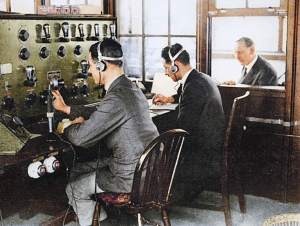
CATOs in radio communication with aircraft. Picture taken 1927

Radio direction-finding (RDF), however, provided the Civil Aviation Traffic Officers (CATOs) with the bearing from the airport of any aircraft transmitting a radio message, thus they could provide the crew with a course to fly to arrive overhead the aerodrome. Indeed two other RDF stations in England’s south-east (Lympne, Kent and Pulham, eastern Norfolk) would pick up the same transmission from the aircraft and send to Croydon the machine’s bearing from each, so its location could be determined by triangulation in the Croydon tower, using large charts. They could also provide the pilots with weather information, including visibility, wind speed and direction, but also the approximate position of other traffic in the area so the crew could keep their eyes out for it.

Airline travel in 1920. An Airco de Havilland DH-4 plied the London Croydon – Paris Le Bourget route

Navigation was primitive in aviation’s early years. Clearly identifying the destination aerodrome so the crew landed at the right one was important. The pilots were helped to find the aerodrome by a bright, strobing “lighthouse” beam – green alternating with white – which was located on a high point. When control towers came in, the light was above the tower.

Croydon airport from above, 1925

Positive airfield identification was provided by very large lettering spelling out the airport name, either on the ground, or on the roof of a large hangar.

Separation between aircraft, if there was more than one near the aerodrome at any time, was assured visually by pilots looking out for other aeroplanes, with advice from the tower if necessary as to the position of potentially conflicting traffic.

Protocols about which of any two aircraft has the right to hold course and which should give way are set in the rules of the air, similar to the rules which mariners follow on the sea, and a disciplined circuit pattern over an aerodrome was a system with which pilots were familiar.

Permission to land or take off could be signalled by radio, or by a CATO shining a green aldis lamp toward the aircraft cockpit. Similarly, a red lamp would refuse permission. Firing off a green or red Verey flare from the tower was an alternative.

The UK’s principal air traffic management provider NATS is somewhat more sophisticated today! But its daily traffic tally is nearly 9,000 movements across the country, so it rather has to be.

P.S. Thanks to NATS for providing the colourised old photographs and historical detail from their archives