EK159 avoiding conflict zones

The blog article before this one examines the practice of routing civil flights through designated conflict zones when there are lower-risk alternatives. The main subjects were Emirates and Turkish Airlines.

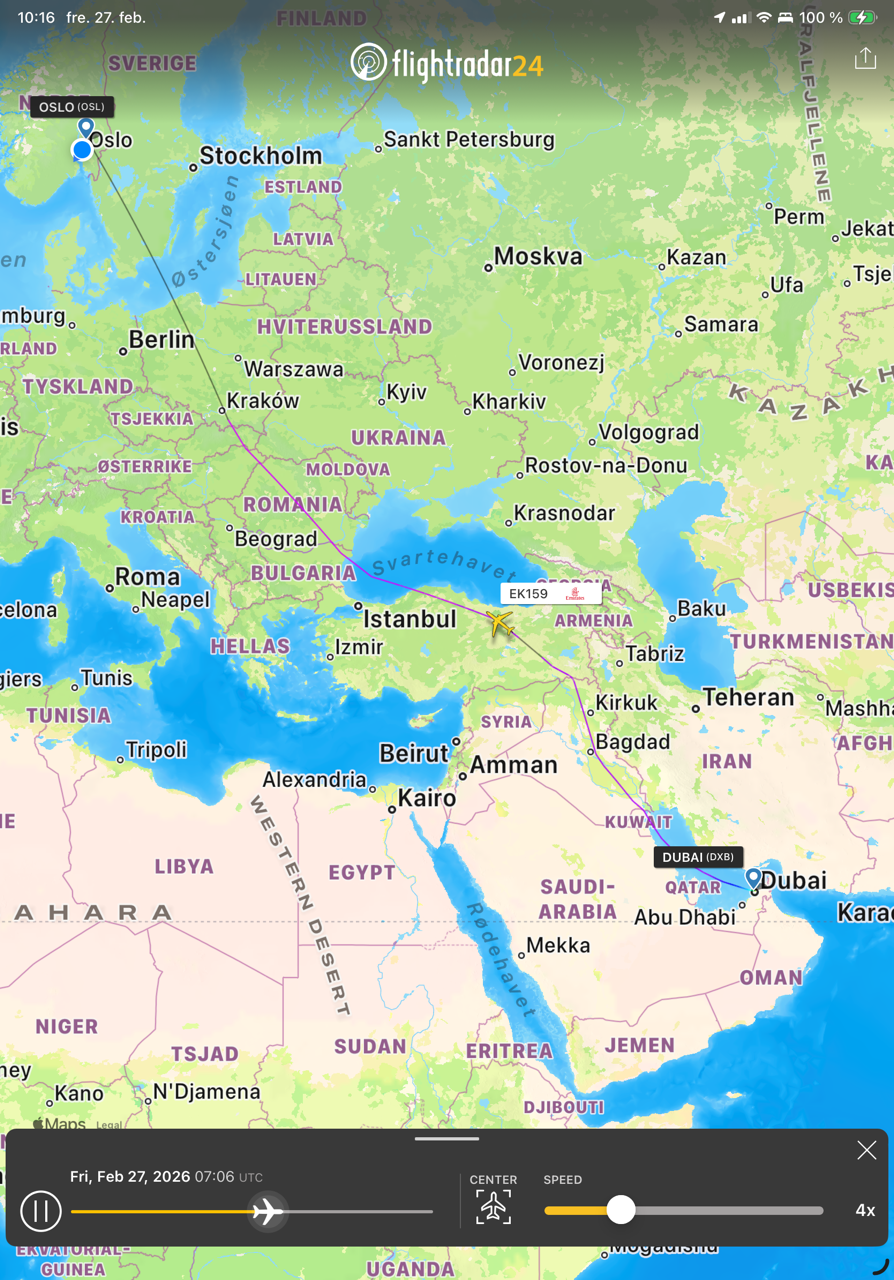
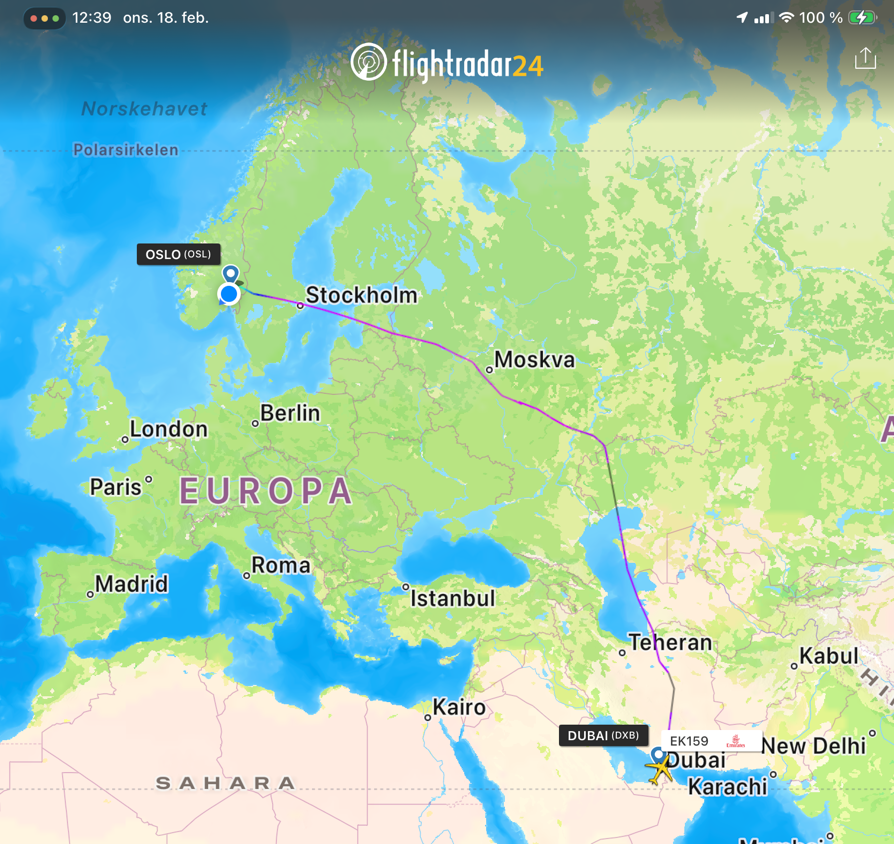
Maybe Emirates was listening, because this morning it didn’t route its Dubai-Oslo schedule (EK159) through Iran and Russia as it did yesterday. Instead it took the route pictured below (courtesy of Flightradar24).

We also noticed yesterday that Turkish Airlines re-routed its Istanbul-Mumbai schedule to avoid Iranian airspace.

Also possible as an explanation for the changes is that Emirates – and Turkish Airlines – have carried out a dispatch risk assessment and decided that the gathering of American military task forces in the region, combined with White House sabre-rattling directed at Teheran, cannot be ignored.

Emirates, incidentally, has not replied to my questions about its routeing choices.

Sensible routeing choices. Finally.

Flying through dangerous airspace

Emirates flies an Airbus A380 schedule from Dubai to Moscow, the route normally used passing through Iranian and Russian airspace that is subject to European Union Aviation Safety Agency Conflict Zone Information Bulletins, a form of advice backed by the International Civil Aviation Organisation.

The CZIB is not legally enforceable for Emirates, and anyone boarding the flight in Dubai has, presumably, made a choice to fly there, whether they know the risks or not.

But a couple of weeks ago a retired airline pilot boarded an Emirates flight at Dubai, destination Oslo, Norway (EK159) and – not surprisingly given his professional history, he took an interest in his routeing. He was surprised to find himself flying through Iran, Western Turkmenistan, Western Kazakhstan, Russia and finally Estonia, before heading out over the Baltic Sea toward his destination.

Knowing there are efficient alternatives to that routeing, he was surprised that the crew flew a track that passed close to the south-west of Moscow. It was not the flight path he would have chosen for a flight under his command, because of the multitude of military conflicts currently affecting the Middle Eastern region, and particularly Iran and Russia.

Alternatively, for example, if the aircraft were to route from Dubai north-west up the Gulf, then fly through Iraq, Turkey, Romania, Poland and Sweden into Norway it could operate the whole time in conflict-free airspace. The advantage, however, for any airline willing to take a calculated risk, is to fly through the much less busy Iranian and Russian airspace. Routes skirting – but staying outside – Ukrainian and Russian airspace to the south and west are very busy indeed.

If you watch operations through CZIBs in the region, using Flightradar24, airlines that regularly fly through Iranian airspace include Emirates, Etihad, FlyDubai, and Turkish Airlines. Interestingly, the other big long-haul Gulf carrier, Qatar takes the routes that avoid Iranian airspace.

Russian airspace is used regularly by Emirates, by Russian domestic and government flights, and Chinese carriers like Air China and China Eastern.

How much of a risk is it to ignore CZIB warnings and fly through conflict zones?

Judge for yourself. Here are the accounts of three flights that ignored conflict zone warnings. All those on board died on two of the flights, and most of the passengers in the third. There are other such regular conflict zone events in different parts of the world, but these are the most relevant here:

17 July 2014. A Malaysia Airlines Boeing 777-200ER (MH17) was shot down and destroyed in Ukrainian airspace by a Russian Buk ground to air missile system fired from Ukrainian territory held by pro-Russia militias in the country’s eastern sector near the Russian border. All 298 people on board were killed. This was the result of a deliberately launched missile, but probably the militia who launched the missile did not know – and certainly did not care about – the identification of the flight that they shot down.

8 January 2020. A Ukraine International Airlines Boeing 737-800 was shot down by an Iranian military surface to air missile while climbing away from Imam Khomeini international airport, Teheran, Iran, bound for Kyiv, Ukraine. The shoot-down was probably the result of target misidentification by Iranian military during a nervous stand-off between Iran and American military in the area. All 176 people on board died.

There is a nervous stand-off between Iran and a major American military task force in the Gulf, Red Sea and Mediterranean right now.

25 December 2024. An Azerbaijan Airlines Embraer ERJ-190, flying en route from Baku, Azerbaijan to Grozny, Russia was hit and badly damaged by military action in airspace where there was active conflict between Russian and Ukrainian forces. Some 38 of the 67 people on board were killed when the damaged aircraft eventually crashed because the crew had practically no remaining control of the flight path.

There is another relevant local event, but it took place in airspace that had not been declared a Conflict Zone despite the fact that there was, as now, a stand-off between Iran and the American military.

3 July 1988. An Iran Air Airbus A300 operating a scheduled flight from Bandar Abbas to Dubai was shot down by a missile fired from American frigate the USS Vincennes, killing all 290 people on board. The crew of the Vincennes misidentified the flight as a hostile threat to a small task force of American frigates in the Gulf.

As evident from these events, conflict zone shoot-downs are almost always the result of misidentification. But the results are just as terminal.

Lessons from Dubai

The 3 August Emirates Boeing 777 crash at Dubai may have happened a while ago, but the man/machine interface implications are so complex it still has human factors experts’ heads spinning.

Following an uneventful final approach to runway 12L the aircraft hit the runway with its gear in the retraction cycle, slid to a halt on its belly and burst into flames. All on board got out alive before the fire destroyed the fuselage, but a firefighter was killed by a fuel tank explosion.

That’s a surprising outcome for a serviceable aeroplane carrying out a normal landing at its home base.

So what happened?

Flight EK521 was inbound from Thiruvananthapuram, India carrying 282 passengers and 18 crew. The ambient temperature was high, nearly 50degC, and there was a windshear warning on all runways, but this did not cite high winds or powerful gusts. Probably the wind was swinging around under the influence of vertical air currents generated by intense surface heating combined with the coastal effect.

When the 777 had about 5nm to go on approach to 12L ATC cleared it to land and told the crew the surface wind was 340deg/11kt. That’s a touchdown-zone tailwind.

As the aircraft descended through 1,100ft on final approach the aircraft was also registering an airborne tailwind. It persisted almost all the way down.

But apart from the tailwind on the aircraft’s approach, the descent was uneventful until just before touchdown. At that point the tailwind switched to a headwind, adding about 20kt to the 777’s airspeed.

Around 5sec after the flare the right gear touched down about 1,100m beyond the threshold, and 3sec after that both main gear touchdown switches were made and the RAAS (runway awareness advisory system) voiced the alert “long landing, long landing”.

Questions still remain about exactly what happened next on the flightdeck. Who did what, and why?

The United Arab Emirates General Civil Aviation Authority has released some factual information about weather and aircraft performance, but the investigators are expected to take another three months or so to ready their final report.

Meanwhile from what the GCAA has released, we know that the captain was the pilot flying. He disconnected the autopilot at about 900ft on approach but left the autothrottle in. When he began the flare at 35ft AGL the throttles retarded to idle, and within about 10sec both touchdown switches had been made.

What happened next, or at least why it happened, is difficult to work out.

Witnesses say the aircraft “bounced” from the first touchdown. But the crew was attempting a go-around – possibly prompted by the “long landing” alert mentioned earlier – so the “bounce” may have been the result of the crew pulling the nose up for a go-around.

Some 4sec after the warning the aircraft was airborne again, the crew reduced the flap setting to 20deg, and 2sec later selected the gear up, both acts part of a go-around drill.

But the throttle levers remained at idle.

About 5sec after the aircraft had become airborne the tower, noticing the apparent intention,  cleared the aircraft straight ahead to 4,000ft, and the crew read that back. Then the first officer called “check speed”, the throttle levers were moved from idle to fully forward, and the autothrust transitioned from idle mode to thrust mode.

Unfortunately the increasing engine power arrived too late to prevent the aircraft sinking back onto the runway with its gear almost fully up. It slid on its belly for 800m before coming to rest with the right engine detached and a fire under that wing.

The GCAA interim report doesn’t mention whether or not the crew attempted to trigger go-around power by selecting the TO/GA (take-off/go-around) switches at the time of the go-around decision, but it appends a page from the flight crew operating manual about autothrust modes.  It contains this sentence: “The TO/GA switches are inhibited when on the ground and enabled again when in the air for a go around or touch and go.”

This situation raises questions galore. In a go-around situation the drill is to select power first, then set the appropriate flap, then register a positive rate of climb and pull the gear up. Maybe the crew thought activating TO/GA was enough, but they didn’t monitor engine power, throttle lever movement or rate of climb before retracting the gear.

This is basic stuff, so what’s going on here?

Are we witnessing the actions of a crew rendered insensitive by automation, or de-skilled by the same thing? Or is this an event involving mode-confusion because of the complexity of modern aircraft and their smart control systems?

The industry is going through a crisis of confidence in pilot training. The doubt arises from increasing numbers of accidents that began with a non-critical fault or distraction and result in the pilots becoming startled and not acting as they had been trained to do.

Behind it all is the fact that today’s aircraft and their systems are impressive and reliable, but ultra-complex. Meanwhile the basic approach to pilot training is the much the same at was in the pre-digital era.

Emirates is in the vanguard of modern attitudes toward evidence-based training, but maybe the fundamentals are set before pilots reach the line.

Finally, pilots are never really trained to operate the digital systems they use all the time at work. They just learn that on the job.

Let’s go back a bit to the quote from the Emirates 777 FCOM: “The TO/GA switches are inhibited when on the ground and enabled again when in the air for a go around or touch and go.”

I bet the pilots never tried that in the simulator.

Modern aeroplanes now are rather like personal computers in the relationship pilots have with them: most people are skillful users of tablets or laptops for routine tasks, but never have a chance to try out their full capabilities, most of which would rarely be needed. But if things go wrong or something unusual happens, the user is often out of his depth.

The Royal Aeronautical Society is hosting its two-day International Flight Crew Training Conference in London next week. This is one of the subjects that will be examined there.
Flydubai FZ981

A Boeing 737-800 attempts to land in windy weather in the small hours of the morning at Rostov-on-Don, Russia on a runway approach notorious for its windshear .

The crew fails to stabilise the aircraft on its first approach either because of windshear, or because it fails to make visual contact with the runway lights in time for a safe landing, and decides to climb away and circle, waiting for an improvement in the weather.

On its second attempt to approach the same runway – 22 – using a category 1 instrument landing system for guidance, it crashes short of the runway. There was no emergency call.

But this is no ordinary crash of the type that would have occurred if the crew – now under pressure to land because fuel is getting low – had made the decision to continue the descent through decision height, despite not being able to see the runway. If that had been true large sections of the aircraft would have remained intact.

This aircraft hit the ground about 300m short of the runway 22 threshold with such force it was shattered into tiny pieces which were scattered across the airfield. How could that happen?

Information from flight tracking service FlightRadar 24 suggests that the crew also abandoned this second approach, climbing away, but then disappearing.

On 17 November 2013 a Tatarstan Airlines Boeing 737-500, en route from Moscow to Kazan, abandoned a poorly executed night approach at its destination airport, applying full power for a go-around. The nose pitched up to 25deg and the speed rapidly dropped because of the steep climb. The crew, becoming disorientated, pushed the nose down hard, putting the aircraft into a dive at an angle of 75deg just before impact. The aircraft was shattered.

On 12 May 2010 an Afriquiyah Airways Airbus A330-200 carried out a go-around from the approach to Tripoli airport’s runway 09 at dawn, the crew lost control because of disorientation and the aircraft crashed. There was one survivor among the 104 on board.

There have been  many documented cases of crews nearly losing control when carrying out an all-engines-operating go-around.

This does not pretend to be the definitive answer to what happened to Flydubai flight FZ981 on 19 March, but it does pose the question as to what kind of event could cause the wreckage to be so badly fragmented.