About two years ago I posted a nine-episode serial about early military flying called “Leonard’s War”.
This story follows an RFC aviator on his journey from flying lessons at Brooklands, Surrey in 1915 to Squadron Commander over Flanders in 1918. Once in France, he flies with 7 Sqn over Ypres, returns to UK in 1916 to command 15 (Reserve) Squadron in Doncaster – a mission training unit – and commands 22 Sqn over Passchendaele and Cambrai.
If you missed “Leonard’s War” at the time, I recommend you try it. Even if you did read it then, I suggest you re-visit, because – following extensive research – I have added much new material and corrected earlier detail.
It has struck me that, in many accounts about military aviation in the Great War, there seemed to be two separate battles going on: one in the air where gallant aces shot each other down in dogfights, the other on the ground where soldiers crouched in trenches and emerged to die on muddy battlefields. “Leonard’s War” – as now revised – describes how the airmen and soldiers learned to cooperate, and how aviation changed everything about a war that began in 1914 with cavalry charges in Flanders and ended with airborne stereoscopic photo-reconnaissance and close-air-support to troops on the ground.
At the beginning of July 1917, 22 Squadron moved to Izel les Hameaux, west of Arras. Its pilots were still flying the FE2bs, but as the month progressed the first of a fleet of F.2B Bristol Fighters began to arrive. These were two-seater strike fighters.
The “Brisfit”, or “Biff”, was not just faster, it was a tractor – rather than a pusher like the Fee, which made it handle very differently. Its armament gave it a formidable field of fire. There was an awful lot for the crews to learn.
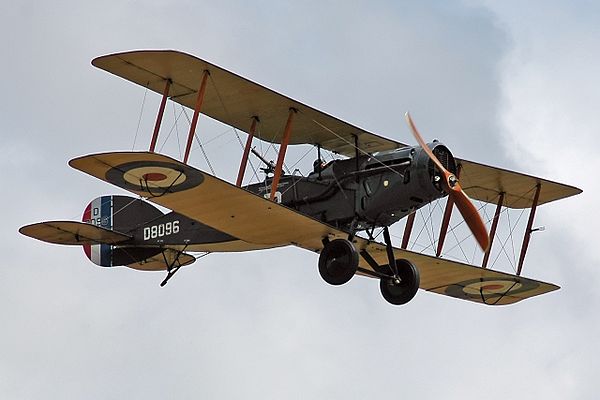
The still-flying Bristol Fighter of the Shuttleworth Trust at Old Warden museum and aerodrome, Bedfordshire
The pilots – in the forward cockpit – had a machine gun with interrupter gear, enabling it to fire ahead through the propeller. The observer/gunner’s cockpit, immediately behind the pilot’s, had dual flying controls, and a Lewis gun mounted on a rotating “scarff” ring that gave it a field of fire rearward through a 180deg arc. The Brisfit was powered by a V12 Rolls-Royce Falcon engine, had an airspeed of 126mph (40mph faster than the Fee), a better rate of climb and altitude capability, plus greater range.
This is an illustration from “Hell in the Heavens”, Whitehouse’s book about life on No. 22 Squadron, RFC. Major Learmount continued to command the Squadron until mid-March 1918.
Whitehouse caught the buzz that arrived with the new fighter: “From that day on we went to work on Jerry with the Bristol Fighters, and within two weeks the General Staff and royalty were visiting the squadron, and our pictures were being splashed over every paper in the Empire”.
Meanwhile, scanning the pages of Trevor Henshaw’s remarkable gazetteer of RFC experience, “The Sky Their Battlefield”, a change in 22 Squadron’s fortunes is plainly visible in July when the Bristol Fighters began replacing the FE2bs at Izel les Hameaux. The casualties stop for some weeks, and on 29 July 22 Sqn scored its first two F2b air-to-air victories. The Bristol Fighter wasn’t invincible, but its capabilities had taken the Germans by surprise.
One new role enabled by the Bristol Fighters’ longer range was dreaded by the crews. This was operating as an escort for British bombers – de Havilland DH.4s – tasked to fly deep into enemy territory, their bombs targeting the new German airfield at Gontrode, eastern Flanders. From there, German Gotha heavy bombers were known to be taking off every day, aiming for London.
Observer/gunner Archie Whitehouse scripted a particularly lyrical account of a six-ship Brisfit formation taking-off for a Gontrode escort: “They stand throbbing, wing-tip to wing-tip, their propellers glistening in the sunshine. The leader’s hand goes up, and the pilots take the alert with hands on throttles. The leader’s hand goes down and the machines seem to stiffen for the spring as the motors open up. The rudders waggle and the colours flash. The observers in their brown leather helmets snuggle down inside the scarff-ring and flick friendly salutes to each other. Then they are away in a swirl of dust, and suddenly all climb together.”
Once airborne, the Brisfits headed for Ypres, where they rendezvoused with the DH.4s, and set course for Gontrode.
Meanwhile, evident on both sides of the Front were preparations for what became the Third Battle of Ypres, the huge slugging match fought between the end of July and early November 1917, also known as the Battle of Passchendaele. The name of that battle evokes images of men, machines and horses almost immobilised by deep mud , the result of an awful summer of continual, soaking rain and heavy shelling that broke up the ground. Army casualty numbers – on both sides – eventually matched those at Verdun and the Somme.
The summer and early autumn saw 22 Sqn concentrate its operations around Ypres and Passchendaele, and as winter approached they moved to Cambrai.
Casualty numbers at 22 Sqn began to climb as the battle progressed, and as ground commanders looked for new ways of gaining an advantage. During this Third Battle of Ypres, and other peripheral clashes in the area, a new role for air power was being developed: coordinated ground attack, and what would today be called close air support for army units on the ground. Risks were high, because all this work was carried out at low level within the range of ground fire. It included strafing, bombing of enemy airfields, and detailed reconnaissance with rapid reporting back of enemy attempts to regroup or counter-attack.
In early August, 22 Sqn had moved yet again from Izel les Hameaux to Boisdinghem. For the crews, after the relentlessness of flying under fire from above and below, precious off-duty time fostered friendships with the local people that would spawn a lifetime of memories for those few fated to survive – military men and civilians alike. Madame Beaussart’s was an estaminet in a local village, and Marie and Annette who worked there knew the squadron aircraft, their markings and who flew them. Just like the men on the aerodrome, the girls watched the aircraft go, and they counted them back again.
On 19 August, Captain Clement’s Brisfit didn’t return. Clement had stepped in to take a mix of A and B Flight ships out on a mission, because “A” Flight had lost its leader. It was his last sortie. This was awful for the Squadron, and C Flight in particular. Clement’s younger brother Ward Clement had recently joined the Squadron as a gunner, and he and Whitehouse had become firm friends. Clement the younger was distraught and refused to believe Carl wouldn’t return. Hours later he persuaded himself his elder brother had force-landed and would make his way back. But that wasn’t true.
Whitehouse wrote: “When we went back to Madame Beaussart’s, Marie and Annette knew that ‘N’ had not come back, but they said nothing. The coffee and rum were good. I think we drank an awful lot of it.”
After an appallingly wet August, September brought drier weather and good visibility, making the RFC’s close air support in this war-torn region of Flanders highly effective. On 10 September 22 Sqn moved again, out of Boisdinghem to Estrée Blanche. For five days from 20 September 1917, at the Battle of Menin Road Ridge, the 22 Sqn Biffs were used highly effectively for ground attack, air superiority, and reconnaissance. Rapid reporting of German counter-attack manoeuvres allowed Allied artillery to be directed accurately. This clash was one of many on the periphery of the main battle.
On 26 September 1917 Learmount wrote a letter to the HQ of 9 Wing, complaining in detail about how the pilots arriving on 22 from training had not been sufficiently endowed with basic skills like navigation, formation flying and making reliable landings, let alone for air warfare. He named five pilots as an example of what he was complaining about, describing their shortcomings and specific mishaps, usually resulting in significant damage to one of the Bristol Fighters. All were described as having received no training in aerial gunnery, several as having had insufficient experience at cross-country flying (navigation), and most as lacking formation flying skills.
Learmount summed up his problem: “It is at times very difficult to obtain the necessary machines for giving this instruction and although my Squadron may be up to establishment in pilots there are invariably three or four who are not ready for war flying.”
He continued: “Many of my casualties are the result of inexperience and it stands to reason that pilots with no experience cannot put up a decent fight against the pick of the German Flying Corps.”
“I think it is hardly realised at home that the Bristol Fighter is a magnificent fighting machine, and all pilots trained for service on this machine should be of the very best type and should receive far more thorough training.”
Learmount is clearly making a pitch to get the best pilots sent to his squadron! The response arrived from Brigadier General Hugh Trenchard himself, the Officer Commanding the RFC in France, who made it crystal clear that the resources to do more were not available, and that it was the responsibility of the squadron CO to assess the arriving pilots and provide the necessary training that they needed for front line flying. He also emphasised that Learmount’s squadron “gets a fair pick of the pilots that come out from home,” and that 22 could not expect special treatment.
Finally in November came the end of the epic Passchendaele campaign, and the beginning of the Battle of Cambrai. The latter was an attempt by the British to break through the Hindenburg Line for the first time, in a massive attack combining artillery, tanks, infantry and air power.
Tomorrow: Episode 9, in which the winter weather gets very difficult, Cambrai puts new demands on the Squadron, the men put on a Christmas show, Whitehouse goes back to England to train as a pilot, and Major Learmount gets his blighty.
(If you missed the first episode, scroll down to find it before this one)
It was on 12 June 1915 – almost the height of summer – that 2nd Lieutenant Leonard Learmount joined his first operational unit – No 7 Squadron – at Saint-Omer aerodrome, north-eastern France. His flying log book records the weather as almost perfect for flying a wood-and-fabric aeroplane: clear with a 10mph easterly breeze.
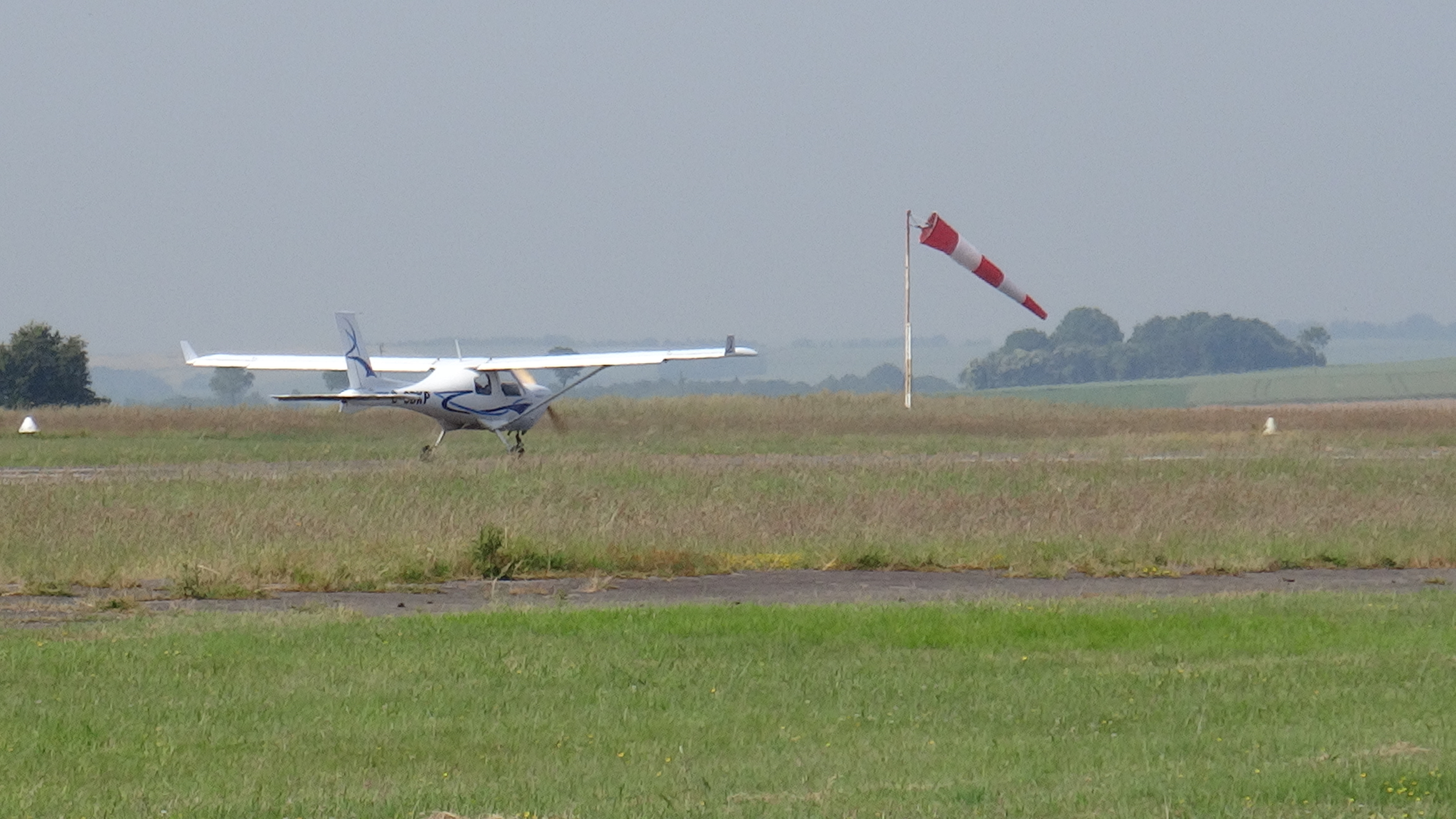
Saint Omer aerodrome 12 June 2015, exactly a century after Learmount’s arrival there. Even the weather was identical, with an easterly breeze. It still operates as the home of the Aéro Club de Saint-Omer, and one of its aircraft is backtracking for take-off from the runway’s other end.
There is no evidence that Learmount was given an aeroplane to ferry across La Manche to Saint-Omer, so we must assume that – like most men posted to France – he caught the sea shuttle from Southampton to Le Havre and took a boat up the River Seine to Rouen, thence by road to his destination.
Learmount’s flying log book shows that four short trips out of Saint-Omer aerodrome on a new aircraft type were deemed sufficient for him to master its peculiarities and to complete local area familiarisation sorties. The machine he was learning to control was the French-built two-seater Voisin “pusher” biplane [engine and propeller behind the cockpit].
His first sortie consisted of 20min flying circuits, but the second trip was a brief affair lasting 10min. His log book explains: “During spirals, five ribs collapsed. Landed safely.” The instructor had taken control and put the aircraft down without delay.
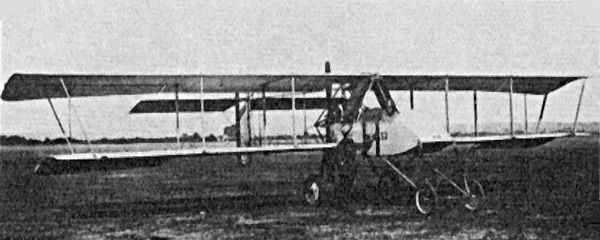
The Voisin, a French two-seater pusher biplane also used by the RFC
“Spirals” were climbing or descending turns, and if the aircraft was not kept in balance by a careful combination of aileron, rudder and elevator, a spin could develop. The Voisin had a level airspeed of about 65mph, but that was only about 40mph above its stalling speed. The evidence suggests that, before the need for a formal flying training syllabus was recognised in 1916, military aviation was seen simply as a means of putting eyes in the sky for the army, and – especially at first – there was no preparation for air-to-air combat. The pilots were just seen as drivers, their task being to fly cautiously and avoid loss-of-control so as to bring their observers home safely to pass on their vital reconnaissance information.
After his final familiarisation sortie, Learmount wrote in his log book: “Above clouds, steered by compass.” He had clearly experienced neither of those things before, yet he was deemed ready for command of a two-seater aircraft operating in hostile skies above the battlefield.
The very first RFC air-to-air combat losses were reported in early June 1915. Indeed a 7 Sqn RE5 was “shot-up” and damaged at 7,000ft over Douai/Valenciennes on 6 June, and on 6 July 2nd Lieutenants LW Yule (pilot) and RH Peck (observer) in a Voisin were both wounded by “exploding cartridges” at 7,000ft near Armentiéres. Both crews successfully recovered to Saint-Omer. (Combat detail from Trevor Henshaw’s admirable “The Sky Their Battlefield”)
Air warfare tactics in that precise location not far east of Ypres were evolving, but were about to start developing at breakneck speed. Air-to-air combat was still very rare, many of the crews armed only with rifles and revolvers, and the primary mission was still reconnaissance and artillery spotting.
In Learmount’s early operational flying with 7 Sqn, he flew the painfully slow Voisin first out of Saint-Omer, and then from other aerodromes further east in the “Ypres Salient” region of Flanders, among them Droglandt. At first, he was purely carrying out reconnaissance and artillery-spotting for the army, but the Voisin was equipped with a Lewis light machine gun, so it was capable of defending itself.
Flying with Learmount on his first operational sortie in command – on 19 June 1915 – was his observer/gunner, the same 2nd Lieutenant Peck just mentioned earlier. Indeed Peck almost certainly directed his rookie commander’s sortie! His handwritten reconnaissance report (see below) records the aircraft’s take-off from Saint-Omer at dawn (04:30), and describes observed activity behind enemy lines between Courtrai and Ghent, Flanders. The pencilled words, inscribed carefully by cold hands, provide details of train and other surface transport movements, assemblies of troops and equipment and estimated numbers. The aircraft landed at 07:45am, so they had been airborne for 3h 15min.
Copy of the 19 June 1915 reconnaissance report, filed from Learmount’s first operational flight. (National Records Office)
On the ground, beneath 7 Sqn’s patrolling aircraft, a fierce German offensive was raging against the British forces holding Ypres. The airmen, pre-briefed on what the army wanted them to look out for, provided their recce reports direct to specific units on the ground. The German offensive was eventually stalled, but at huge cost to both sides.
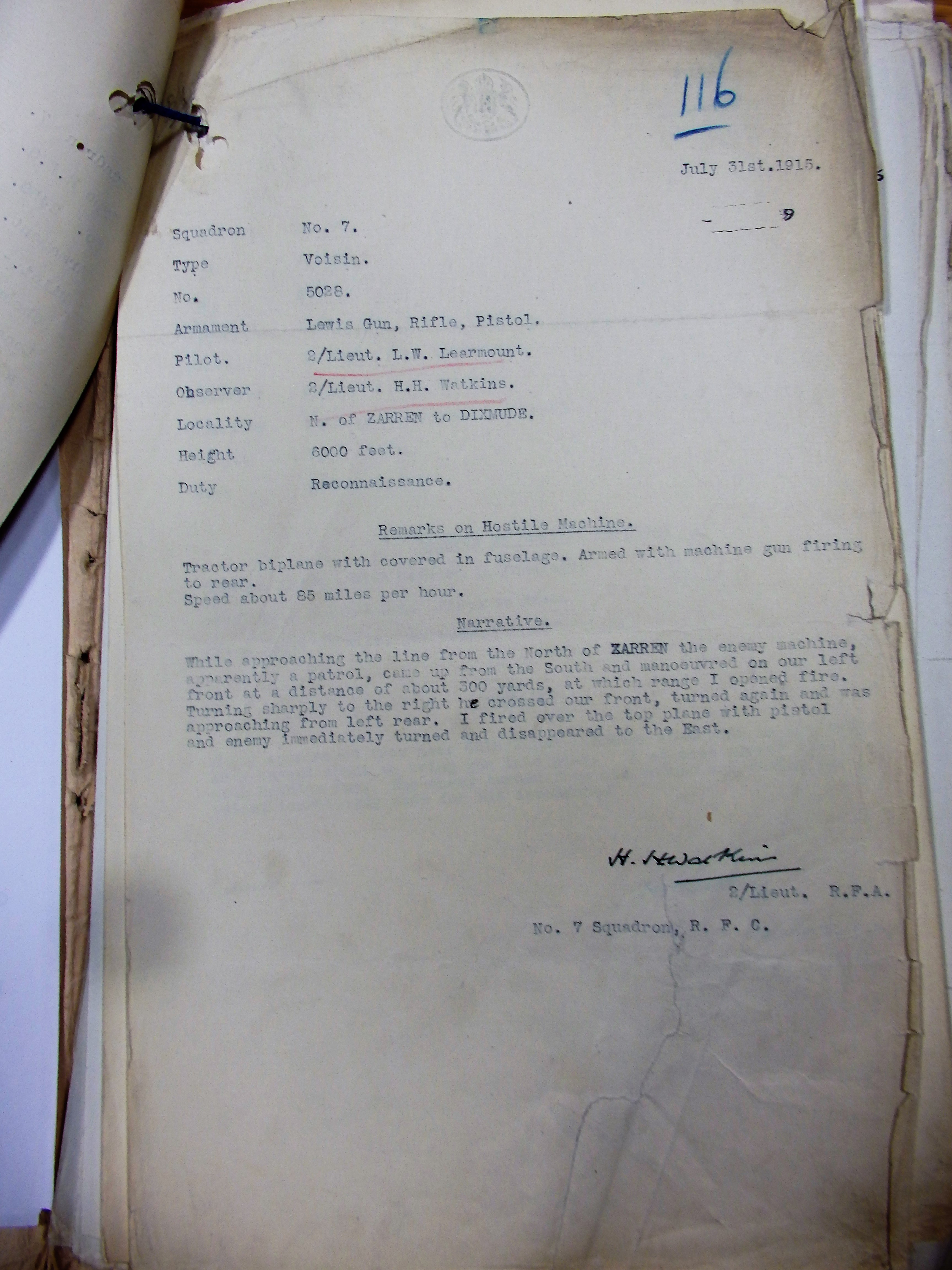
In a 31 July 1915 combat report filed by Learmount’s observer/gunner describing an inconclusive encounter with an enemy biplane, the Voisin crew’s armament was recorded as: “Lewis gun, rifle and pistol”. The observer, 2nd Lieutenant HH Watkins, initiated the hostile exchange with his Lewis gun, but the German machine positioned itself behind the RFC aircraft. Watkins reports: “I fired over the top plane with the pistol, and the enemy immediately turned and disappeared to the east.” The German aircraft was not identified by type, but was described thus: “Tractor biplane with covered-in fuselage. Machine gun firing to rear. Speed about 85mph.” This kind of encounter was common at that stage of the war, but exchanges quickly became more dramatic as Germany started to field armed fighters.
(National Records Office)
Meanwhile 7 Sqn aircraft were increasingly often engaged in air-to-air exchanges and, with the arrival of August, the “Fokker scourge” began to take its toll of RFC aircraft and crews. The Fokker Eindecker was, as its name implies, a monoplane, and it was a “tractor” (engine and propeller at the front), not a “pusher”. It was the first aircraft on either side to be armed with a forward-firing machine gun equipped with interrupter gear to enable it to fire ahead through the propeller. This made it a game-changer, and accelerated the development of air combat tactics.
The Eindecker’s armament might have caused far more problems than it did, but fortunately for the RFC the aircraft had an unreliable engine, and was difficult to fly, causing many training crashes. Thus only a small number were effectively deployable on a daily basis at front-line units. In fact it was so difficult to manage that the Germans took the Eindecker out of service in early September, but such was its known effectiveness in capable hands that it was declared operational again a few weeks later.
And the RFC’s airborne operations were becoming more varied. By early autumn, bombing sorties were more regularly executed – including against German aerodromes. For example a handwritten, undated operation order held by the UK National Records Office tasked five 7 Sqn pilots – including Learmount – with carrying out two bombing raids on Gits aerodrome in Flanders, near the Gits railway station just east of the Torhout-Roulers road. The first was to be at 7am, the second at 2pm to disrupt attempts at repair. Each aircraft normally carried two or three 20-pound bombs.
There was a difference between the overall aviation strategies of the Allies and Germany. Germany frequently had technology and performance advantages, but they had a significantly smaller aircraft fleet and knew it. The RFC leadership, notably the general commander of the RFC in France Colonel Hugh Trenchard, wanted the RFC crews to fly aggressively – whether trained for combat manoeuvres or not – and venture every mission into airspace over the German lines to gain intelligence and disrupt operations. The Germans, on the other hand, would work to limit their own losses by staying defensively over their lines, except for making brief, organised formation attacks to the west of the Front.
When the Battle of Loos began on 25 September 1915, No. 7 Sqn was flying out of Droglandt, 20km west of Ypres in Flanders, heavily involved in providing air support, bombing and reconnaissance for the allied troops, operating a mix of BE2c and RE5 aircraft. The Battle of Loos was a British offensive on the Western Front close to Lille, not far north of Arras which included the first British use of chlorine gas on the ground. But by 8 October the push came to a standstill against staunch German defences.
The original site of Droglandt aerodrome is in the farmer’s field to the right of the telegraph poles
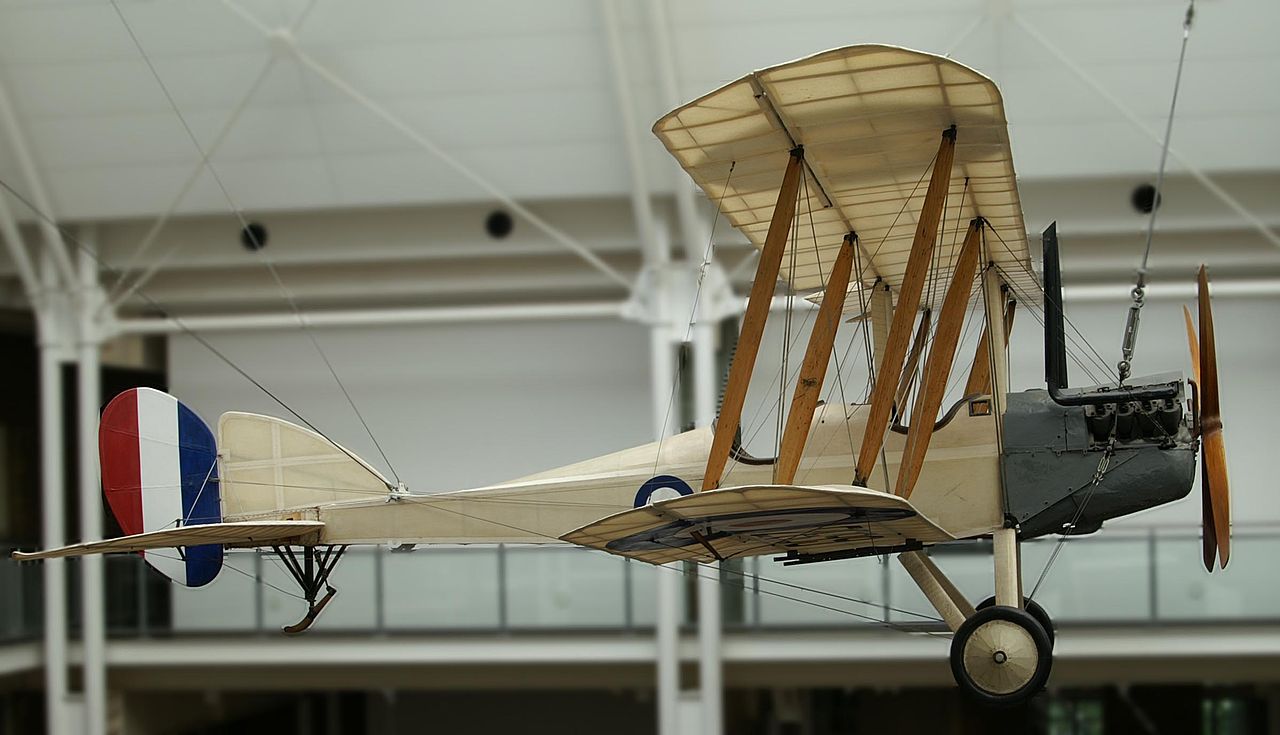
Learmount himself was now mostly flying the BE2c out of Droglandt. The BE2 series had originally been designed – in 1912 – as a very stable, unarmed reconnaissance machine, and that was fine until the Germans introduced well-armed aircraft like the Fokker Eindecker. The Allies didn’t have an answer to the latter’s capabilities until early 1916, so the BE2c’s previously desirable stability made it a sitting duck (more about this in future episodes). Many were shot down but – fortunately – because they were such stable machines to handle, the crews were often able to control the damaged machine to a forced landing.
Royal Aircraft Factory BE2c at the Imperial War Museum
So many BE2cs had been built, however, that they continued to be used for reconnaissance and bombing into 1917, and crews began to dread being assigned to them.
Meanwhile Learmount was recommended for a Military Cross. The citation lauded his general performance since joining 7 Sqn in June, but it described a specific action on the second day of the Battle of Loos: “Consistent good work, done most gallantly and conscientiously from 13.6.15 to present time. This Officer bombed and hit one half of a train on 26.9.15, coming down to 500ft immediately after Lieut DAC Symington had bombed the other half.” The train was on the Lille-Valencienne line, and Symington had achieved a direct hit on it close to its front, bringing the whole train to a halt. Just after that, Learmount dropped a 100lb bomb that made a direct hit on one of the coaches in the train’s centre.
The point about coming down to 500ft or less is that it puts the aircraft within easy range of machine gun fire, and trains were almost always armed.
Tomorrow: Episode 3, Learmount is seconded to the French Armée de l’Air to report on their development of night bombing techniques
When the Great War began, a grammar school boy from Newcastle upon Tyne who had gone into business as a shipper and trader in the far reaches of the British Empire, found himself in the skies above Flanders. Aviation was in its infancy, and every flight had an element of the experimental about it.
When Britain declared war on a Germany whose troops were already marching through Belgium in early August 1914, one Leonard Learmount, aged 25, was employed in the Straits Settlements (Malaya and Singapore), working for London-headquartered shipping and trading company Paterson Simons.
Learmount (front centre) at his club in Singapore
Life in the British Empire’s warmer climes was good for a young single man then, expat clubs providing social connections and sport.
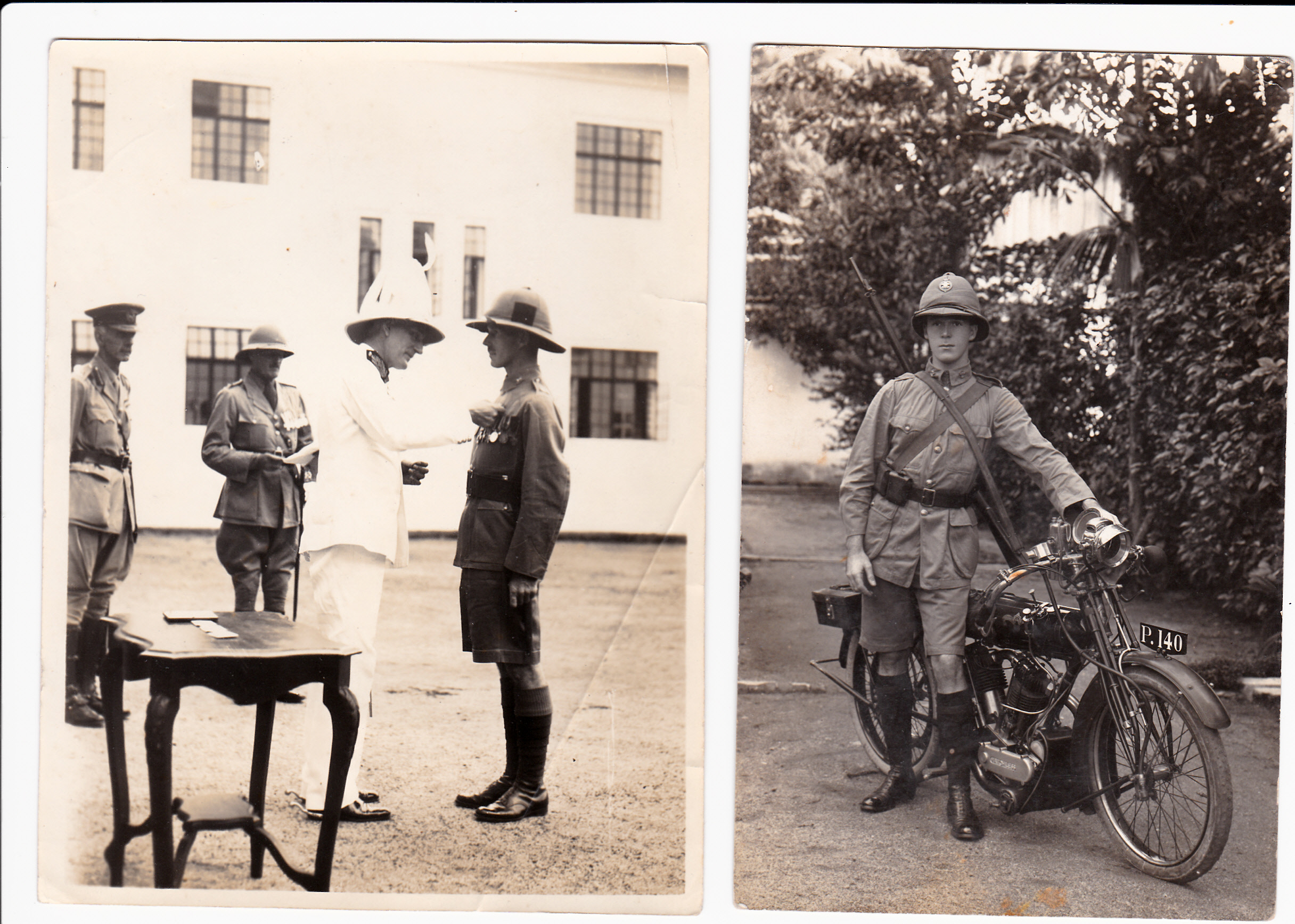
Learmount had also joined the Malay States Volunteer Rifles (MSVR), a British overseas military reserve unit, as a Private Soldier. Nevertheless, following the outbreak of a war predicted to be “over by Christmas”, that November he took a ship back home to join up.
The local army reserve unit taught him to maintain and ride a motorcycle
When he reported for military service he was chosen for training as a pilot in the Royal Flying Corps (RFC). It is not clear – historically at least – why the RFC decided he was suitable material, but given the indicators for other such personnel choices at the time, it’s probably because the MSVR had trained Learmount to ride and maintain a motorcycle. These skills, combined with his maths and physics education at the Royal Newcastle Grammar School, probably swung the decision.
Learmount reported to Brooklands aerodrome, Surrey, on 19 March 1915 for RFC flying training, and his flying log book says he got airborne the next day for his first lesson in a Maurice Farman “Longhorn” biplane, an ungainly French-designed machine.
A Maurice Farman Longhorn trainer
His instructor, Sgt Watts, hadn’t been trained as an instructor, he merely had flying experience. The RFC hadn’t developed a flying training syllabus until early 1917, and didn’t begin formally training instructors until late 1917.
On 1 April 1915, Learmount flew a sortie lasting 45min, by far the longest duration trip he had flown. In the remarks column of his flying log book he wrote: “First time controlled machine from pilot’s seat. Did several landings. No wind – no bumps.”
The next day, he took off for his first solo flight at 6:15am, exactly two weeks after his very first flight. By that point Learmount had flown ten trips, all within sight of the airfield, and logged a total of 3h 10min in the air. The solo flight lasted 10min and was flown at 1,000ft – probably one circuit of Brooklands aerodrome. At 10:30am the same day, he got airborne for his flying test, which took 1hr exactly, and it earned him his “ticket” – his Royal Aero Club Aviator’s Certificate (Number 1147).
By the time he was dispatched to France on 12 June, Learmount’s entire pilot training had lasted 12 weeks exactly, about half of it flown on the Farman Longhorn, the remainder on the excitingly named Vickers Fighter – the FB5 – also known as the Vickers Gunbus. It was a two-seater “pusher” biplane which, in operation (not in training), was fitted with a Lewis machine gun at the forward crew position. Learmount’s flying training time had been divided about equally between the aerodromes at Brooklands, Surrey and Joyce Green, Kent in the Dartford marshes.
The question is, how were these newly trained pilots performing operationally when they arrived on the front in France? Major Raymond Smith-Barry – a graduate of the very first course at the Central Flying School, Upavon in 1912, had been serving as an RFC pilot in France from August 1914, and by 1916 he realised that the standard of flying among the arriving aviators was simply appalling, and he decided something had to be done. By late 1916 he had compiled a formal training syllabus, which he first introduced at Grange airfield, Gosport, on the south coast near Portsmouth, where he was appointed Commanding Officer of No 1 (Reserve) Squadron – a training unit – and took up his appointment there in December 1916.
In the meantime, those aviators who – like Learmount – were a product of the system well ahead of this training upgrade, had to survive with what little skill they had! By the time Learmount was posted, as a 2nd Lieutenant, to No 7 Squadron at Saint-Omer, France, about 25km south-east of Calais, he’d accumulated exactly 24h airborne time. The entry in the “remarks” column of his log book for his 9 June 1915 final training sortie reveals how much the RFC was prepared to forgive to get pilots rapidly to the front line. It says: “Pancaked over sheds, smashed undercarriage and one wing landing.”
Learmount’s flying log book at the end of his training
Anyway, the crash-landing at the end of Learmount’s final training sortie was clearly good enough for the RFC, because the next inscription in his log book is: “Arrived in France 12 June 1915.”
Saint-Omer aerodrome, about 25km from the Channel coast and a similar distance from the Western Front battle lines, became the largest RFC base in France or the UK.http://www.greatwar.co.uk
Continued tomorrow, Episode 2: Learmount arrives at the RFC aerodrome at Saint-Omer, where he learns to fly a new type and to cope with operations in hostile airspace.








 Learmount.com