Jeju Air – the missing four minutes

Birdstrikes on airliners are not rare, but they don’t usually cause crashes, let alone fatal ones.

The most famous birdstrike accident before the Jeju Air crash at Muan, Korea a little more than a month ago was the “Miracle on the Hudson”, in which a US Airways Airbus A320 climbing away from take-off at New York LaGuardia airport in January 2009 hit a flock of large geese that disabled both engines. What followed captured the public’s imagination to the extent that Hollywood made a movie about it.

When the geese collided with his aircraft, Captain “Sully” Sullenberger made the decision not to attempt a turn-back to land on the runway, but to glide down for a ditching in the Hudson River. All 155 passengers and crew survived the ditching in the river’s freezing water.

Moving forward 15 years, the Korean aviation and railway and accident investigation board (ARAIB) interim report on the 29 December 2024 Jeju Air crash at Muan International Airport has now confirmed that the chain of events leading to the accident also started with a birdstrike on both engines. The Boeing 737-800, on final approach to runway 01 at Muan, ran into a flock of small ducks which caused the engines and the aircraft extensive damage. Details of the extent and nature of the damage have not been established, but it is clear that some of the aircraft’s electrical systems stopped working.

Much more would normally be known at this stage, but the flight data recorder (FDR) and cockpit voice recorder (CVR) stopped operating at the time of the birdstrike (08:58:50 local time), depriving the investigators of extensive data about the last four minutes of the flight that would otherwise have been captured. Simultaneously the aircraft’s ADS-B transmissions that enable the its three-dimensional trajectory to be tracked in real time also stopped, so it will be more difficult to establish the precise course the crew flew in order to line up for the emergency landing they chose to make.

It was at 08:54:43 that Jeju Flight 7C2216, inbound from Bangkok, Thailand, had first contacted Muan Control Tower and received clearance to land on runway 01. If they had not already done so, at that point they would have selected the undercarriage down and set the flaps for landing.

The first hint of the problems the flight was about to face came four minutes later when the Tower warned the Jeju pilots of bird activity ahead (08:57:50). At that point they were about 3nm from their anticipated landing. The electrical failure that stopped the two recorders occurred a minute later at 08:58:50, at which time the aircraft was still 1.1nm away from the threshold of runway 01, according to the ARAIB report.

The crew saw the flock of ducks ahead and below them just before the birdstrike, it seems, so they decided to abandon the approach and carry out a go-around, increasing engine power and starting to climb away. Six seconds later, at 08:58:56 local time, they declared a Mayday emergency, citing a birdstrike, and announcing their go-around, which had now become far more difficult to carry out because of reduced power from the damaged engines.

The report emphasizes that recordings during the last 4min 7sec of the flight are missing. That is the time that elapsed between the electrical failure that stopped the recorders and the moment of the 737’s violent collision with the earth and concrete mound beyond the end of the landing runway in which the ILS localizer antenna array was embedded (09:02:57).
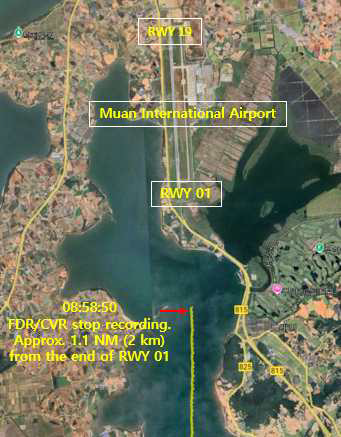
Image from ARAIB interim report

As they initiated their go-around, the pilots felt – and heard – the birdstrike and witnessed a loss of engine thrust just after they had advanced the throttles to climb away. As a part of the go-around drill the crew retracted the undercarriage and selected the flap fully up. There is no recording to confirm this, but they must have done so, as events in the next few minutes make clear.

The attempt to save the flight

The crew knew they had to get the aircraft on the ground fast in case the damaged engines failed completely, but by this time they were losing sight of the runway 01 threshold below the nose as they initiated their go-around, so landing ahead on 01 was no longer an option. Circling back to set up a new approach to the same runway was risky because they might not have sufficient power to maintain height for that long. The ARAIB report says that the last pressure altitude recorded was effectively 500ft (498ft to be precise), and indicated airspeed was 161kt.

At such a point the pilots would want to gain any height and speed they could with the remaining engine power so as to increase their gliding range in the event of total engine failure, and to stay withing gliding range of the runway. So their decision was to fly ahead, then turn through 180deg to land on the same runway but in the opposite direction – that is designated runway 19. Because, during the go-around, they were positioned to the left of runway 01 and parallel to it, they were committing to a right turn to reverse their heading and line up for the approach to 19.

The workload and stress on the pilots at that moment were massive. They did not know how much engine power they would have, or how long they would still have it, so the temptation to turn early to line up on the runway was high. Video of the aircraft’s arrival on runway 19 at Muan shows the aircraft touching down gently with its wings perfectly level, but nearly 2/3rds of the way along the tarmac, travelling very fast with no flaps set, the undercarriage still retracted, and no spoilers deployed.

With the data available at present there is no way of knowing whether the crew failed to get the flap and gear down because of hydraulic problems, or whether the high workload and lack of time made them forget to deploy them. Apart from the failure of electric power to the flight recorders, the investigators don’t know what other problems the pilots faced.

It’s even difficult to work out why an external collision with relatively small birds (Baikal Teals, average weight given as 400g) would cause an electrical supply to fail, unless the undercarriage was still down at the point of birdstrike, leaving electrical wiring and hydraulic tubing in the gear bay vulnerable to impact damage.

Almost all the 181 people on board the Jeju 737 were killed, the only survivors being two cabin crew strapped into their seats in the tail of the aircraft. Everyone on board would still have been alive until the high speed impact with the solid foundations for the ILS localiser antenna array about 200m into the runway overrun, which caused the aircraft to break up and catch fire.

Lessons from Dubai

The 3 August Emirates Boeing 777 crash at Dubai may have happened a while ago, but the man/machine interface implications are so complex it still has human factors experts’ heads spinning.

Following an uneventful final approach to runway 12L the aircraft hit the runway with its gear in the retraction cycle, slid to a halt on its belly and burst into flames. All on board got out alive before the fire destroyed the fuselage, but a firefighter was killed by a fuel tank explosion.

That’s a surprising outcome for a serviceable aeroplane carrying out a normal landing at its home base.

So what happened?

Flight EK521 was inbound from Thiruvananthapuram, India carrying 282 passengers and 18 crew. The ambient temperature was high, nearly 50degC, and there was a windshear warning on all runways, but this did not cite high winds or powerful gusts. Probably the wind was swinging around under the influence of vertical air currents generated by intense surface heating combined with the coastal effect.

When the 777 had about 5nm to go on approach to 12L ATC cleared it to land and told the crew the surface wind was 340deg/11kt. That’s a touchdown-zone tailwind.

As the aircraft descended through 1,100ft on final approach the aircraft was also registering an airborne tailwind. It persisted almost all the way down.

But apart from the tailwind on the aircraft’s approach, the descent was uneventful until just before touchdown. At that point the tailwind switched to a headwind, adding about 20kt to the 777’s airspeed.

Around 5sec after the flare the right gear touched down about 1,100m beyond the threshold, and 3sec after that both main gear touchdown switches were made and the RAAS (runway awareness advisory system) voiced the alert “long landing, long landing”.

Questions still remain about exactly what happened next on the flightdeck. Who did what, and why?

The United Arab Emirates General Civil Aviation Authority has released some factual information about weather and aircraft performance, but the investigators are expected to take another three months or so to ready their final report.

Meanwhile from what the GCAA has released, we know that the captain was the pilot flying. He disconnected the autopilot at about 900ft on approach but left the autothrottle in. When he began the flare at 35ft AGL the throttles retarded to idle, and within about 10sec both touchdown switches had been made.

What happened next, or at least why it happened, is difficult to work out.

Witnesses say the aircraft “bounced” from the first touchdown. But the crew was attempting a go-around – possibly prompted by the “long landing” alert mentioned earlier – so the “bounce” may have been the result of the crew pulling the nose up for a go-around.

Some 4sec after the warning the aircraft was airborne again, the crew reduced the flap setting to 20deg, and 2sec later selected the gear up, both acts part of a go-around drill.

But the throttle levers remained at idle.

About 5sec after the aircraft had become airborne the tower, noticing the apparent intention,  cleared the aircraft straight ahead to 4,000ft, and the crew read that back. Then the first officer called “check speed”, the throttle levers were moved from idle to fully forward, and the autothrust transitioned from idle mode to thrust mode.

Unfortunately the increasing engine power arrived too late to prevent the aircraft sinking back onto the runway with its gear almost fully up. It slid on its belly for 800m before coming to rest with the right engine detached and a fire under that wing.

The GCAA interim report doesn’t mention whether or not the crew attempted to trigger go-around power by selecting the TO/GA (take-off/go-around) switches at the time of the go-around decision, but it appends a page from the flight crew operating manual about autothrust modes.  It contains this sentence: “The TO/GA switches are inhibited when on the ground and enabled again when in the air for a go around or touch and go.”

This situation raises questions galore. In a go-around situation the drill is to select power first, then set the appropriate flap, then register a positive rate of climb and pull the gear up. Maybe the crew thought activating TO/GA was enough, but they didn’t monitor engine power, throttle lever movement or rate of climb before retracting the gear.

This is basic stuff, so what’s going on here?

Are we witnessing the actions of a crew rendered insensitive by automation, or de-skilled by the same thing? Or is this an event involving mode-confusion because of the complexity of modern aircraft and their smart control systems?

The industry is going through a crisis of confidence in pilot training. The doubt arises from increasing numbers of accidents that began with a non-critical fault or distraction and result in the pilots becoming startled and not acting as they had been trained to do.

Behind it all is the fact that today’s aircraft and their systems are impressive and reliable, but ultra-complex. Meanwhile the basic approach to pilot training is the much the same at was in the pre-digital era.

Emirates is in the vanguard of modern attitudes toward evidence-based training, but maybe the fundamentals are set before pilots reach the line.

Finally, pilots are never really trained to operate the digital systems they use all the time at work. They just learn that on the job.

Let’s go back a bit to the quote from the Emirates 777 FCOM: “The TO/GA switches are inhibited when on the ground and enabled again when in the air for a go around or touch and go.”

I bet the pilots never tried that in the simulator.

Modern aeroplanes now are rather like personal computers in the relationship pilots have with them: most people are skillful users of tablets or laptops for routine tasks, but never have a chance to try out their full capabilities, most of which would rarely be needed. But if things go wrong or something unusual happens, the user is often out of his depth.

The Royal Aeronautical Society is hosting its two-day International Flight Crew Training Conference in London next week. This is one of the subjects that will be examined there.

Flydubai accident update from MAK

Russian accident investigator MAK has released preliminary information from the flight data recorder suggesting that there was no mechanical or aircraft systems fault in the Flydubai Boeing 737-800 at the time it appeared to go out of control and crash on final approach to Rostov on Don (see details in blog entry for 20 March).

Also since the previous blog story was written, video imagery has been released indicating that the final trajectory of the aircraft to impact was a nose-down high speed dive, which matches closely the flight profile of a Tatarstan Airlines 737-500 before it crashed on approach to Kazan, Russia in November 2013 (see also 20 March story for details).

If the MAK confirms these details in a fuller release soon it will highlight a need for the industry to train crews better for all-engines go-around manoeuvres because of the potentially dangerous combination – especially at night or in IMC – of the strong pitch-up moment caused by go-around power from underslung engines, plus “somatogravic illusion” in the pilots. Somatogravic illusion is the feeling induced by rapid forward acceleration that the nose has pitched up when it has not.

Another factor in this lack of crew familiarity with all-engines-go-around risks is believed to be that the go-arounds most practiced during recurrent training involve an engine-out abandoned approach, in which the power, pitch-up moment, climb rate and airspeed acceleration are all much more gentle.

The Flight Safety Foundation has been alerting airlines to this risk for many years now, and some airlines have modified their recurrent training accordingly.

Pilot groups in Dubai are also alleging that crew fatigue may have played a part in this accident. If this is true, it will emerge in the MAK final report.