About two years ago I posted a nine-episode serial about early military flying called “Leonard’s War”.
This story follows an RFC aviator on his journey from flying lessons at Brooklands, Surrey in 1915 to Squadron Commander over Flanders in 1918. Once in France, he flies with 7 Sqn over Ypres, returns to UK in 1916 to command 15 (Reserve) Squadron in Doncaster – a mission training unit – and commands 22 Sqn over Passchendaele and Cambrai.
If you missed “Leonard’s War” at the time, I recommend you try it. Even if you did read it then, I suggest you re-visit, because – following extensive research – I have added much new material and corrected earlier detail.
It has struck me that, in many accounts about military aviation in the Great War, there seemed to be two separate battles going on: one in the air where gallant aces shot each other down in dogfights, the other on the ground where soldiers crouched in trenches and emerged to die on muddy battlefields. “Leonard’s War” – as now revised – describes how the airmen and soldiers learned to cooperate, and how aviation changed everything about a war that began in 1914 with cavalry charges in Flanders and ended with airborne stereoscopic photo-reconnaissance and close-air-support to troops on the ground.
Dateline: Mid-November 1917, Estrée Blanche, north-eastern France.
The weather at Estrée Blanche aerodrome worsened in mid-November (1917), and fog made reconnaissance in the whole area extraordinarily difficult. 22 Squadron, still under the command of Major Leonard Learmount, was tasked with finding out what the enemy was up to around German-held Cambrai, information which headquarters badly needed for the planned British assault there on the Hindenburg Line, a heavily fortified German defensive line to the west of the town.
The Cambrai assault, which began on 20 November, was conceived by General Sir Julian Byng as a surprise attack from the west, across terrain suitable for tanks – unlike the Ypres area – and RFC close air support was part of the plan. The latter had proved highly effective toward the end of the Passchendaele battle.
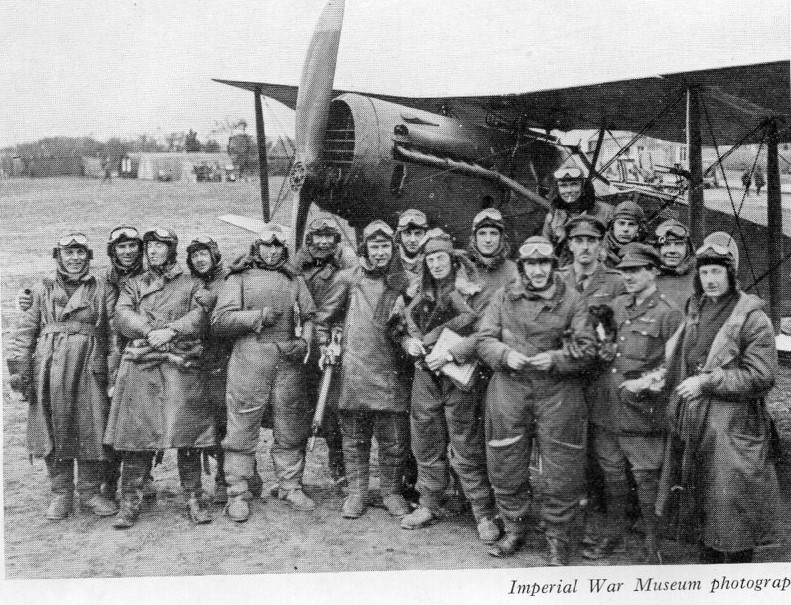
A and B Flights of 22 Squadron with a Bristol Fighter early in 1918.
This patch of grass was the location of the Estrée Blanchemess buildings in the corner of the aerodrome, looking south west over the village. This was an agricultural and coal-mining area, and the now-grassed-over coal slag heaps are visible in the middle distance. Mounds like them took the lives of low-flying airmen when the weather was foggy.
On 20 November the Cambrai offensive began, and yielded a suspiciously successful British six-mile advance over nine days, after which it was brought to a halt. It was still short of the town, but had breached some of the defensive lines. Very quickly, however, the advantage of surprise was lost and the Germans successfully counter-attacked. By the 6th December, they had retaken much of the ground that had been won.
Air Gunner Archie Whitehouse described 22 Sqn’s role at Cambrai: “We had the unenviable job of blowing up the enemy observation balloons, strafing road transport, and making a general nuisance of ourselves. We were down low, flying through our own shell-fire to hammer Cooper bombs on the German anti-tank gun emplacements. We strafed the roads and chased horse-drawn transport all over open fields, and generally played merry hell…
“We fired hundreds of rounds of ammunition and burned out our gun barrels. We returned again and again for fuel, bombs and the reviving encouragement of Major Learmount. Thank God for the Major during those days!”
It left them with a feeling of emptiness, against which the only antidote was the adrenaline summoned up by the next sortie. Whitehouse wrote: “We flew, slept, flew, slept and flew some more. We staggered back and forth to our machines, too tired to eat. No-one spoke, no-one laughed, no-one argued. Faces were lined with weariness, pitted with cordite, and daubed with whale-oil.”
Whitehouse described the festive preparations: “We got up a programme that was a honey for wartime humour. Among the mechanics we had a wealth of talent, so we could put on a show worthy of any outfit out there!” They rigged up lights powered from a dynamo lorry and searched out decorations to put up.
Learmount in his RAF uniform. The RFC, a corps of the army during most of the war, became the nation’s autonomous air arm on 1 April 1918.
Then they put on the show, with “the inevitable slightly bawdy female impersonator”, tricks, recitations and plenty of songs accompanied by piano. Marie and Annette, waitresses from the small estaminet in the village – and their mother – were guests of honour, along with quite a few other “puzzled-looking” civilians from Estrée Blanche, and they were given seats at the front near the piano. It all ended with God Save the King and the Marseillaise.
Then back to business. C Flight had to go on patrol on Christmas Day, but nothing much came of it. The Hun had chosen to be quiet for Christmas too, apparently.
On 20th January 1918 Archie Whitehouse, whose ambition all along had been pilot training and a Commission, was sent back to England to achieve both, wearing the ribbons for his newly-awarded Military Medal and a chest-full of campaign gongs. He reported in his memoire: “I lived to wear pilot’s wings and fly a single-seater fighter. I lived to see the Armistice!” He clearly felt lucky. He definitely was.
The squadron commander who had bid Whitehouse farewell was now the very last of the aircrew left from January 1917, but he had his work to keep him sane. He still had to lead 22 Squadron’s mechanics, armourers, stores-wallahs, cooks and caterers whose names he knew well, and to encourage the new, barely-trained young pilots and observers to believe in their roles and in their ability to carry them out.
On 22 January 1918 the Squadron moved briefly from Estrée Blanche to Auchel/Lozinghem, then again on 2 February to Treizennes, where losses were high and increasing. The Geman air force was venturing more over the Allied lines than they had been accustomed to do, seeking intelligence for planning purposes. It was on a patrol from Treizennes, on 9 March, in his Bristol Fighter, that Learmount got his blighty while attacking a German aircraft that was being far too successful at directing German fire onto British artillery positions. Although losing blood fast, his remarkable luck still held, and he got his Biff back to base. He was stretchered away from his mount.
From March 1918, No. 22 Squadron found itself dealing with German preparations for the imminent – ostensibly successful but short-lived – Spring Offensive. The German army, commanded by Gen Erich Ludendorff, had benefited from the transfer of huge numbers of troops from the Eastern to the Western Front, and consequently appeared to have assembled the means to mount an attack on a wide front. On 21 March the first of three separate chronologically sequenced attacks took place on different parts of the British sector of the Western Front. Ludendorff’s objective was to drive the British to the Channel coast and cut them off from French forces before the newly-arrived Americans were able to put their full weight behind the Allies.
The final push of the Spring Offensive, in late May, was aimed further south on the French-defended part of the line near the Champagne. But Ludendorff had dissipated his forces too widely and, despite gaining a significant amount of ground, he had failed to defeat the retreating British and French armies, which were able to re-group. By July the attack had ground to a halt without achieving any of its aims. This marked the beginning of a progressive collapse within the exhausted, demoralised German military.
The RFC shipped the badly wounded Learmount back to England, where he was sent to St Bartholomew’s hospital, London, for treatment. France awarded him the Croix de Guerre avec Palme.
At “Bart’s”, Learmount met “Peggy” Ball, a young nursing auxiliary charged with looking after him. Less than two months later – on 7th May – he married her in a church in Muswell Hill, north London, where her parents lived.
While Leonard and Peggy were exchanging vows, the German Spring Offensive was still advancing, but the Allied victory that (we now know) was to come in November was nowhere in sight at that time. Nevertheless, the newlyweds took a few days off to honeymoon at a pub on the banks of the River Thames, at Staines, 15 miles west of London – very rural in those days – and they went rowing together. Wedding photographs show Learmount left the church still using a walking stick.
A cutting from the Daily Mirror. Learmount, leaning on a walking stick, is leaving St James’s Church, Muswell Hill, London with his bride. He was 28 then, but looks much older. Convalescence would have to continue on honeymoon.
He was taken off the sick list on 22 August 2018 and posted to No 33 Training Depot Station at Witney near Oxford as an instructor on Bristol Fighters.
Upon his demobilisation in February 1919, Learmount returned to his trading job in the Far East. Once he was established there, his new wife and baby son, travelling by ship (of course), joined him there a few months later.
The marriage lasted a lifetime.
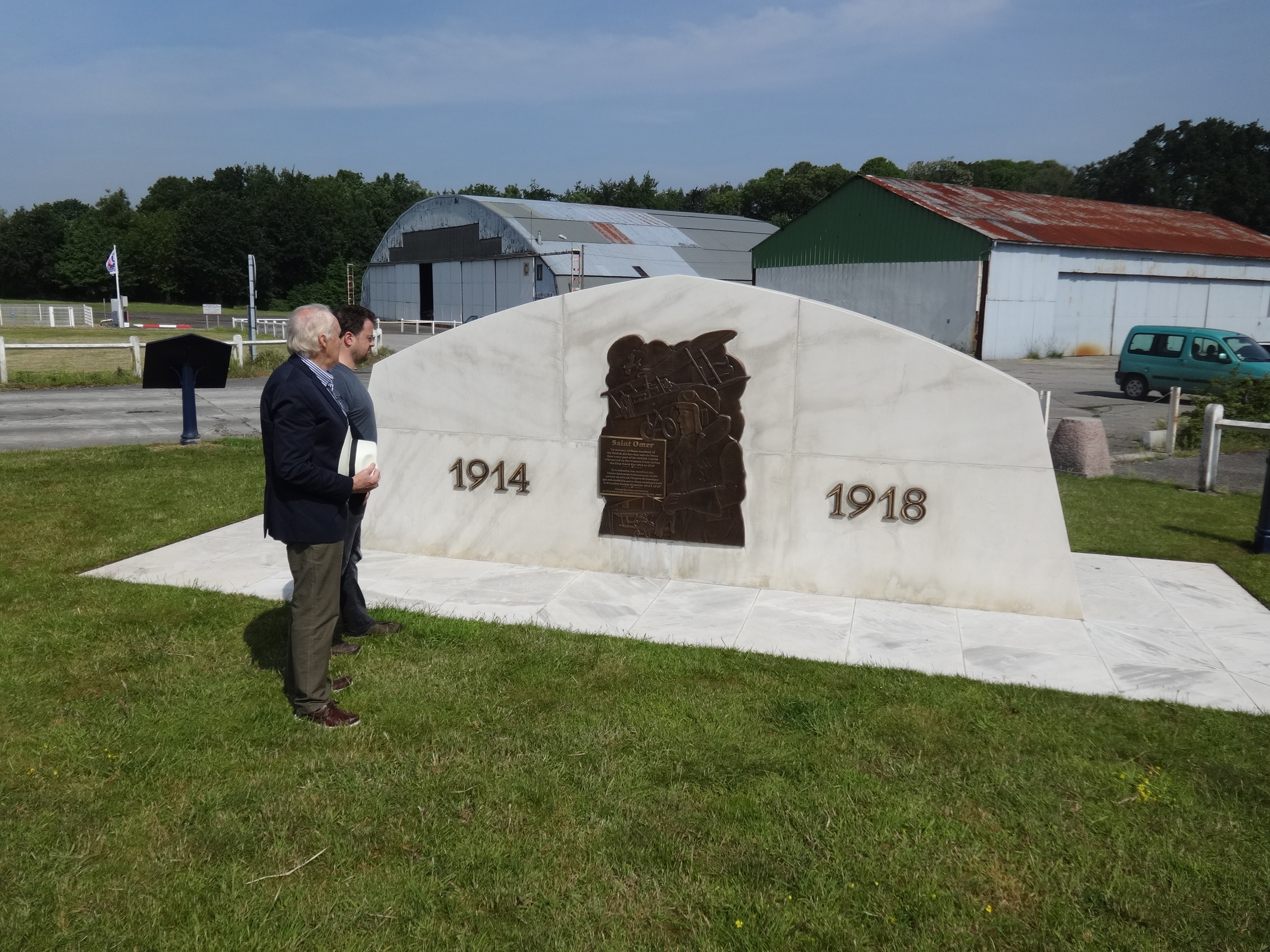
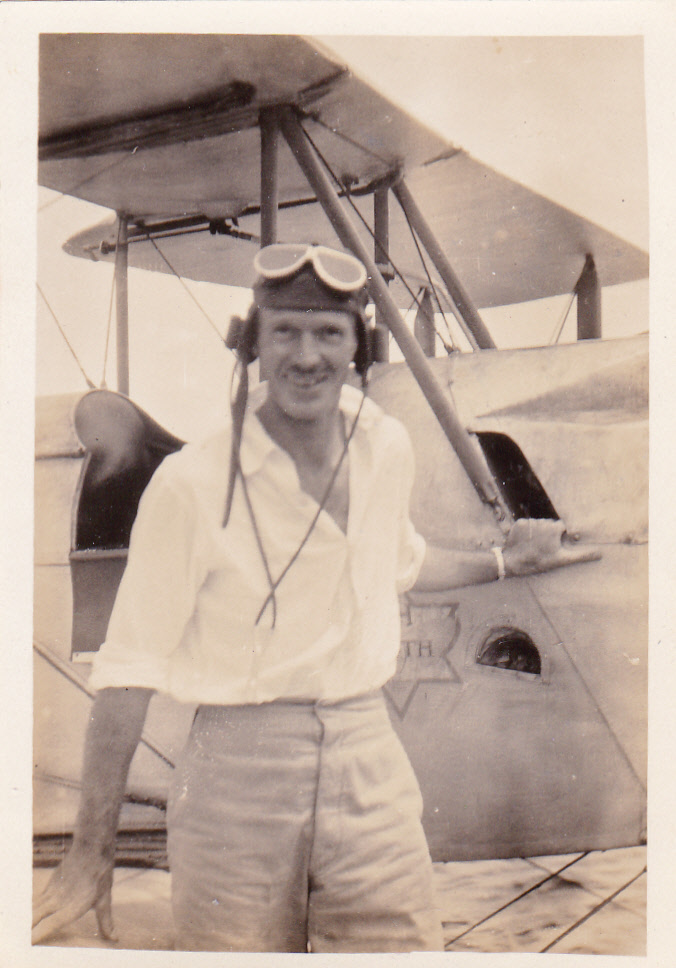
Author and son at the British Air Services Memorial, Saint-Omer aerodrome in June 2015. The memorial was erected by the First World War Aviation Historical Society in 2004. None of the buildings in view were in place during the Great War. The hangar on the left was built by the Germans in the Second World War and today is occupied by the Aéro Club de Saint-Omer. The Club keeps a museum of Great War aviation history at Saint-Omer in their hangar, and visitors are welcomed.Learmount’s decorations. From Left: Distinguished Service Order, Military Cross, 1914-15 Star, British War Medal, Victory Medal, Colonial Auxiliary Services Long Service and Good Conduct Medal, Croix de Guerre avec PalmeLearmount did keep flying, but for leisure. Here he is – in the late 1920s – with a De Havilland Cirrus Moth float-plane at Seletar Creek, Singapore, where he was one of the founder members of what was then called the Royal Singapore Flying Club. He also founded what was known as the Royal Selangor Flying Club in Malaysia. Both clubs still operate today under different names.
ENDS
Click here to go to Episode One of “Leonard’s War” and read it all again!
The No. 22 Squadron duty armourer issues Lewis guns to crews (Imperial War Museum)
Shortly after landing from his maiden flight with Capt Clement, Air Gunner Second Class Archie Whitehouse was called out for another flight, this time with Lt Brooks. It was a patrol with a formation of C Flight Fees. They gained height over the airfield, joined up and headed east over the German lines.
After surviving fierce “Archie” [anti-aircraft fire], the flight was bounced by German machines from above. It turned out to be one of those encounters where the two formations pass through each other firing wildly, then disengage.
On the return leg, Whitehouse caught sight of a German aircraft above and behind his own that neither his pilot nor any of the others had seen. He grabbed the aft Lewis gun and let fly over the top wing. Describing the result, he wrote: “I saw a blaze. I heard a low explosion and something went hissing past our wing-tip…I saw struts flickering in the afternoon sunlight, a long, greasy trail of smoke.” Brooks looked at him with disbelief, which Whitehouse interpreted as disapproval. He began – with dread – to believe he had shot down one of the C Flight Fees by mistake. He huddled into his tub, and waited fearfully for the landing.
Once on the ground, Capt Clement grabbed him exclaiming: “Best damned gunner on the Front! He’s mine! Got a Hun first time up…Judas!”
Within minutes Whitehouse was airborne again, but with Clement. This time C Flight bounced three German machines from above, encircled them, and destroyed two. But then: “The archie barrage increased in venom. There was a tremendous crash and I saw one of our planes disintegrate. The planes fluttered away lightly, the nose and the engine seemed to hover for a few seconds and then plunged forward, the bamboo tail-booms fluttering like silly sticks.” He then described how horror became catastrophe: “I watched it and saw a man fall away, all arms and legs. The wreckage gathered speed and hurtled down – smack on top of the ship nearest to us.”
Clement and Whitehouse watched helplessly as the remains of the two Fees spun earthward in a death embrace. Seconds later Clement pointed ahead at a German Albatros, and Whitehouse went to work. “It twisted and jerked and I heard [Clement] yell…[then] we dove on it with a fierce hatred. I gave it the rest of my drum, and saw it start a tight spin.” Then, incredibly, another disaster: the wreckage of the Albatros collided with another of the Fees, and down it spiralled too.
By the time Whitehouse got back to No. 22 Squadron’s Chipilly base at the end of his first day as an aviator, he had logged eight hours airborne and shot down two German aircraft.
In that single day in late April he had also seen a fatal aircraft structural failure over his new base before he even got airborne; witnessed a rare but catastrophic “archie” [anti-aircraft fire] hit on his formation; and seen one of his own kills collide with – and destroy – a C Flight FE.2b and its crew.
There were going to be many more days like that.
On 1st May 22 Sqn left Chipilly for Flez, and on the 10th May Whitehouse took off with Captain Bush and C Flight for a patrol which got very busy. Having brought down one German machine, Whitehouse copped a load of shrapnel in one of his shoulders and his arm stopped working. Bush realised what had happened and headed for base.
On the ground, Whitehouse carefully extracted himself from his Fee with Bush’s help, and they saw a commotion around one of the other machines. The duty flight sergeant explained that Learmount had been hit. Bush asked him how bad it was, and Whitehouse’s account of the reply is rendered in East London vernacular: “Mostly ‘is feelin’s, sir. One came up through ‘is tank and spoiled ‘is trousers. You ought to ‘ear ‘im aswearin’! The Major carn’t arf say it!”
Watching this scene, Whitehouse remarked: “He just looked just angry, not hurt. I didn’t blame him. You can’t go home with a blighty in the breeches and expect to get any sympathy.” Actually, Learmount had returned from a low-level “oblique photography” sortie, which explained the nature of his injury. For these missions, the crews have to fly so low above the battle lines that they are within easy range of small arms fire from the ground.
This painting by aviation artist Tim O’Brien depicts Learmount’s FE2b at Flez aerodrome, preparing to depart on 10 May for a low-level aerial photography using new oblique sighting techniques. The trip was one of a series of missions the objective of which was to obtain images of activity in the Germans’ highly fortified Hindenberg Line. Learmount returned wounded by small arms fire from the ground and with his aircraft extensively damaged.
As it turned out, neither airman had got his “blighty” [a wound that gives the damaged man a ticket home]. They recovered with some attention from the camp medic, and a few days off active duty.
From then on, Learmount and Whitehouse flew together a lot more, but increasingly in the new F2b Bristol Fighters that were just beginning to be delivered to 22 Sqn. Whitehouse explained: “After that, whenever the Major wanted to try any tricks [test new equipment or procedures] he usually came and rousted me out. And I loved it. He was a gallant gentleman!”
Between July and September 1917, 22 Squadron moved base three times in a northerly direction, respectively via Warloy, Izel les Hameaux, and Boisdinghem, as the offensive focus for the British-led ground forces moved northward from the Somme toward Ypres and Passchendaele, Flanders. In September they were to end up for some months at Estrée Blanche, an aerodrome on a low hill not far south of Saint-Omer, in gentle farmland disfigured by coal mine slag heaps.
Tomorrow’s episode 7: The personal cost of aerial photography, and No. 22 Squadron gets the RFC’s new hot ship, the Bristol Fighter.
Learmount with one of No 22 Squadron’s FE2bs. It is not clear whether this photograph was taken at Bertangles, Chipilly, or Flez, but Bertangles seems unlikely because 22 was there in winter time.
In the middle of the snowy January of 1917, Leonard Learmount was promoted to Acting Major and given command of No 22 Squadron at Bertangles, about 5km north of Amiens. In his promotion from Lieutenant he had leapfrogged the substantive rank of Captain (he had been made an acting Captain during his immediately preceding command at 15 Reserve Squadron, Doncaster, a training unit, whence he travelled to France) and gone straight to Major. War seems to make military procedure much more flexible.
22 Sqn was equipped with FE.2b pusher biplanes – dubbed the “Fee” by its fliers and mechanics. The Squadron’s main roles when Learmount joined it were aerial photography over the German lines, and reconnaissance. In this vital role, which required steady, stable flying often at low level, it was vulnerable, so a pair of Sopwith Pup fighters were attached to the squadron to fly as escorts above the FE2b formations, able to intervene from above if German fighters attacked. At 27, Learmount was older than most of his fellow pilots, and equipped with all of 22 months’ experience of military aviation since his first flying lesson at Brooklands.
A farmer’s field near the River Somme, the former site of Chipilly aerodrome. The gentleness of the countryside and the beauty of the River Somme itself belies the horrors perpetrated here.
At the end of April 22 Sqn moved east about 20km from Bertangles to Chipilly, an aerodrome a few kilometres south of Albert and just to the north of the River Somme. During a few days sojourn there before moving further east to Flez, a new young American volunteer, AGJ (Archie) Whitehouse, who had just transferred from the army to 22 Squadron as an Air Gunner Second Class, brought to his first squadron a useful familiarity with firearms he had won both as a soldier and back at his childhood home in the USA. He was about to put that skill very successfully to use in the air, in charge of a Lewis light machine gun mounted above the front edge of his slipstream-blasted, canoe-like work-space in the nose of the Fee. His “foot-bath”, as he called it, was immediately forward of the pilot’s rather deeper cockpit.
About ten years later Whitehouse, who kept a diary at the front, was to publish a memoire of his time on No 22 Sqn called “Hell in the Heavens”. Some of the experiences recorded here are from Whitehouse’s book. While there is no reason to doubt his tales of squadron life, and the airborne experiences he describes, the precise chronology of events he records – including 22’s migration from one aerodrome to another from time to time – is not reliable.
The Fee itself was stable, reliable, could take a lot of damage and still fly, but rather slow. Its strong point was that the pilot and observer/gunner had a completely unobstructed view forward, laterally, above and below, which was excellent for 22 Sqn’s main roles – reconnaissance and aerial photography. In fact the Fee has – by a modern RFC historian – been dubbed the RFC’s MRCA (multi-role combat aircraft, the name given to the joint European strike aircraft project that ultimately became the Tornado). Also the field of fire from its two pivoted Lewis guns was excellent in all directions except in its blind spot directly behind and below the tail. The observer’s gun was on the forward lip of his “tub”. The other – on a higher mount just ahead of the pilot – could either be fired forward by the pilot, or used by the observer to fire backward over the upper wing. So the Fee, although not designed as a fighter, could defend itself.
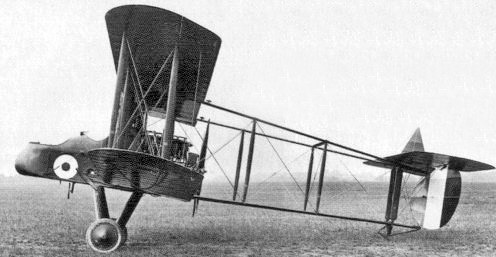
The FE2b “Fee”. This is shown without the guns on their mounts, but it clearly shows the Observer/Gunner’s shallow forward cockpit and the pilot’s deeper aft cockpit. Two Lewis guns were mounted on raised pivots, one on the front lip of the Gunner’s cockpit, the other – behind him on the front lip of the pilot’s station – could be fired forward by the pilot or rearward over the top wing by the Gunner.
The day Whitehouse reported to Chipilly, he describes himself walking between the mess huts and canvas Bessonneau hangars when he heard a wailing sound, looked up and saw the silver fuselage and tailplane of a No. 2 Squadron Nieuport Scout diving toward the ground, its wings torn away and flailing separately to earth. Nieuports were fast, nimble French single-seaters, but if a pilot pulled too hard the wings would come off, and this time they did.
Unfamiliar with what he was witnessing, it took Whitehouse a moment to realise the Nieuport was coming straight at him, and he began to run for cover between the hangars. The wingless hull smashed into the hardened area just in front of them. He must have dashed over, because he found himself pulling frantically at the fur coat containing the mangled corpse of the pilot, before somebody swore loudly at him and pulled him away.
They said the pilot was the CO of No 2 Squadron, which was co-located with No 22 at Chipilly, and speculated that he was showing his aircrew what the Nieuport could do. Whitehouse watched while a crew grabbed the corners of the fur coat and pulled the human remains clear of the wreckage so the squadron would have something to bury. Whitehouse himself was told to clear off, so he continued to the orderly room to report for duty.
Whitehouse had received no training for the air. He reported to stores and was issued with his sheepskin flying kit and goggles. An attempt by the stores team to wash away the blood of a former owner had not completely succeeded.
As soon as the new gunner had carried the kit to his Nissen hut quarters, one of the flight commanders, a Canadian called Capt Carl Clement who was C Flight Commander, put his head around the door and told him to get kitted up for a sortie that would be ideal for “getting his air legs in”.
Whitehouse’s first experience of leaving the earth’s surface was to be on a post-maintenance engine test flight. Once airborne, Clement shouted at him to tell him that, on the way back, they’d pass over the aircraft-shaped practice target on the ground near the aerodrome perimeter so Whitehouse could fire the Lewis gun at it.
To direct the gun properly Whitehouse had to get on his feet, blasted by the slipstream from his knees upward. No harness, no parachute. Standing would enable him to pivot the Lewis gun widely on its mounting. He was understandably reluctant, so Clement reached forward over his cockpit coaming and yanked him by the collar to persuade him to get up. When he finally did, the Lewis gun became both his weapon and his support – the only thing he had to hold on to. “I realised how it feels to be standing on the edge of … nothing.” But then, when Clement dived steeply at the practice target, Whitehouse filled it with lead. Clement was impressed and told him so.
When the Great War began, a grammar school boy from Newcastle upon Tyne who had gone into business as a shipper and trader in the far reaches of the British Empire, found himself in the skies above Flanders. Aviation was in its infancy, and every flight had an element of the experimental about it.
When Britain declared war on a Germany whose troops were already marching through Belgium in early August 1914, one Leonard Learmount, aged 25, was employed in the Straits Settlements (Malaya and Singapore), working for London-headquartered shipping and trading company Paterson Simons.
Learmount (front centre) at his club in Singapore
Life in the British Empire’s warmer climes was good for a young single man then, expat clubs providing social connections and sport.
Learmount had also joined the Malay States Volunteer Rifles (MSVR), a British overseas military reserve unit, as a Private Soldier. Nevertheless, following the outbreak of a war predicted to be “over by Christmas”, that November he took a ship back home to join up.
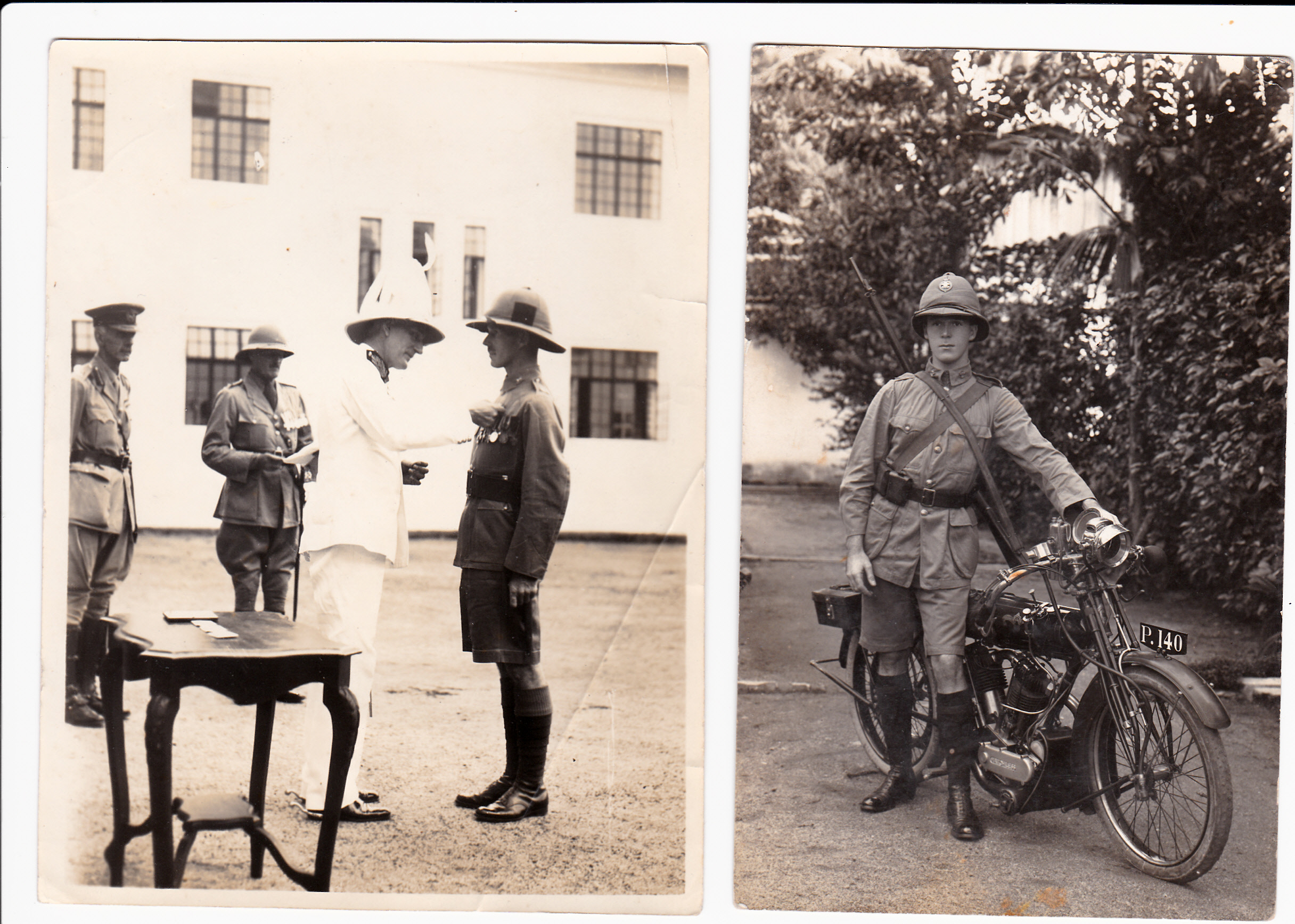
The local army reserve unit taught him to maintain and ride a motorcycle
When he reported for military service he was chosen for training as a pilot in the Royal Flying Corps (RFC). It is not clear – historically at least – why the RFC decided he was suitable material, but given the indicators for other such personnel choices at the time, it’s probably because the MSVR had trained Learmount to ride and maintain a motorcycle. These skills, combined with his maths and physics education at the Royal Newcastle Grammar School, probably swung the decision.
Learmount reported to Brooklands aerodrome, Surrey, on 19 March 1915 for RFC flying training, and his flying log book says he got airborne the next day for his first lesson in a Maurice Farman “Longhorn” biplane, an ungainly French-designed machine.
A Maurice Farman Longhorn trainer
His instructor, Sgt Watts, hadn’t been trained as an instructor, he merely had flying experience. The RFC hadn’t developed a flying training syllabus until early 1917, and didn’t begin formally training instructors until late 1917.
On 1 April 1915, Learmount flew a sortie lasting 45min, by far the longest duration trip he had flown. In the remarks column of his flying log book he wrote: “First time controlled machine from pilot’s seat. Did several landings. No wind – no bumps.”
The next day, he took off for his first solo flight at 6:15am, exactly two weeks after his very first flight. By that point Learmount had flown ten trips, all within sight of the airfield, and logged a total of 3h 10min in the air. The solo flight lasted 10min and was flown at 1,000ft – probably one circuit of Brooklands aerodrome. At 10:30am the same day, he got airborne for his flying test, which took 1hr exactly, and it earned him his “ticket” – his Royal Aero Club Aviator’s Certificate (Number 1147).
By the time he was dispatched to France on 12 June, Learmount’s entire pilot training had lasted 12 weeks exactly, about half of it flown on the Farman Longhorn, the remainder on the excitingly named Vickers Fighter – the FB5 – also known as the Vickers Gunbus. It was a two-seater “pusher” biplane which, in operation (not in training), was fitted with a Lewis machine gun at the forward crew position. Learmount’s flying training time had been divided about equally between the aerodromes at Brooklands, Surrey and Joyce Green, Kent in the Dartford marshes.
The question is, how were these newly trained pilots performing operationally when they arrived on the front in France? Major Raymond Smith-Barry – a graduate of the very first course at the Central Flying School, Upavon in 1912, had been serving as an RFC pilot in France from August 1914, and by 1916 he realised that the standard of flying among the arriving aviators was simply appalling, and he decided something had to be done. By late 1916 he had compiled a formal training syllabus, which he first introduced at Grange airfield, Gosport, on the south coast near Portsmouth, where he was appointed Commanding Officer of No 1 (Reserve) Squadron – a training unit – and took up his appointment there in December 1916.
In the meantime, those aviators who – like Learmount – were a product of the system well ahead of this training upgrade, had to survive with what little skill they had! By the time Learmount was posted, as a 2nd Lieutenant, to No 7 Squadron at Saint-Omer, France, about 25km south-east of Calais, he’d accumulated exactly 24h airborne time. The entry in the “remarks” column of his log book for his 9 June 1915 final training sortie reveals how much the RFC was prepared to forgive to get pilots rapidly to the front line. It says: “Pancaked over sheds, smashed undercarriage and one wing landing.”
Learmount’s flying log book at the end of his training
Anyway, the crash-landing at the end of Learmount’s final training sortie was clearly good enough for the RFC, because the next inscription in his log book is: “Arrived in France 12 June 1915.”
Saint-Omer aerodrome, about 25km from the Channel coast and a similar distance from the Western Front battle lines, became the largest RFC base in France or the UK.http://www.greatwar.co.uk
Continued tomorrow, Episode 2: Learmount arrives at the RFC aerodrome at Saint-Omer, where he learns to fly a new type and to cope with operations in hostile airspace.









 Learmount.com