Yesterday (see previous article) we were talking about Conflict Zone Information Bulletins and the advisibility of observing the warnings in them. Today the Gulf region is overshadowed by actual war, a conflict between US military forces and Iran officially announced by Presiden Donald Trump of the USA.
President Trump was characteristically imprecise about America’s objective in conducting a war. Timescales were absent.
Yesterday, airline traffic was active over Iran, Iraq and all the states with shores on the Gulf. Today the skies are empty there.
There are streams of diverted traffic to the north and the south of the Gulf, wanting to fly between the Indian subcontinent/South East Asia and Europe. They have been forced to travel over the southern half of Saudi Arabia and through Egypt, or through the Afghanistan/Turkmenistan/Azerbaijan/Turkey bottleneck between southern Ukraine/southern Russia and northern Iran.
This war cannot be said to be a surprise following the steady build-up of massive American military capability in the area, both at sea and at land bases. But the first actual hostile moves in all wars are always a surprise when launched.
No-one knows where this is going. European states that normally ally with America through NATO are silent.
Emirates flies an Airbus A380 schedule from Dubai to Moscow, the route normally used passing through Iranian and Russian airspace that is subject to European Union Aviation Safety Agency Conflict Zone Information Bulletins, a form of advice backed by the International Civil Aviation Organisation.
The CZIB is not legally enforceable for Emirates, and anyone boarding the flight in Dubai has, presumably, made a choice to fly there, whether they know the risks or not.
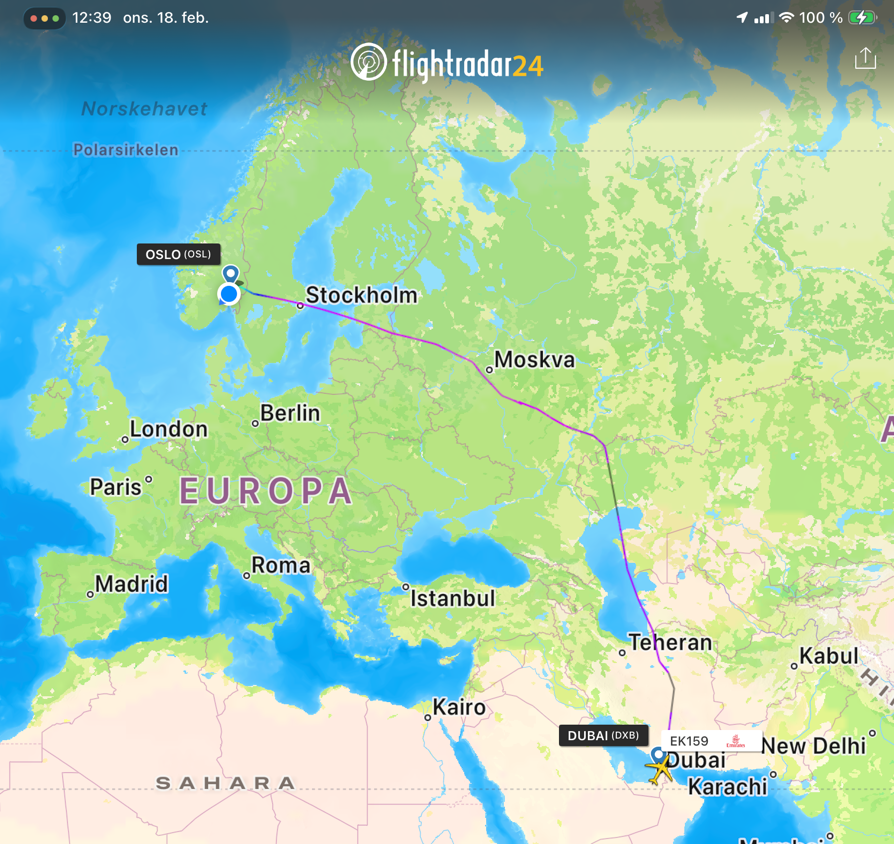
But a couple of weeks ago a retired airline pilot boarded an Emirates flight at Dubai, destination Oslo, Norway (EK159) and – not surprisingly given his professional history, he took an interest in his routeing. He was surprised to find himself flying through Iran, Western Turkmenistan, Western Kazakhstan, Russia and finally Estonia, before heading out over the Baltic Sea toward his destination.
Knowing there are efficient alternatives to that routeing, he was surprised that the crew flew a track that passed close to the south-west of Moscow. It was not the flight path he would have chosen for a flight under his command, because of the multitude of military conflicts currently affecting the Middle Eastern region, and particularly Iran and Russia.
Alternatively, for example, if the aircraft were to route from Dubai north-west up the Gulf, then fly through Iraq, Turkey, Romania, Poland and Sweden into Norway it could operate the whole time in conflict-free airspace. The advantage, however, for any airline willing to take a calculated risk, is to fly through the much less busy Iranian and Russian airspace. Routes skirting – but staying outside – Ukrainian and Russian airspace to the south and west are very busy indeed.
If you watch operations through CZIBs in the region, using Flightradar24, airlines that regularly fly through Iranian airspace include Emirates, Etihad, FlyDubai, and Turkish Airlines. Interestingly, the other big long-haul Gulf carrier, Qatar takes the routes that avoid Iranian airspace.
Russian airspace is used regularly by Emirates, by Russian domestic and government flights, and Chinese carriers like Air China and China Eastern.
How much of a risk is it to ignore CZIB warnings and fly through conflict zones?
Judge for yourself. Here are the accounts of three flights that ignored conflict zone warnings. All those on board died on two of the flights, and most of the passengers in the third. There are other such regular conflict zone events in different parts of the world, but these are the most relevant here:
17 July 2014. A Malaysia Airlines Boeing 777-200ER (MH17) was shot down and destroyed in Ukrainian airspace by a Russian Buk ground to air missile system fired from Ukrainian territory held by pro-Russia militias in the country’s eastern sector near the Russian border. All 298 people on board were killed. This was the result of a deliberately launched missile, but probably the militia who launched the missile did not know – and certainly did not care about – the identification of the flight that they shot down.
8 January 2020. A Ukraine International Airlines Boeing 737-800 was shot down by an Iranian military surface to air missile while climbing away from Imam Khomeini international airport, Teheran, Iran, bound for Kyiv, Ukraine. The shoot-down was probably the result of target misidentification by Iranian military during a nervous stand-off between Iran and American military in the area. All 176 people on board died.
There is a nervous stand-off between Iran and a major American military task force in the Gulf, Red Sea and Mediterranean right now.
25 December 2024. An Azerbaijan Airlines Embraer ERJ-190, flying en route from Baku, Azerbaijan to Grozny, Russia was hit and badly damaged by military action in airspace where there was active conflict between Russian and Ukrainian forces. Some 38 of the 67 people on board were killed when the damaged aircraft eventually crashed because the crew had practically no remaining control of the flight path.
There is another relevant local event, but it took place in airspace that had not been declared a Conflict Zone despite the fact that there was, as now, a stand-off between Iran and the American military.
3 July 1988. An Iran Air Airbus A300 operating a scheduled flight from Bandar Abbas to Dubai was shot down by a missile fired from American frigate the USS Vincennes, killing all 290 people on board. The crew of the Vincennes misidentified the flight as a hostile threat to a small task force of American frigates in the Gulf.
As evident from these events, conflict zone shoot-downs are almost always the result of misidentification. But the results are just as terminal.
After an apparently near-impeccable year for airline safety in 2017, the traditional accidents are returning. In the last week a Russian carrier has fatally lost a twinjet, and an Iranian airline a twin turboprop.
It would be closer to the truth to say these accidents – or at least the risk they represent – never went away, it’s just that a year is too short a time in which to measure the true safety performance of an industry.
The previous story in this blog sequence investigated the part that luck plays in airline safety, and it concluded that it still plays an unacceptably big part in an industry that confidently tells its passengers it has high standards.
The Russian loss involved a Saratov Airlines Antonov An-148 regional twinjet. It had taken off from Moscow Domodedovo airport in snow, bound eastward for Orsk, but after about 6min its climb became a rapid descent and it hit fields at high speed.
Early data from the investigation suggests the trigger for the fatal sequence of events was a disparity in airspeed indicator readings, probably caused by ice build-up in the external sensor because its heater had failed. The crew saw the disparity developing between the airspeed indicators and tripped out the autopilot, but failed in their attempts to fly the aircraft successfully relying on instruments that included misleading airspeed data.
Less detail is known about the Iran Aseman Airlines ATR72, but it was on a flight from Tehran to Yasouj among Iran’s south-western mountains. The destination is cradled in a valley, and the aircraft hit mountains about 30km north of the city in its early descent. The mountainous terrain was under complete cloud cover and snow.
The Saratov case provides more evidence of pilots’ unpreparedness for “limited panel” instrument flying. Air France 447 was the most famous example of pilot inability to cope with instrument flying when the airspeed sensors were temporarily compromised by ice, but the final report revealed that there had been six other recorded occasions in the same aircraft type (A330) where pilots had coped successfully with unreliable airspeed readings.
Airline recurrent trainers need to go back to basics with instrument flying, because it is increasingly clear many pilots all over the world are losing this crucial skill.
Loss of reliable airspeed information is unsettling, and it usually causes the autopilot to trip out, so airlines should ensure their pilots are able to cope with this situation.
In stable flight, whether level, climbing or descending, airspeed is a product of engine power and pitch attitude. All pilots with time on a particular type should know approximately what power will produce the performance they want.
So if they become aware that airspeed indications are compromised, it makes sense to adopt straight and level flight (if at a safe altitude) while sorting out a Plan B. That way the attitude is stable, and if the pilot selects the power setting that will produce a safe airspeed, all is well. However unsettling it is to see an airspeed reading that is clearly wrong, and which would be dangerous if true, it is a plain fact that the correct pitch attitude for S & L flight plus the correct power setting will produce the correct airspeed.
In the case of the Iran Aseman ATR72 the cause of the crash isn’t known yet, but there was no emergency call and that range of mountains contains many aircraft wrecks. If it turns out to be a classic case of CFIT (controlled flight into terrain), the issue will be one of three-dimensional navigation on instruments. Yes, such approaches are demanding, but these procedures should be the lifeblood of crews working for Iranian domestic carriers, for whom approaches into airports surrounded by mountains is their daily work.
These airlines – and others – have to ask themselves what is missing in their pilots’ skills, and why these skills are missing at all. Finally, they have to ask what they need to do to replace skills that have lapsed.
If the investigators’ final verdict is that pilot error was a factor in these accidents, the fault lies squarely with the carriers for failing to ensure, in their recurrent training regime, that their pilots have the living skills their passengers have a right to expect.
And again, if that verdict were to be delivered by the investigators, the airlines should worry about whether their existing crews could fail in the same way tomorrow.
 Learmount.com