Leonard’s War, episode 5: Learmount takes command of No. 22 Squadron

(For previous episodes, scroll down)

Learmount with one of No 22 Squadron’s FE2bs. It is not clear whether this photograph was taken at Bertangles, Chipilly, or Flez, but Bertangles seems unlikely because 22 was there in winter time.

In the middle of the snowy January of 1917, Leonard Learmount was promoted to Acting Major and given command of No 22 Squadron at Bertangles, about 5km north of Amiens. In his promotion from Lieutenant he had leapfrogged the substantive rank of Captain (he had been made an acting Captain during his immediately preceding command at 15 Reserve Squadron, Doncaster, a training unit, whence he travelled to France) and gone straight to Major. War seems to make military procedure much more flexible.

22 Sqn was equipped with FE.2b pusher biplanes – dubbed the “Fee” by its fliers and mechanics. The Squadron’s main roles when Learmount joined it were aerial photography over the German lines, and reconnaissance. In this vital role, which required steady, stable flying often at low level, it was vulnerable, so a pair of Sopwith Pup fighters were attached to the squadron to fly as escorts above the FE2b formations, able to intervene from above if German fighters attacked. At 27, Learmount was older than most of his fellow pilots, and equipped with all of 22 months’ experience of military aviation since his first flying lesson at Brooklands.

A farmer’s field near the River Somme, the former site of Chipilly aerodrome. The gentleness of the countryside and the beauty of the River Somme itself belies the horrors perpetrated here.

At the end of April 22 Sqn moved east about 20km from Bertangles to Chipilly, an aerodrome a few kilometres south of Albert and just to the north of the River Somme. During a few days sojourn there before moving further east to Flez, a new young American volunteer, AGJ (Archie) Whitehouse, who had just transferred from the army to 22 Squadron as an Air Gunner Second Class, brought to his first squadron a useful familiarity with firearms he had won both as a soldier and back at his childhood home in the USA. He was about to put that skill very successfully to use in the air, in charge of a Lewis light machine gun mounted above the front edge of his slipstream-blasted, canoe-like work-space in the nose of the Fee. His “foot-bath”, as he called it, was immediately forward of the pilot’s rather deeper cockpit.

About ten years later Whitehouse, who kept a diary at the front, was to publish a memoire of his time on No 22 Sqn called “Hell in the Heavens”. Some of the experiences recorded here are from Whitehouse’s book. While there is no reason to doubt his tales of squadron life, and the airborne experiences he describes, the precise chronology of events he records – including 22’s migration from one aerodrome to another from time to time – is not reliable.

The Fee itself was stable, reliable, could take a lot of damage and still fly, but rather slow. Its strong point was that the pilot and observer/gunner had a completely unobstructed view forward, laterally, above and below, which was excellent for 22 Sqn’s main roles – reconnaissance and aerial photography. In fact the Fee has – by a modern RFC historian – been dubbed the RFC’s MRCA (multi-role combat aircraft, the name given to the joint European strike aircraft project that ultimately became the Tornado). Also the field of fire from its two pivoted Lewis guns was excellent in all directions except in its blind spot directly behind and below the tail. The observer’s gun was on the forward lip of his “tub”. The other – on a higher mount just ahead of the pilot – could either be fired forward by the pilot, or used by the observer to fire backward over the upper wing. So the Fee, although not designed as a fighter, could defend itself.
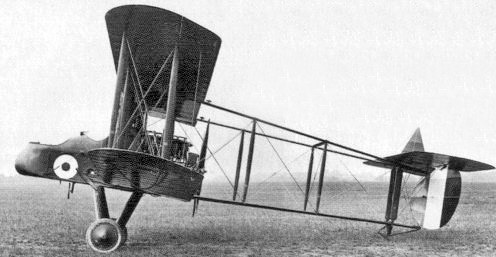
The FE2b “Fee”. This is shown without the guns on their mounts, but it clearly shows the Observer/Gunner’s shallow forward cockpit and the pilot’s deeper aft cockpit. Two Lewis guns were mounted on raised pivots, one on the front lip of the Gunner’s cockpit, the other – behind him on the front lip of the pilot’s station – could be fired forward by the pilot or rearward over the top wing by the Gunner.

The day Whitehouse reported to Chipilly, he describes himself walking between the mess huts and canvas Bessonneau hangars when he heard a wailing sound, looked up and saw the silver fuselage and tailplane of a No. 2 Squadron Nieuport Scout diving toward the ground, its wings torn away and flailing separately to earth. Nieuports were fast, nimble French single-seaters, but if a pilot pulled too hard the wings would come off, and this time they did. 

Unfamiliar with what he was witnessing, it took Whitehouse a moment to realise the Nieuport was coming straight at him, and he began to run for cover between the hangars. The wingless hull smashed into the hardened area just in front of them.  He must have dashed over, because he found himself pulling frantically at the fur coat containing the mangled corpse of the pilot, before somebody swore loudly at him and pulled him away.

They said the pilot was the CO of No 2 Squadron, which was co-located with No 22 at Chipilly, and speculated that he was showing his aircrew what the Nieuport could do. Whitehouse watched while a crew grabbed the corners of the fur coat and pulled the human remains clear of the wreckage so the squadron would have something to bury. Whitehouse himself was told to clear off, so he continued to the orderly room to report for duty.

Whitehouse had received no training for the air. He reported to stores and was issued with his sheepskin flying kit and goggles. An attempt by the stores team to wash away the blood of a former owner had not completely succeeded.  

As soon as the new gunner had carried the kit to his Nissen hut quarters, one of the flight commanders, a Canadian called Capt Carl Clement who was C Flight Commander, put his head around the door and told him to get kitted up for a sortie that would be ideal for “getting his air legs in”.

Whitehouse’s first experience of leaving the earth’s surface was to be on a post-maintenance engine test flight. Once airborne, Clement shouted at him to tell him that, on the way back, they’d pass over the aircraft-shaped practice target on the ground near the aerodrome perimeter so Whitehouse could fire the Lewis gun at it.

To direct the gun properly Whitehouse had to get on his feet, blasted by the slipstream from his knees upward. No harness, no parachute. Standing would enable him to pivot the Lewis gun widely on its mounting. He was understandably reluctant, so Clement reached forward over his cockpit coaming and yanked him by the collar to persuade him to get up. When he finally did, the Lewis gun became both his weapon and his support – the only thing he had to hold on to. “I realised how it feels to be standing on the edge of … nothing.” But then, when Clement dived steeply at the practice target, Whitehouse filled it with lead. Clement was impressed and told him so.

Tomorrow’s episode 6: Whitehouse logs more spectacular airborne time
Leonard’s War episode 4: mission training at Doncaster, and air support for the Somme offensive

(For previous episodes, scroll down)

On 8 May 1916 2nd Lieutenant Leonard Learmount was posted from No 7 Squadron at Baillieul, Northern France to No 15 (Reserve) Squadron at Doncaster, south Yorkshire, a training unit. At the same time he was promoted to Lieutenant, and on 17 May he was made a Flight Commander, rapidly followed on 15 July 1916 by being appointed Commanding Officer of the 15 (Reserve) depot.

As an illustration of how highly-prized even a small amount of operational flying experience was, this posting for Learmount took place less than a year since he had completed his basic flight training. He had flown just 11 months over the Western Front with No 7 Squadron, had survived the experience – which many hadn’t – and here he was, commanding a training unit himself.

In that role, his career path crossed that of one 2nd Lieutenant James Kerr, whose log book Learmount signed off on 22 July, the latter having trained on both the BE2c and the Armstrong Whitworth FK3 at the 15 (Reserve) Squadron training depot. Learmount’s rank, as signed in Kerr’s log book, was Captain (presumably acting or temporary), and a note accompanying Learmount’s signature stated that Kerr had been “posted overseas” on 24 July. That was, indeed, the date that Kerr arrived in France, at Saint-Omer, and by the end of that month he had been assigned to No 5 Squadron operating out of Droglandt, not far west of Ypres, flying the BE2c and d. So it is clear that No 15 (Reserve) Squadron was not a unit preparing pilots for 15 Squadron, it was just the 15th Reserve Squadron so far formed, and its task was to meet a need by any and all active units for improved flying skills in the new trainees arriving in France.

The task of No 15 (Reserve) Squadron seems to have been to take new pilots who had learned basic flying skills and prepare them for the tasks that they would face over the Western Front – mainly reconnaissance and navigation skills, but also surviving air-to-air combat. The last few entries in Kerr’s log book contained the information that he had looped the BE2c once and the FK3 twice, a marked contrast to Learmount’s experience level at the end of his training a year earlier. “Stunting”, however, was not a part of training, and it was generally frowned upon at that time.

Back in 1915, pilots had been given no preparation for the mission skills they would need on the front line until they arrived there. Indeed, in his log book on arrival on 7 Squadron in France, Learmount remarked – on one of five familiarisation sorties out of Saint-Omer – that he had navigated by compass for the first time, and flown above cloud also for the first time. These few trips were clearly his mission preparation, and the final (sixth) one recorded in his training log book was a 10min sortie over the aerodrome at 1,000ft flown “for the benefit of Indian cavalry”.

There was clearly a growing awareness in the RFC that the quality and and quantity of training provided to pilots was insufficient. Indeed, as related in Episode 1 of this series, in July 1916 Major Raymond Smith-Barry, who had noted the low quality of trainees arriving for duty, had begun the process of compiling the RFC’s first formal flying training syllabus, but it had not yet been published and would first see the light of day in December 1916. Smith-Barry believed in the need to train military pilots to fly their aircraft to their limits, and to recover successfully if they exceeded them, rather than simply to get airborne and fly cautiously. As air-to-air combat was becoming increasingly routine, timid flying was no longer an option.

Learmount’s arrival at Doncaster in early May 1916 preceded – by a few weeks – the beginning of the massive and deadly Somme offensive by the British army 4th Corps, allied with Canadian and Australian troops. The artillery fired up early on the morning of 1st July. So supporting this push by maintaining air superiority above it was to be the task of many of the brand new pilots and observers that Learmount was preparing at Doncaster.

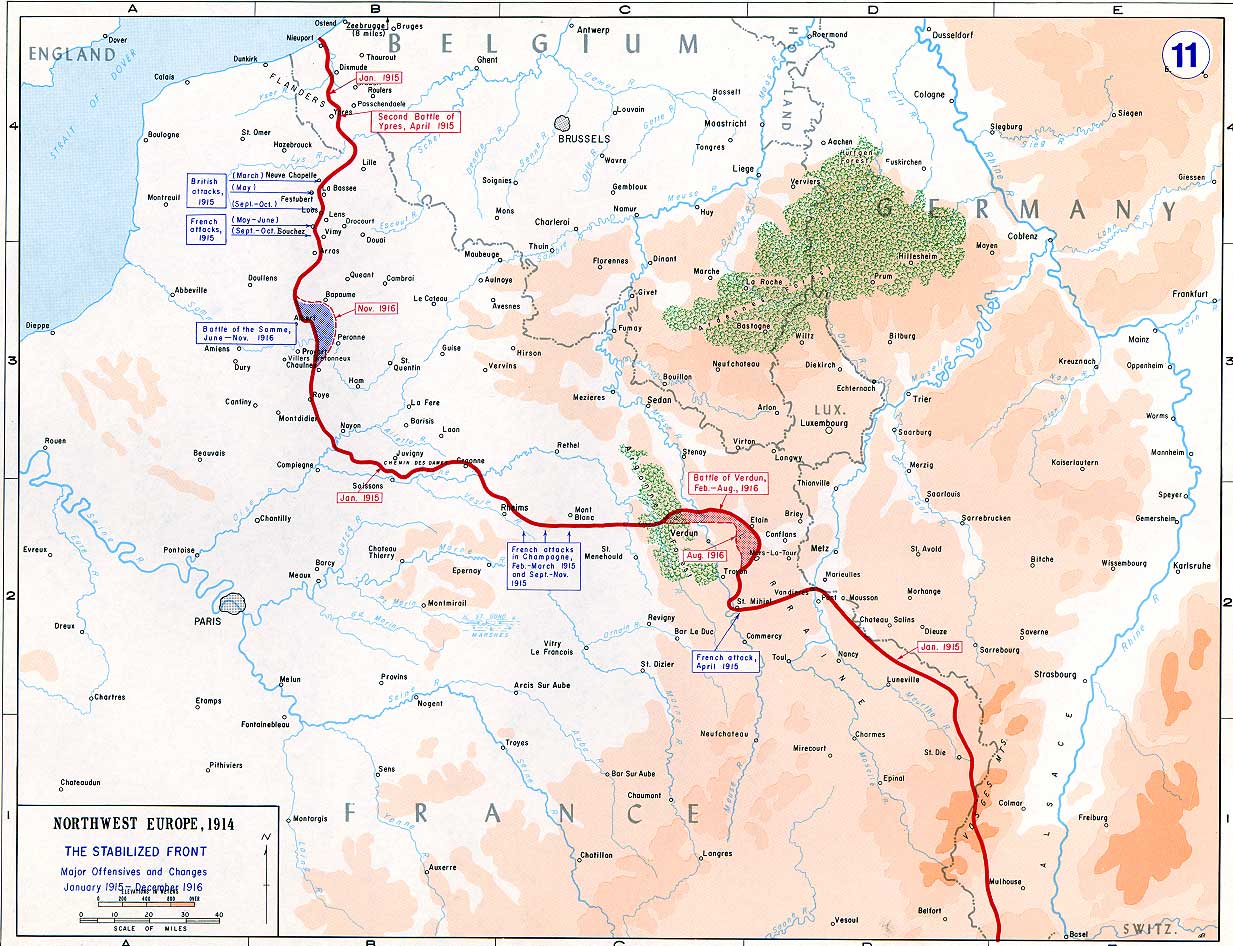
A general view of the Western Front 1915-16, with battle locations indicated

The priority in advance of the Somme push, was to get photographs and intelligence about the enemy’s movements, supply routes and defensive lines (trenches). The BE2c two-seater “tractor” biplane – one of the types in use for instruction at No 15 (Reserve) Squadron at that time, was a machine well-suited to the reconnaissance task, but not much more than that.

BE2c (Imperial War Museum)

In June and July – operating out of airfields in the vicinity of Arras – the BE2c for was mostly used for reconnaissance and as a light bomber, although it could be fitted with underwing-mounted rockets for attacking balloons. And unlike its unarmed BE pure reconnaissance predecessors, the BE2c observer/gunner was given a pivot-mounted Lewis gun, but more for self-defence than attack. Some BE2cs were given two Lewis guns. Unfortunately, because the observer’s cockpit was forward of the pilot’s, he was positioned more or less in line with the leading edges of the wings, which limited his field of fire considerably, with the propeller just ahead and the struts either side. The trailing edge of the upper wing, however, was cut away at its centre, allowing fire upwards, which was useful for attacking balloons.

Part of the Allied strategy leading up to the Somme push was to make good use of the RFC’s sheer numbers – far in excess of the numbers of aircraft available to the Germans – so they could keep control of the air above the battlefield. The combined aircraft fleets of the Allies exceeded significantly the numbers of German aircraft, even if their effectiveness didn’t match that of the newer German machines like the Fokker Eindecker. Often the BE2s were protected by a pair of Bristol Scouts which could escort them in their reconnaissance role.

In the last days of the Somme offensive, a BE2c (from 15 Sqn as it happened), was hit in combat with five Albatros Ds. The pilot, 2nd Lt JC Lees and observer Lt TH Clarke, were both wounded. The pilot brought the stricken aircraft to a crash landing in enemy territory near Miraumont where the two were taken prisoners of war. The German troops who attended the downed aircraft expressed disbelief that the British were still using such an old-fashioned machine. In fact they referred disparagingly to the aircraft as “kaltes Fleische” (cold meat). Over the five-month offensive from July to November the RFC lost 600 aircraft and 252 crew.

Meanwhile propaganda, normally perceived as information disseminated by the enemy, is a two-way art. Of course the RFC had to generate its own. It seems Britain’s political leaders wanted the people at home to be told about “our boys defending our skies”, because Zeppelins were now succeeding in bombing civilian targets in British cities – a development that had deeply shocked the public.

At about this time – although it was probably somewhat earlier in 2016 – Learmount was clearly chosen as the “right stuff” to provide the British people with a word-picture of what it was like to be an RFC pilot. So he duly wrote a story, published in the Daily Mirror, headlined “Mr Learmount at the Front – Experiences in the Royal Flying Corps”, claiming to be “extracts from a letter received from Lieut LW Learmount of the Royal Flying Corps from ‘Somewhere in France’”. When interpreted in the light of history, this “letter” seems to contain a compendium of experiences over quite a wide period. The newspaper cutting kept by Learmount’s family is not marked with its date, so the period of operations described in the article cannot be precisely identified.

Press cutting from the Daily Mirror in Autumn 1916, from Learmount’s family records

This is what the “letter” says:

“We are having a very strenuous time here. I suppose I put in about 5 hours every day. Not all of it is over the enemy’s lines, of course. A new duty is patrolling the town where we are stationed, as some time ago a few Huns came over and dropped bombs on us and were off again before we could get up to them, so we go up every morning and cruise around at about 10,000ft so that should any more of them venture an attack we are prepared for them.

“I had a most exciting time the other day. I was going to Ostend and just after crossing the Lines a German machine came up and attacked us with a machine gun. We soon brought ours into play, but owing to his vastly superior speed we were not altogether having things all our own way, when a little British Scout which had been patrolling somewhere near us [probably a fighter escort for the reconnaissance type] dropped from the skies and opened fire and, between us, we downed the Hun pretty successfully.

“After this we went on with our reconnaissance and on the way back we met another Hun, but on this occasion we managed to do him in ourselves, and proceeded gaily on our way, somewhat badly damaged it is true, but still we got home all right.

“These air duels are very thrilling, the sky is thick with bursting shells [“Archie”- or anti-aircraft fire] and amidst the roar of our machine guns you can hear the zip of the Hun’s bullets when they get pretty close, and all the time the two machines are circling about, dropping and climbing, each trying to get the other at a disadvantage.

“Aerial warfare becomes more and more like a sea fight as machines are improved, but unfortunately the Huns have usually got better machines than we have. I have so far flown a rather an antiquated type, a French make, but am now the proud possessor of the very latest British machine, a real beauty [BE2c?]

“We have got a most splendid lot of fellows in the RFC, and I am serenely happy among them, although I get depressed at times the way one after another of them disappears. It is so rotten to see a vacant chair at the Mess table every now and then, and to have to go and pack up some unfortunate chap’s belongings is positively horrible. It make one sick at heart to witness the slaughter, for it amounts to nothing less, of all these fine men.”

Tomorrow, Episode 5: Learmount is promoted from Captain to Acting Major, and given command of No. 22 Squadron at Bertangles, near Amiens, equipped with FE2b two-seater pushers, and gets increasingly involved in aerial photography over the heavily fortified German Hindenberg Line.

Leonard’s War episode 2: Fight and flight over Flanders

(If you missed the first episode, scroll down to find it before this one)

It was on 12 June 1915 – almost the height of summer – that 2nd Lieutenant Leonard Learmount joined his first operational unit – No 7 Squadron – at Saint-Omer aerodrome, north-eastern France. His flying log book records the weather as almost perfect for flying a wood-and-fabric aeroplane: clear with a 10mph easterly breeze.

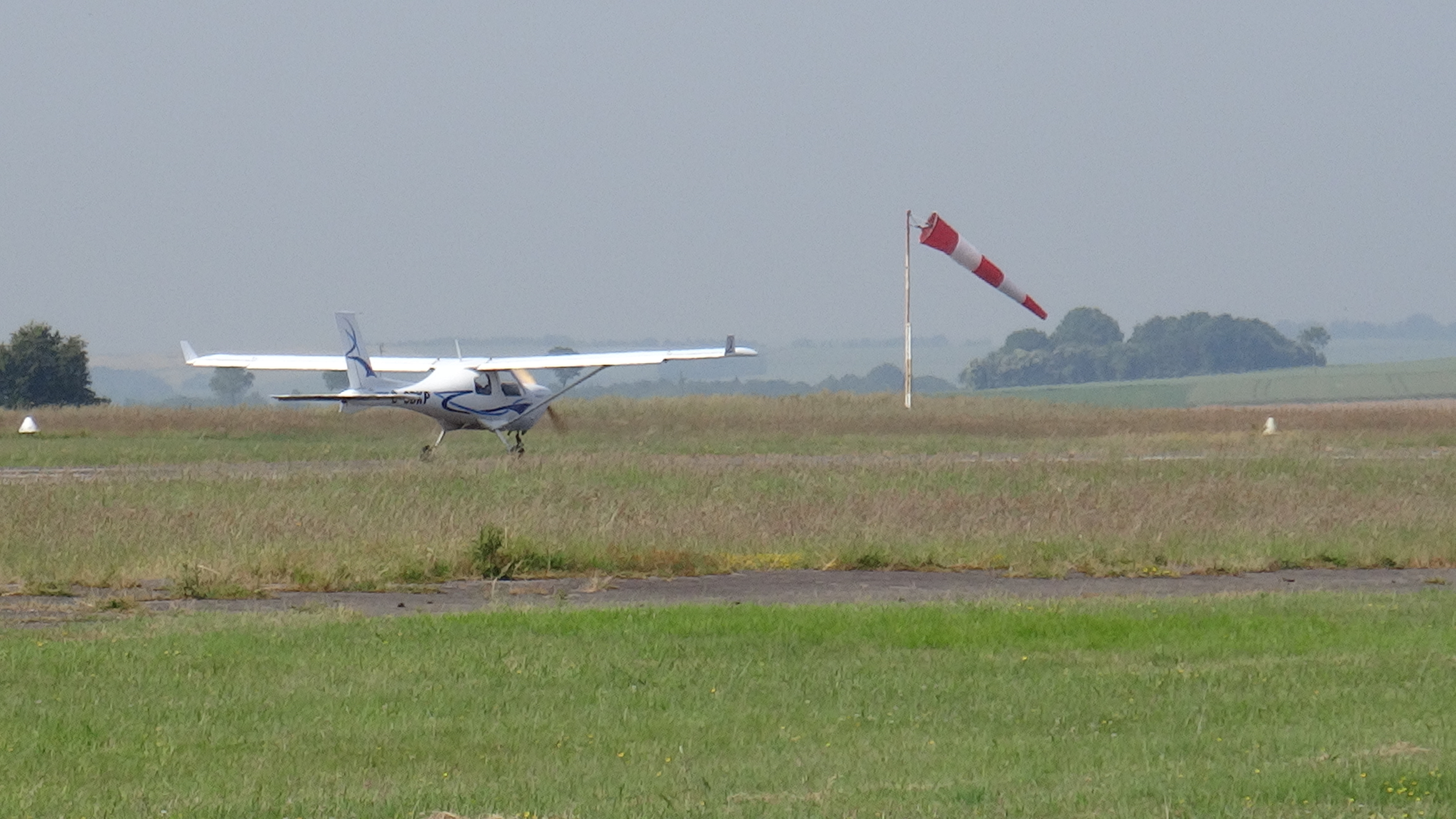
Saint Omer aerodrome 12 June 2015, exactly a century after Learmount’s arrival there. Even the weather was identical, with an easterly breeze. It still operates as the home of the Aéro Club de Saint-Omer, and one of its aircraft is backtracking for take-off from the runway’s other end.

There is no evidence that Learmount was given an aeroplane to ferry across La Manche to Saint-Omer, so we must assume that – like most men posted to France – he caught the sea shuttle from Southampton to Le Havre and took a boat up the River Seine to Rouen, thence by road to his destination.

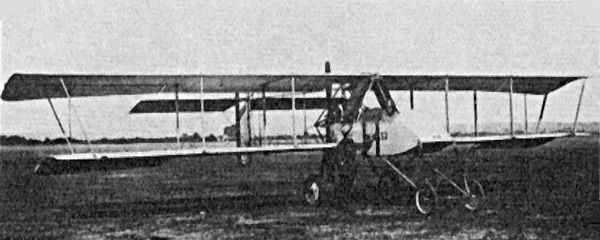
Learmount’s flying log book shows that four short trips out of Saint-Omer aerodrome on a new aircraft type were deemed sufficient for him to master its peculiarities and to complete local area familiarisation sorties. The machine he was learning to control was the French-built two-seater Voisin “pusher” biplane [engine and propeller behind the cockpit].

His first sortie consisted of 20min flying circuits, but the second trip was a brief affair lasting 10min. His log book explains: “During spirals, five ribs collapsed. Landed safely.” The instructor had taken control and put the aircraft down without delay.

The Voisin, a French two-seater pusher biplane also used by the RFC

“Spirals” were climbing or descending turns, and if the aircraft was not kept in balance by a careful combination of aileron, rudder and elevator, a spin could develop. The Voisin had a level airspeed of about 65mph, but that was only about 40mph above its stalling speed. The evidence suggests that, before the need for a formal flying training syllabus was recognised in 1916, military aviation was seen simply as a means of putting eyes in the sky for the army, and – especially at first – there was no preparation for air-to-air combat. The pilots were just seen as drivers, their task being to fly cautiously and avoid loss-of-control so as to bring their observers home safely to pass on their vital reconnaissance information.

After his final familiarisation sortie, Learmount wrote in his log book: “Above clouds, steered by compass.” He had clearly experienced neither of those things before, yet he was deemed ready for command of a two-seater aircraft operating in hostile skies above the battlefield.

The very first RFC air-to-air combat losses were reported in early June 1915. Indeed a 7 Sqn RE5 was “shot-up” and damaged at 7,000ft over Douai/Valenciennes on 6 June, and on 6 July 2nd Lieutenants LW Yule (pilot) and RH Peck (observer) in a Voisin were both wounded by “exploding cartridges” at 7,000ft near Armentiéres. Both crews successfully recovered to Saint-Omer. (Combat detail from Trevor Henshaw’s admirable “The Sky Their Battlefield”)

Air warfare tactics in that precise location not far east of Ypres were evolving, but were about to start developing at breakneck speed. Air-to-air combat was still very rare, many of the crews armed only with rifles and revolvers, and the primary mission was still reconnaissance and artillery spotting.

In Learmount’s early operational flying with 7 Sqn, he flew the painfully slow Voisin first out of Saint-Omer, and then from other aerodromes further east in the “Ypres Salient” region of Flanders, among them Droglandt. At first, he was purely carrying out reconnaissance and artillery-spotting for the army, but the Voisin was equipped with a Lewis light machine gun, so it was capable of defending itself.

Flying with Learmount on his first operational sortie in command – on 19 June 1915 – was his observer/gunner, the same 2nd Lieutenant Peck just mentioned earlier. Indeed Peck almost certainly directed his rookie commander’s sortie! His handwritten reconnaissance report (see below) records the aircraft’s take-off from Saint-Omer at dawn (04:30), and describes observed activity behind enemy lines between Courtrai and Ghent, Flanders. The pencilled words, inscribed carefully by cold hands, provide details of train and other surface transport movements, assemblies of troops and equipment and estimated numbers. The aircraft landed at 07:45am, so they had been airborne for 3h 15min.

Copy of the 19 June 1915 reconnaissance report, filed from Learmount’s first operational flight. (National Records Office)

On the ground, beneath 7 Sqn’s patrolling aircraft, a fierce German offensive was raging against the British forces holding Ypres. The airmen, pre-briefed on what the army wanted them to look out for, provided their recce reports direct to specific units on the ground. The German offensive was eventually stalled, but at huge cost to both sides.

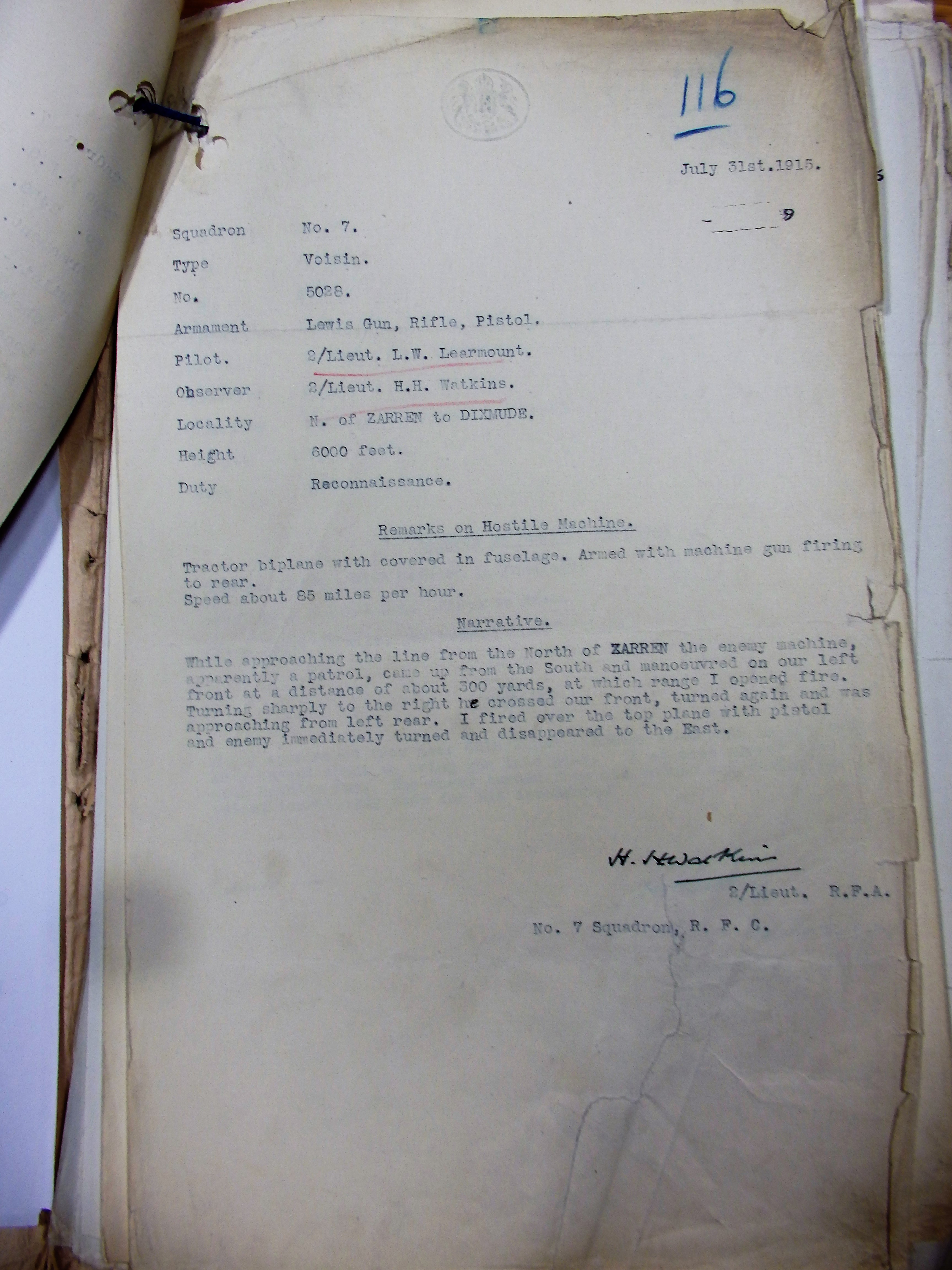
In a 31 July 1915 combat report filed by Learmount’s observer/gunner describing an inconclusive encounter with an enemy biplane, the Voisin crew’s armament was recorded as: “Lewis gun, rifle and pistol”. The observer, 2nd Lieutenant HH Watkins, initiated the hostile exchange with his Lewis gun, but the German machine positioned itself behind the RFC aircraft. Watkins reports: “I fired over the top plane with the pistol, and the enemy immediately turned and disappeared to the east.” The German aircraft was not identified by type, but was described thus: “Tractor biplane with covered-in fuselage. Machine gun firing to rear. Speed about 85mph.” This kind of encounter was common at that stage of the war, but exchanges quickly became more dramatic as Germany started to field armed fighters.

(National Records Office)

Meanwhile 7 Sqn aircraft were increasingly often engaged in air-to-air exchanges and, with the arrival of August, the “Fokker scourge” began to take its toll of RFC aircraft and crews. The Fokker Eindecker was, as its name implies, a monoplane, and it was a “tractor” (engine and propeller at the front), not a “pusher”. It was the first aircraft on either side to be armed with a forward-firing machine gun equipped with interrupter gear to enable it to fire ahead through the propeller. This made it a game-changer, and accelerated the development of air combat tactics.

The Eindecker’s armament might have caused far more problems than it did, but fortunately for the RFC the aircraft had an unreliable engine, and was difficult to fly, causing many training crashes. Thus only a small number were effectively deployable on a daily basis at front-line units. In fact it was so difficult to manage that the Germans took the Eindecker out of service in early September, but such was its known effectiveness in capable hands that it was declared operational again a few weeks later.

And the RFC’s airborne operations were becoming more varied. By early autumn, bombing sorties were more regularly executed – including against German aerodromes. For example a handwritten, undated operation order held by the UK National Records Office tasked five 7 Sqn pilots – including Learmount – with carrying out two bombing raids on Gits aerodrome in Flanders, near the Gits railway station just east of the Torhout-Roulers road. The first was to be at 7am, the second at 2pm to disrupt attempts at repair. Each aircraft normally carried two or three 20-pound bombs.

http://www.greatwar.co.uk

There was a difference between the overall aviation strategies of the Allies and Germany. Germany frequently had technology and performance advantages, but they had a significantly smaller aircraft fleet and knew it. The RFC leadership, notably the general commander of the RFC in France Colonel Hugh Trenchard, wanted the RFC crews to fly aggressively – whether trained for combat manoeuvres or not – and venture every mission into airspace over the German lines to gain intelligence and disrupt operations. The Germans, on the other hand, would work to limit their own losses by staying defensively over their lines, except for making brief, organised formation attacks to the west of the Front.

When the Battle of Loos began on 25 September 1915, No. 7 Sqn was flying out of Droglandt, 20km west of Ypres in Flanders, heavily involved in providing air support, bombing and reconnaissance for the allied troops, operating a mix of BE2c and RE5 aircraft. The Battle of Loos was a British offensive on the Western Front close to Lille, not far north of Arras which included the first British use of chlorine gas on the ground. But by 8 October the push came to a standstill against staunch German defences.

The original site of Droglandt aerodrome is in the farmer’s field to the right of the telegraph poles

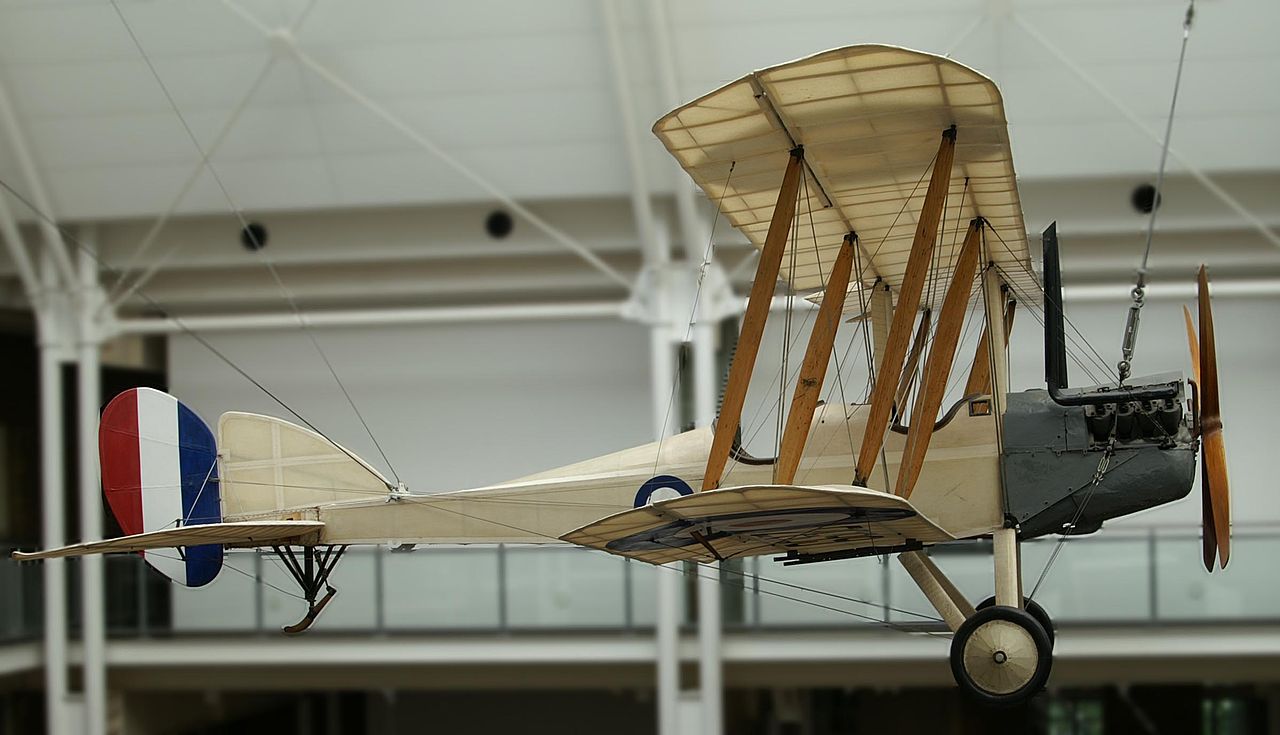
Learmount himself was now mostly flying the BE2c out of Droglandt. The BE2 series had originally been designed – in 1912 – as a very stable, unarmed reconnaissance machine, and that was fine until the Germans introduced well-armed aircraft like the Fokker Eindecker. The Allies didn’t have an answer to the latter’s capabilities until early 1916, so the BE2c’s previously desirable stability made it a sitting duck (more about this in future episodes). Many were shot down but – fortunately – because they were such stable machines to handle, the crews were often able to control the damaged machine to a forced landing.

Royal Aircraft Factory BE2c at the Imperial War Museum

So many BE2cs had been built, however, that they continued to be used for reconnaissance and bombing into 1917, and crews began to dread being assigned to them.  

Meanwhile Learmount was recommended for a Military Cross. The citation lauded his general performance since joining 7 Sqn in June, but it described a specific action on the second day of the Battle of Loos: “Consistent good work, done most gallantly and conscientiously from 13.6.15 to present time. This Officer bombed and hit one half of a train on 26.9.15, coming down to 500ft immediately after Lieut DAC Symington had bombed the other half.” The train was on the Lille-Valencienne line, and Symington had achieved a direct hit on it close to its front, bringing the whole train to a halt. Just after that, Learmount dropped a 100lb bomb that made a direct hit on one of the coaches in the train’s centre.

The point about coming down to 500ft or less is that it puts the aircraft within easy range of machine gun fire, and trains were almost always armed.

Tomorrow: Episode 3, Learmount is seconded to the French Armée de l’Air to report on their development of night bombing techniques