Boeing 737: the beginning of the end.

It hasn’t surprised anyone in the industry to hear rumours – via the pages of the Wall Street Journal – that Boeing is working on the design of a new narrowbody jet, because it’s what everyone – including Boeing – knows the manufacturer should have done instead of launching the 737 Max.

The confidence in that statement is completely un-influenced by hindsight.

Now the Max has been purged of the ghastly design mistake that was MCAS (manoeuvring characteristics augmentation system), and Boeing has radically overhauled its corporate safety culture under a new leader – former Rockwell Collins engineer CEO Kelly Ortberg – the 737 series can once again trade on the lazy confidence that comes from the fact that – with all its faults and its antique technology – it’s a known quantity.

As a result the 737 is selling well, but nothing like as well as its competitor the Airbus A320 series.

The first 737-100 entered service in 1968, initially to fly the routes that the larger 727 series trijet was too big for. Its basic control technology was – and still is – just-post-war, except that in the latest versions the power-assisted cranks and pulleys are overlaid with electronic flight instrument systems and flight management computers to the extent that the pilots could almost believe the aircraft is fly-by-wire. They know, however, that they themselves are the flight envelope protection.

The industry needs a new-technology narrowbody competitor to the A320, and if Boeing doesn’t supply it, perhaps a development of China’s Comac C919, Russia’s Sukhoi Superjet 100, or a new product from Brazil’s Embraer will fill the gap.

Boeing’s first fly-by-wire airliner was its highly successful 777 widebody, which entered service in 1995 with virtually no birthing pains.

In 2011 it launched the 787 Dreamliner series, also highly commercially successful, but suffering from multiple early problems, some of them still being worked on.

Right now Boeing is struggling to re-launch the 777 as the 777X. The fact that it had a planned 2019 in-service date, but now its launch customer – Lufthansa – will not receive it until 2026, suggests how difficult a task bringing an entirely new narrowbody (the 797?) to service readiness may yet be.

The challenge is always to deliver a safe, trouble-free product, but the staggeringly advanced, fully-integrated electronic technology by which the aircraft and all its systems will be managed and controlled, plus the fact that there must be fallback systems that the pilots can access easily if it all goes wrong, mean its service entry will not be quick.

Look beyond this to the fact that the new systems will inevitably employ artificial intelligence, which makes passengers – and even engineers – nervous when it comes to managing safety-critical systems, and the size of the challenge becomes clear.

So the venerable 737 series will be with us for many years yet.

Ladies and gentlemen, your pilot is unconscious

An official incident report has confirmed that a Lufthansa Airbus A321 flight from Frankfurt, Germany to Seville, Spain on 17 February last year flew for 10min without any pilot supervision because the copilot, alone on the flight deck at the time, suffered a “sudden and severe incapacitation” which was defined in the report as a “seizure”.

An experience of my own many years ago was strikingly similar to this, so we will return to that subject in a moment after examining the events on Lufthansa’s Frankfurt – Seville flight last year.

Once Flight LH77X was established in the cruise over northern Spain at flight level 350 (35,000ft), carrying six crew and 199 passengers, the captain discussed pertinent weather conditions on the route with the copilot, who was the pilot flying, and then left the flight deck for a toilet break at 10:31:00 (UTC). Exactly 36 seconds after the captain had left the flight deck, the copilot suffered an epilepsy-like seizure, according to the Spanish accident investigation authority CIAIAC.

There was no immediate indication to the absent captain that anything was wrong, because the autopilot and autothrust remained engaged, despite some inadvertent switch selections by the copilot, and the fact that his right foot was pressing the rudder pedal hard – but fortunately not hard enough to cause the autopilot to trip out.

Meanwhile the sector controller for Spain’s Pau ATC region attempted three times to establish radio contact with LH77X, but received no reply.

At 10:39:00 the captain was ready to return to the flight deck, and he attempted a standard entry procedure, but there was no response from the copilot who would have had to approve it. After three further attempts he decided to employ the flight deck emergency access code, but while he was doing that the copilot, “pale, sweating and moving strangely”, opened the door from the inside.

The captain took control of the aircraft at 10:42:00, and at his request the cabin crew helped the copilot into the forward galley area, administered first aid, and obtained the help of a doctor from among the passengers. Meanwhile the captain decided to divert the aircraft to Madrid, the nearest airport, rather than continuing to Seville. The A321 landed safely and the copilot was taken to hospital, but released after examination.

The CIAIAC report quotes the definition of a “seizure” under these circumstances as “an abnormal paroxysmal excessive discharge of cerebral cortical neurons”. The copilot had no medical record of any such event previously, and said he had not experienced anything like it before. The medical judgement as reported by the CIAIAC is that, even had the copilot been tested specifically for such a condition, it would not have been detectable unless he had suffered a seizure in the presence of a medical observer.

The report’s main recommendation for the future is that, any time one of the pilots has to leave the flight deck, a member of the cabin crew should join the remaining pilot in the cockpit until the absent pilot returns. This is actually a previously established procedure which had fallen into disuse simply because incapacitation is so rare. But if it had been applied in this case, the cabin crew would have been able to alert the captain immediately about the copilot’s condition, and help him re-enter the flight deck quickly.

Meanwhile here is an account of my personal experience of airborne seizure – and precursors to it – that is highly relevant to cases like this one.

During my time as a qualified flying instructor (QFI) in the RAF I had gradually developed a condition which caused me to suffer minor seizures which, at the time, I did not recognise. They just felt like momentary mental “absences” that I attributed – for example – to having had a few drinks too many in the Officers Mess the night before. At the time I was in my late 20s, and had been flying pressurized jets and turboprops for eight years,

But my wife noticed these “absences”, and reported them to an RAF doctor who then approached me about them. I dismissed the matter as unimportant, and he did not pursue the issue further.

I recall having an “absence” while on short final approach to land a Jet Provost, solo, at RAF Linton on Ouse. I can’t actually remember the touchdown itself, but can remember rolling out at the end of the runway and turning onto a taxiway back to the pan, by which time I felt fine. But the thought of this event – now that I know more about my condition at that time – chills me.

Some months later I suffered a fully-fledged seizure during my sleep, and my wife called the doctor, who attended immediately. When I awoke I felt as if I had been beaten up.

I was taken to an RAF hospital and tested via electro encephalograph (ECG), and underwent brain scans. The diagnosis – given the evidence of the seizure – was that I was “probably” prone to epilepsy, but the condition was defined as “idiopathic”, meaning there was no medically detectable sign of it.

Continuing to fly professionally after that was not an option, so I left the RAF and became an aviation journalist.

At the time I believed my symptoms might have been caused by an sudden and unexpected application of quite high negative G during a practice aerobatic sequence flown by one of my student pilots. But the medics could find no sign of brain damage.

Over the decades since that time, in my job as an aviation journalist, I learned about “Aerotoxic Syndrome”, the name given to a condition caused by damage to the brain and nervous system by neurotoxic chemicals from aero engine lubricants and hydraulic fluids. High doses, gained via a “fume event” in the cockpit or cabin, can cause instant cognitive problems, although these may fade with time. But in other individuals, regular exposure to low doses of neurotoxins over a long time can gradually build up in the body, degrading the nervous systems of pilots and cabin crew.

These organophosphate chemicals, containing known neurotoxins, are delivered to the cockpit and cabin by aircraft air conditioning and pressurization systems, where the air is sourced directly from jet or turboprop engine compressors. Engine oil seals constantly leak fluid at low levels, so when the highly compressed – and therefore hot – air is delivered to the air conditioning system, it contains pyrolized neurotoxic aerosols. This is the air that the crew breathe.

In some individuals, that constant low-level poisoning builds up in their system until it causes visible symptoms of neurological damage. In other individuals, their systems gradually purge the chemicals, making symptoms last only a short time. But so far there is no way of knowing in advance which kind of system individual aircrew have.

In my case, today I no longer have even slight seizures, neither do I have to take any medication which, for more than 25 years, I had to do constantly to keep the symptoms at bay. Neurologists say, nonetheless, that they cannot declare me free of epilepsy or related neurological conditions because they still do not know enough about the subject to be certain. I suspect what has happened is that, since I left the RAF, I fly only occasionally, so my system has had time to purge itself of the neurotoxins that regular flying delivered to me.

I wish the Lufthansa copilot of flight LH77X on 17 February 2024 well, and hope he gets all the support he needs to continue his career, if that is deemed possible.

Meanwhile for him, and all those who want to know more about Aerotoxic Syndrome, FlightGlobal has a useful account here.

Germany studies air navigation fundamentals

Germany’s aviation agency DLR is using a non-stop flight from Hamburg to the Falkland Islands in the far South Atlantic ocean to study the earth’s magnetic field, a navigational resource for aviation and migrating birds alike.

The same flight, operated by Lufthansa using one of its Airbus A350-900s (D-AIXQ), is enabling a crew rotation for scientists working in Antarctic waters in the German research vessel Polarstern.

Lufthansa Airbus A350-900 D-AIXQ is preparing to carry scientists to the South Atlantic

On 30 March Lufthansa’s A350 departs for this, its second non-stop flight on this route, chartered by the Alfred Wegener Institute, Helmholtz Centre for Polar and Marine Research (AWI) in Bremerhaven. The first such trip, which took place in February, was the longest non-stop flight a Lufthansa aircraft had ever made – more than 13,000km, with a duration of more than 15h.

This time, the A350 will also be carrying scientists from the German Aerospace Center (Deutschen Zentrums für Luft und Raumfahrt) who will be collecting measurement data to provide further insights on the influence of the Earth’s magnetic field as it affects aviation.

The surface location of the North Magnetic Pole, located at present among the far north-eastern Canadian islands near northern Greenland, is continuing to migrate in the direction of Russian Arctic waters at a faster rate than a few decades ago.

At this rate the magnetic North Pole is expected to pass the geographic North Pole moving in the direction of northern Russia in the next few years. The full significance of this increased rate of changing polarity is not understood, but the earth is – according to scientists – overdue for a polar reversal of its magnetic field. The last polar reversal is believed to have occurred about 750,000 years ago, and although the potential consequences for earth-dwellers are not fully understood, they are believed to be significant – and not only for air navigation.

In fact navigation would be the least of the problems mankind is likely to face. Marine navigation has been based on True North since the early 1970s. Aviation has had the capability to change, but is still plodding on with navigation referenced to the magnetic poles because the industry is reluctant to incur some modest, one-off costs in making the changeover.

“With the second flight to the Falkland Islands, we are not only pleased  to be able to support the AWI’s polar research expedition, but also to make an important contribution to further research into the Earth’s magnetic field,” says Thomas Jahn, Fleet Captain and Falklands Project Manager. “We have already been supporting climate research projects for more than 25 years now.”

The main reason for this second flight to the Falklands is to rotate the Polarstern crew and to pick up the research expedition team. Since the beginning of February, a team of about 50 researchers have been collecting important data on ocean currents, sea ice and the carbon cycle in the Southern Ocean, which, among other things, enable reliable climate predictions.

On 2 April, using flight number LH2575, Lufthansa’s A350 will be bringing AWI’s international research team and the DLR scientists back to Germany. The landing is scheduled for 3:00 p.m. on 3 April at Munich Airport.

Lufthansa’s longest legs

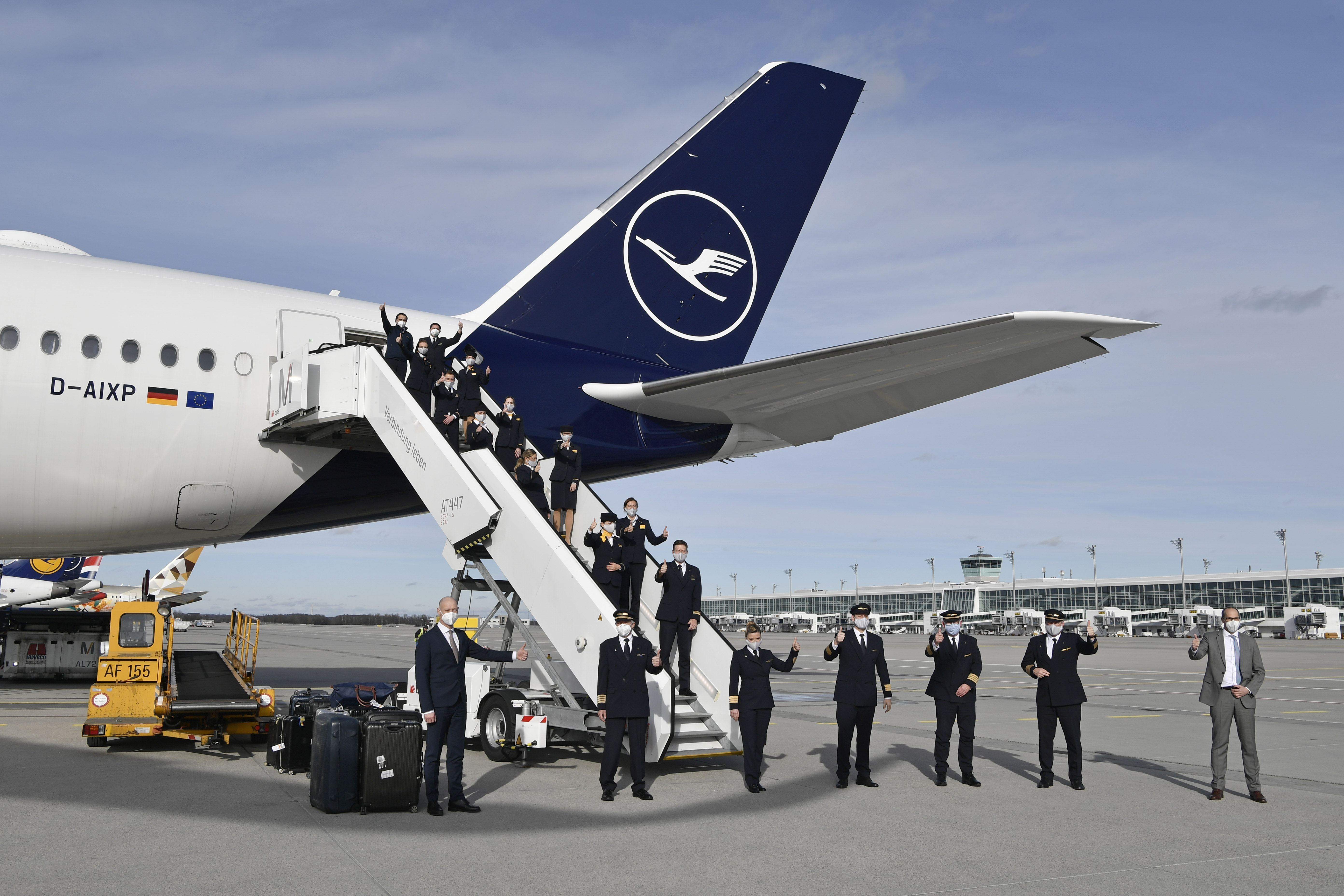
Munich airport has just welcomed a Lufthansa Airbus A350-900 crew from the longest non-stop flight the airline has ever made. The trip also entailed the longest crew-duty period in living memory for the pilots and cabin crew.

On Sunday 31 January the crew of 16 – commanded by Captain Rolf Uzat – took off from Hamburg bound for the Mount Pleasant military airfield on the Falkland Islands. The A350-900 (D-AIXP) covered the 7,392nm (13,700km) distance in 15h 26min.

The 7,230nm return flight on 4 February took 14h 03min, an all-time long-distance record for an incoming flight to Munich airport.

Each of these airborne legs involves formidable crew duty periods, but because of Covid-19 the crew and passengers for this special flight also had to quarantine for two weeks in a Bremerhaven hotel before departure, making the total duty time for the return trip a full 20 days.

The 40 passengers flown from Mount Pleasant to Munich were the crew of the research vessel “Polarstern”, working for the Alfred Wegener Institute’s Helmholtz Centre for Polar and Marine Research (AWI) in Bremerhaven.

Munich welcomes the crew from their record-breaking flights

Unmanned cargo aircraft “on the way”

A recent statement by the National Aeronautical Centre says this: “The operation of unmanned cargo aircraft (UCA) moved closer to reality as delegates from the aerospace and logistics industry met recently to discuss the way forward.”

Where did this come from?

“The unique initiative, organised by the National Aeronautical Centre, West Wales Airport, took place at the Lancaster Hotel in London, in the form of a round-table discussion.  It was a world first event and an important step on a road that will lead to unmanned cargo aircraft being used throughout the global logistics chain.”

It’s true that, for years, the industry has been talking about the practicality of freight aircraft being operated pilotlessly, on the grounds that the technology to do it exists, and unlike pilotless passenger airliners, the public wouldn’t care.

This group discussion reportedly included Thales, BAE Systems, Leonardo Finmeccanica, Avio Aero, IATA, Lufthansa, Heathrow cargo “and other airline representation”,  and the agenda included “a wide range of potential UCA operations from intercontinental air freighters to local deliveries by small drones.”

Ray Mann, Managing Director of West Wales Airport, said, “The past 20 years has seen the evolution of unmanned aircraft and although initially developed for military operations, they have demonstrated the means of having far greater potential for all sorts of civilian use. As UCA can be constructed in any size and shape depending on the task required, this first round-table discussion has been invaluable for both industries to understand how they can best respond to this growing demand.”

Global Head of Cargo at IATA Glyn Hughes commented that – while it looks like a great opportunity:  “For the full economic and social benefits of commercial drone technology to be realized the groundwork needs to be done now to ensure their safe integration with existing air traffic and infrastructure.”

The latter will not be a rapid process.

My personal guess is that, for large freighters, single-pilot operations will precede zero-pilot ops.

That idea could really be very close, because the aircraft can be fitted with a system that enables remote piloting of the aircraft in the event of the onboard pilot becoming incapacitated or needing help.

And as the NAC says: “The initiative is set to continue with further meetings planned in the coming months.”