Flying through dangerous airspace

Emirates flies an Airbus A380 schedule from Dubai to Moscow, the route normally used passing through Iranian and Russian airspace that is subject to European Union Aviation Safety Agency Conflict Zone Information Bulletins, a form of advice backed by the International Civil Aviation Organisation.

The CZIB is not legally enforceable for Emirates, and anyone boarding the flight in Dubai has, presumably, made a choice to fly there, whether they know the risks or not.

But a couple of weeks ago a retired airline pilot boarded an Emirates flight at Dubai, destination Oslo, Norway (EK159) and – not surprisingly given his professional history, he took an interest in his routeing. He was surprised to find himself flying through Iran, Western Turkmenistan, Western Kazakhstan, Russia and finally Estonia, before heading out over the Baltic Sea toward his destination.

Knowing there are efficient alternatives to that routeing, he was surprised that the crew flew a track that passed close to the south-west of Moscow. It was not the flight path he would have chosen for a flight under his command, because of the multitude of military conflicts currently affecting the Middle Eastern region, and particularly Iran and Russia.
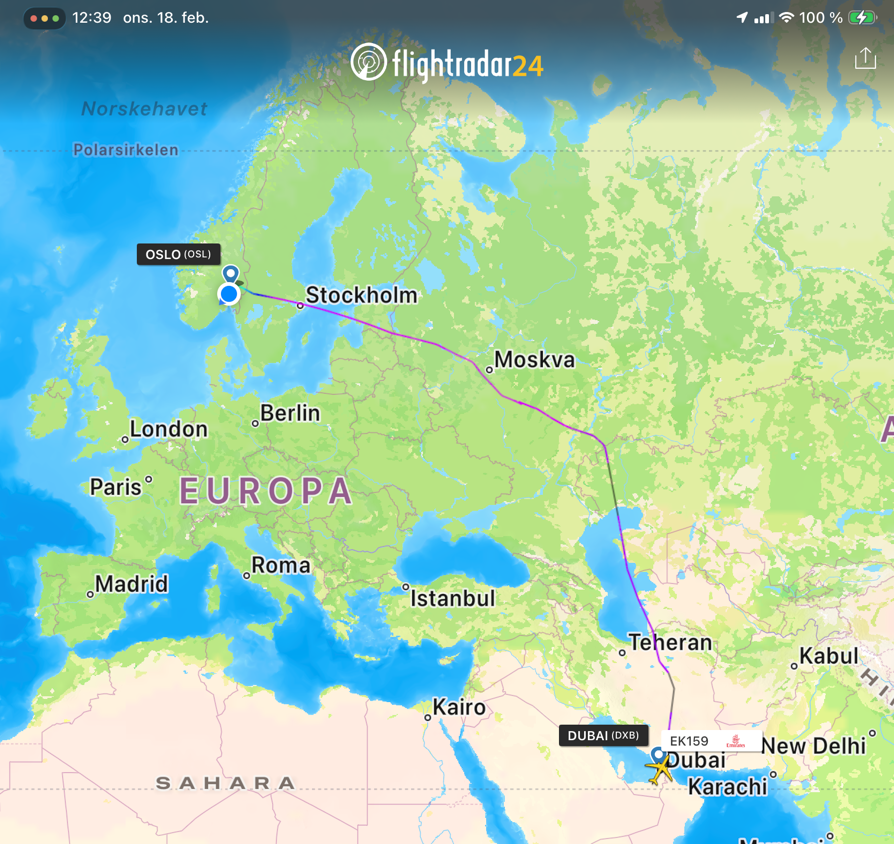
Alternatively, for example, if the aircraft were to route from Dubai north-west up the Gulf, then fly through Iraq, Turkey, Romania, Poland and Sweden into Norway it could operate the whole time in conflict-free airspace. The advantage, however, for any airline willing to take a calculated risk, is to fly through the much less busy Iranian and Russian airspace. Routes skirting – but staying outside – Ukrainian and Russian airspace to the south and west are very busy indeed.

If you watch operations through CZIBs in the region, using Flightradar24, airlines that regularly fly through Iranian airspace include Emirates, Etihad, FlyDubai, and Turkish Airlines. Interestingly, the other big long-haul Gulf carrier, Qatar takes the routes that avoid Iranian airspace.

Russian airspace is used regularly by Emirates, by Russian domestic and government flights, and Chinese carriers like Air China and China Eastern.

How much of a risk is it to ignore CZIB warnings and fly through conflict zones?

Judge for yourself. Here are the accounts of three flights that ignored conflict zone warnings. All those on board died on two of the flights, and most of the passengers in the third. There are other such regular conflict zone events in different parts of the world, but these are the most relevant here:

17 July 2014. A Malaysia Airlines Boeing 777-200ER (MH17) was shot down and destroyed in Ukrainian airspace by a Russian Buk ground to air missile system fired from Ukrainian territory held by pro-Russia militias in the country’s eastern sector near the Russian border. All 298 people on board were killed. This was the result of a deliberately launched missile, but probably the militia who launched the missile did not know – and certainly did not care about – the identification of the flight that they shot down.

8 January 2020. A Ukraine International Airlines Boeing 737-800 was shot down by an Iranian military surface to air missile while climbing away from Imam Khomeini international airport, Teheran, Iran, bound for Kyiv, Ukraine. The shoot-down was probably the result of target misidentification by Iranian military during a nervous stand-off between Iran and American military in the area. All 176 people on board died.

There is a nervous stand-off between Iran and a major American military task force in the Gulf, Red Sea and Mediterranean right now.

25 December 2024. An Azerbaijan Airlines Embraer ERJ-190, flying en route from Baku, Azerbaijan to Grozny, Russia was hit and badly damaged by military action in airspace where there was active conflict between Russian and Ukrainian forces. Some 38 of the 67 people on board were killed when the damaged aircraft eventually crashed because the crew had practically no remaining control of the flight path.

There is another relevant local event, but it took place in airspace that had not been declared a Conflict Zone despite the fact that there was, as now, a stand-off between Iran and the American military.

3 July 1988. An Iran Air Airbus A300 operating a scheduled flight from Bandar Abbas to Dubai was shot down by a missile fired from American frigate the USS Vincennes, killing all 290 people on board. The crew of the Vincennes misidentified the flight as a hostile threat to a small task force of American frigates in the Gulf.

As evident from these events, conflict zone shoot-downs are almost always the result of misidentification. But the results are just as terminal.

Crisis of confidence follows Norway helicopter disaster

Video footage from the fatal 29 April Norway helicopter disaster horrified the millions who saw it on television news.

The main rotor blades were filmed spinning slowly to earth like a sycamore seed while, unseen by the camera, the flightless body of the machine had plunged to impact on an island just offshore from Bergen.

The two-pilot crew and all 11 passengers – North Sea oil industry workers – died in the aircraft. It was operated by CHC Helikopter Services. Very quickly all the affected type – the Airbus Helicopters H225 Super Puma – in the Norwegian and British fleets were grounded.

This is a disaster not just for those who died and their relatives, but also for manufacturer Airbus Helicopters because, on 1 April 2009, a Bond Offshore Helicopters Super Puma also suffered main rotor separation offshore from Peterhead on Scotland’s east coast.

In that case the aircraft hull plunged into the sea killing all 16 people on board. There was no video of the accident, but ultimately the investigation determined it was caused by the catastrophic failure of a main gearbox component – the epicyclic reduction gear. The disaster aircraft in 2009 was an AS332L, a lighter four-bladed variant of the heavy-lift five-bladed H225, but the cause of the Norway crash – still unknown – already looks as if it may be very different from the Scottish case.

Perceptions of Super Puma safety were not helped when, in 2012, two UK sector EC225s (the earlier designation of the H225) were forced to ditch in the North Sea because of main gearbox loss of oil pressure. The ditchings were successful, and the component failure that caused the problem in both cases has since been fixed, but the events exacerbated the crisis of confidence over the Super Puma fleet, especially among the oil workers who depended on them for transport to and from the rigs.

A press conference given by the Norwegian Air Accident Investigation Branch on 3 May has now confirmed that the accident was the result of a “technical” cause, not some kind of crew error, and that the time between a fault indication and rotor detachment was less than one second. Data from the cockpit voice and flight data recorder is complete, says the investigator, but the nature of the mechanical failure is still being investigated and a further statement will be released when they have more information.

Meanwhile EASA has issued an airworthiness directive requiring H225 operators to check the correct installation of the main gearbox suspension bars, examine chip detectors and oil filters for metallic particles, and to download data from the vibration health monitoring system to check for exceedences. The agency describes the measures as “interim”, but the breadth of the instructions suggests a precise cause is not yet known. On 3 May Airbus put out a bulletin to operators telling them to check the main gearbox suspension bars.

In Norway, oil industry workers are being quoted in the press as saying they will not fly in H225s when they are cleared to fly again. This will make life difficult because the type is the main heavy-lift helicopter used for transporting industry workers’ between the shore and the rigs.

The accident is a huge story in the Norwegian media. Norway is not a populous country, and North Sea oil is an important industry there. Among the oil rig commuters, few of whom have much technical knowledge of helicopters and their operation, the issue is being talked about almost with superstition – a phenomenon that replicates the reaction of UK oil rig commuters a few years ago. For example, newspapers are quoting a fact that may not be causal in either of the main-rotor-loss accidents, and is probably just a coincidence, but they quote it none the less: in the case of the 2009 UK accident the aircraft underwent a rotor change on 1 March and the crash happened on 1 April, and in the case of the recent Norwegian accident the aircraft had a rotor change on 27 March and the crash occurred on 29 April.

An additional concern being aired by Norwegian oil rig commuters is the effect of increasing pressure on costs because of the global slump in oil prices. They express a worry that pressure from Statoil for rapid aircraft turnarounds reduces time for pilots and technicians to carry out checks, although they have no means of linking this factor to the accident.

Since the 2009 crash a great deal has been done to learn about – and rectify – the technical causes of that accident and of the 2012 ditchings. Also the UK Civil Aviation Authority has carried out a searching safety review of oil-support helicopter operations in the UK sector of the North Sea.

The Norwegians had gone through a similar soul-searching review after an accident in the late 1990s, but since then – until this disaster – they had enjoyed a long period of exemplary offshore helicopter safety while British operators struggled with a series of accidents and serious incidents, the most recent being a Super Puma fatal crash on approach to Sumburgh in August 2013. The latter, according to the final report, was the result of a crew flight monitoring problem, not a technical fault.

Now the extended safe period for Norwegian oil support operations has come to an abrupt end, and a nightmare has returned for Airbus Helicopters. Rapidly finding – and fixing – the cause for this accident is crucial to confidence in the Super Puma fleet. The H225 is still in production, as is the latest version of the AS332, new-build versions of which are now designated H215.

To put it all in proportion, the Puma series has been in production since 1968, originally designed and built by Sud Aviation. The Super Puma designation arrived in 1978, and it has been through a series of changes in manufacturer branding: Aerospatiale, Eurocopter, and now Airbus Helicopters. The series has had a long and distinguished service with the military all over the world as well as operating extensively in civil transport and utility roles. As Airbus Helicopters has pointed out to the restless Norwegian media, Super Pumas have racked up 4.3 million flight hours in the air.

But all this is cold comfort to nervous oil rig commuters while they await news of the accident cause, worried about a subsequent decision by the authorities to authorise the type’s return to service in Norway and UK.