Yesterday (see previous article) we were talking about Conflict Zone Information Bulletins and the advisibility of observing the warnings in them. Today the Gulf region is overshadowed by actual war, a conflict between US military forces and Iran officially announced by Presiden Donald Trump of the USA.
President Trump was characteristically imprecise about America’s objective in conducting a war. Timescales were absent.
Yesterday, airline traffic was active over Iran, Iraq and all the states with shores on the Gulf. Today the skies are empty there.
There are streams of diverted traffic to the north and the south of the Gulf, wanting to fly between the Indian subcontinent/South East Asia and Europe. They have been forced to travel over the southern half of Saudi Arabia and through Egypt, or through the Afghanistan/Turkmenistan/Azerbaijan/Turkey bottleneck between southern Ukraine/southern Russia and northern Iran.
This war cannot be said to be a surprise following the steady build-up of massive American military capability in the area, both at sea and at land bases. But the first actual hostile moves in all wars are always a surprise when launched.
No-one knows where this is going. European states that normally ally with America through NATO are silent.
Emirates flies an Airbus A380 schedule from Dubai to Moscow, the route normally used passing through Iranian and Russian airspace that is subject to European Union Aviation Safety Agency Conflict Zone Information Bulletins, a form of advice backed by the International Civil Aviation Organisation.
The CZIB is not legally enforceable for Emirates, and anyone boarding the flight in Dubai has, presumably, made a choice to fly there, whether they know the risks or not.
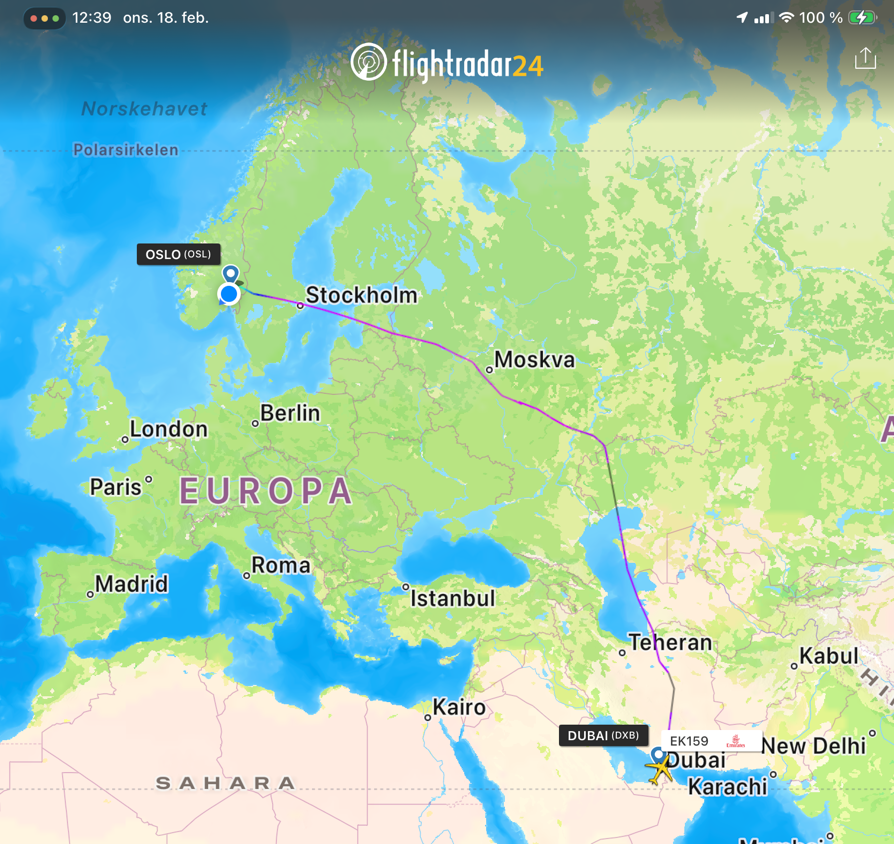
But a couple of weeks ago a retired airline pilot boarded an Emirates flight at Dubai, destination Oslo, Norway (EK159) and – not surprisingly given his professional history, he took an interest in his routeing. He was surprised to find himself flying through Iran, Western Turkmenistan, Western Kazakhstan, Russia and finally Estonia, before heading out over the Baltic Sea toward his destination.
Knowing there are efficient alternatives to that routeing, he was surprised that the crew flew a track that passed close to the south-west of Moscow. It was not the flight path he would have chosen for a flight under his command, because of the multitude of military conflicts currently affecting the Middle Eastern region, and particularly Iran and Russia.
Alternatively, for example, if the aircraft were to route from Dubai north-west up the Gulf, then fly through Iraq, Turkey, Romania, Poland and Sweden into Norway it could operate the whole time in conflict-free airspace. The advantage, however, for any airline willing to take a calculated risk, is to fly through the much less busy Iranian and Russian airspace. Routes skirting – but staying outside – Ukrainian and Russian airspace to the south and west are very busy indeed.
If you watch operations through CZIBs in the region, using Flightradar24, airlines that regularly fly through Iranian airspace include Emirates, Etihad, FlyDubai, and Turkish Airlines. Interestingly, the other big long-haul Gulf carrier, Qatar takes the routes that avoid Iranian airspace.
Russian airspace is used regularly by Emirates, by Russian domestic and government flights, and Chinese carriers like Air China and China Eastern.
How much of a risk is it to ignore CZIB warnings and fly through conflict zones?
Judge for yourself. Here are the accounts of three flights that ignored conflict zone warnings. All those on board died on two of the flights, and most of the passengers in the third. There are other such regular conflict zone events in different parts of the world, but these are the most relevant here:
17 July 2014. A Malaysia Airlines Boeing 777-200ER (MH17) was shot down and destroyed in Ukrainian airspace by a Russian Buk ground to air missile system fired from Ukrainian territory held by pro-Russia militias in the country’s eastern sector near the Russian border. All 298 people on board were killed. This was the result of a deliberately launched missile, but probably the militia who launched the missile did not know – and certainly did not care about – the identification of the flight that they shot down.
8 January 2020. A Ukraine International Airlines Boeing 737-800 was shot down by an Iranian military surface to air missile while climbing away from Imam Khomeini international airport, Teheran, Iran, bound for Kyiv, Ukraine. The shoot-down was probably the result of target misidentification by Iranian military during a nervous stand-off between Iran and American military in the area. All 176 people on board died.
There is a nervous stand-off between Iran and a major American military task force in the Gulf, Red Sea and Mediterranean right now.
25 December 2024. An Azerbaijan Airlines Embraer ERJ-190, flying en route from Baku, Azerbaijan to Grozny, Russia was hit and badly damaged by military action in airspace where there was active conflict between Russian and Ukrainian forces. Some 38 of the 67 people on board were killed when the damaged aircraft eventually crashed because the crew had practically no remaining control of the flight path.
There is another relevant local event, but it took place in airspace that had not been declared a Conflict Zone despite the fact that there was, as now, a stand-off between Iran and the American military.
3 July 1988. An Iran Air Airbus A300 operating a scheduled flight from Bandar Abbas to Dubai was shot down by a missile fired from American frigate the USS Vincennes, killing all 290 people on board. The crew of the Vincennes misidentified the flight as a hostile threat to a small task force of American frigates in the Gulf.
As evident from these events, conflict zone shoot-downs are almost always the result of misidentification. But the results are just as terminal.
It hasn’t surprised anyone in the industry to hear rumours – via the pages of the Wall Street Journal – that Boeing is working on the design of a new narrowbody jet, because it’s what everyone – including Boeing – knows the manufacturer should have done instead of launching the 737 Max.
The confidence in that statement is completely un-influenced by hindsight.
Now the Max has been purged of the ghastly design mistake that was MCAS (manoeuvring characteristics augmentation system), and Boeing has radically overhauled its corporate safety culture under a new leader – former Rockwell Collins engineer CEO Kelly Ortberg – the 737 series can once again trade on the lazy confidence that comes from the fact that – with all its faults and its antique technology – it’s a known quantity.
As a result the 737 is selling well, but nothing like as well as its competitor the Airbus A320 series.
The first 737-100 entered service in 1968, initially to fly the routes that the larger 727 series trijet was too big for. Its basic control technology was – and still is – just-post-war, except that in the latest versions the power-assisted cranks and pulleys are overlaid with electronic flight instrument systems and flight management computers to the extent that the pilots could almost believe the aircraft is fly-by-wire. They know, however, that they themselves are the flight envelope protection.
The industry needs a new-technology narrowbody competitor to the A320, and if Boeing doesn’t supply it, perhaps a development of China’s Comac C919, Russia’s Sukhoi Superjet 100, or a new product from Brazil’s Embraer will fill the gap.
Boeing’s first fly-by-wire airliner was its highly successful 777 widebody, which entered service in 1995 with virtually no birthing pains.
In 2011 it launched the 787 Dreamliner series, also highly commercially successful, but suffering from multiple early problems, some of them still being worked on.
Right now Boeing is struggling to re-launch the 777 as the 777X. The fact that it had a planned 2019 in-service date, but now its launch customer – Lufthansa – will not receive it until 2026, suggests how difficult a task bringing an entirely new narrowbody (the 797?) to service readiness may yet be.
The challenge is always to deliver a safe, trouble-free product, but the staggeringly advanced, fully-integrated electronic technology by which the aircraft and all its systems will be managed and controlled, plus the fact that there must be fallback systems that the pilots can access easily if it all goes wrong, mean its service entry will not be quick.
Look beyond this to the fact that the new systems will inevitably employ artificial intelligence, which makes passengers – and even engineers – nervous when it comes to managing safety-critical systems, and the size of the challenge becomes clear.
So the venerable 737 series will be with us for many years yet.
The Dutch-led international inquiry into the MH17 shootdown has clearly anticipated the organised denial that would follow its publication.
This is evident from the extraordinarily degree of thoroughness in its forensic examination of the wreckage of the Malaysia Airlines Boeing 777.
The inquiry was far more thorough than would have been required simply to confirm that an unidentified missile brought the aircraft down.
But as far as Russia and the eastern Ukrainian rebels are concerned this careful work is irrelevant. They can claim truthfully – although not with honest intent – that the wreckage was not secured, and that it could have been tampered with.
That makes them untouchable in law unless even more detailed evidence is uncovered that proves precisely where the missile was launched from.
Actually, there is a chance that evidence may be found.
But even if it’s not, the care to which the Dutch-led investigation has gone to identify the precise physical damage to the aircraft and chemical traces on the airframe is such that the report has real credibility: it makes clear that a Russian-built Buk missile did to the Malaysia 777 and its passengers and crew what Buk missiles are supposed to do.
The consequence of this report’s credibility is that the credibility of the deniers will be fatally damaged in the eyes of the global community as a whole.
So what else has the world learned as a result of MH17?
The day that MH17 happened the world’s airlines learned that intelligence about the safety of high level airspace is not guaranteed. Ukraine had closed its airspace below 32,000ft in the belief the rebels only had limited-performance weaponry. They were wrong.
ICAO has since set up a system for improving the communication of intelligence about conflict zones to airlines. But they could be wrong too.
So should airlines, from now on, avoid airspace over a zone in which – it is believed – small arms only are being used?…on the grounds that they might be misinformed about that too.
 Learmount.com