Jeju Air – the missing four minutes

Birdstrikes on airliners are not rare, but they don’t usually cause crashes, let alone fatal ones.

The most famous birdstrike accident before the Jeju Air crash at Muan, Korea a little more than a month ago was the “Miracle on the Hudson”, in which a US Airways Airbus A320 climbing away from take-off at New York LaGuardia airport in January 2009 hit a flock of large geese that disabled both engines. What followed captured the public’s imagination to the extent that Hollywood made a movie about it.

When the geese collided with his aircraft, Captain “Sully” Sullenberger made the decision not to attempt a turn-back to land on the runway, but to glide down for a ditching in the Hudson River. All 155 passengers and crew survived the ditching in the river’s freezing water.

Moving forward 15 years, the Korean aviation and railway and accident investigation board (ARAIB) interim report on the 29 December 2024 Jeju Air crash at Muan International Airport has now confirmed that the chain of events leading to the accident also started with a birdstrike on both engines. The Boeing 737-800, on final approach to runway 01 at Muan, ran into a flock of small ducks which caused the engines and the aircraft extensive damage. Details of the extent and nature of the damage have not been established, but it is clear that some of the aircraft’s electrical systems stopped working.

Much more would normally be known at this stage, but the flight data recorder (FDR) and cockpit voice recorder (CVR) stopped operating at the time of the birdstrike (08:58:50 local time), depriving the investigators of extensive data about the last four minutes of the flight that would otherwise have been captured. Simultaneously the aircraft’s ADS-B transmissions that enable the its three-dimensional trajectory to be tracked in real time also stopped, so it will be more difficult to establish the precise course the crew flew in order to line up for the emergency landing they chose to make.

It was at 08:54:43 that Jeju Flight 7C2216, inbound from Bangkok, Thailand, had first contacted Muan Control Tower and received clearance to land on runway 01. If they had not already done so, at that point they would have selected the undercarriage down and set the flaps for landing.

The first hint of the problems the flight was about to face came four minutes later when the Tower warned the Jeju pilots of bird activity ahead (08:57:50). At that point they were about 3nm from their anticipated landing. The electrical failure that stopped the two recorders occurred a minute later at 08:58:50, at which time the aircraft was still 1.1nm away from the threshold of runway 01, according to the ARAIB report.

The crew saw the flock of ducks ahead and below them just before the birdstrike, it seems, so they decided to abandon the approach and carry out a go-around, increasing engine power and starting to climb away. Six seconds later, at 08:58:56 local time, they declared a Mayday emergency, citing a birdstrike, and announcing their go-around, which had now become far more difficult to carry out because of reduced power from the damaged engines.

The report emphasizes that recordings during the last 4min 7sec of the flight are missing. That is the time that elapsed between the electrical failure that stopped the recorders and the moment of the 737’s violent collision with the earth and concrete mound beyond the end of the landing runway in which the ILS localizer antenna array was embedded (09:02:57).
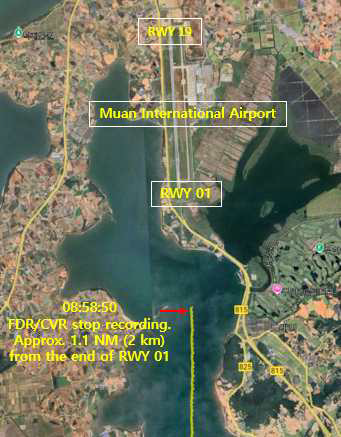
Image from ARAIB interim report

As they initiated their go-around, the pilots felt – and heard – the birdstrike and witnessed a loss of engine thrust just after they had advanced the throttles to climb away. As a part of the go-around drill the crew retracted the undercarriage and selected the flap fully up. There is no recording to confirm this, but they must have done so, as events in the next few minutes make clear.

The attempt to save the flight

The crew knew they had to get the aircraft on the ground fast in case the damaged engines failed completely, but by this time they were losing sight of the runway 01 threshold below the nose as they initiated their go-around, so landing ahead on 01 was no longer an option. Circling back to set up a new approach to the same runway was risky because they might not have sufficient power to maintain height for that long. The ARAIB report says that the last pressure altitude recorded was effectively 500ft (498ft to be precise), and indicated airspeed was 161kt.

At such a point the pilots would want to gain any height and speed they could with the remaining engine power so as to increase their gliding range in the event of total engine failure, and to stay withing gliding range of the runway. So their decision was to fly ahead, then turn through 180deg to land on the same runway but in the opposite direction – that is designated runway 19. Because, during the go-around, they were positioned to the left of runway 01 and parallel to it, they were committing to a right turn to reverse their heading and line up for the approach to 19.

The workload and stress on the pilots at that moment were massive. They did not know how much engine power they would have, or how long they would still have it, so the temptation to turn early to line up on the runway was high. Video of the aircraft’s arrival on runway 19 at Muan shows the aircraft touching down gently with its wings perfectly level, but nearly 2/3rds of the way along the tarmac, travelling very fast with no flaps set, the undercarriage still retracted, and no spoilers deployed.

With the data available at present there is no way of knowing whether the crew failed to get the flap and gear down because of hydraulic problems, or whether the high workload and lack of time made them forget to deploy them. Apart from the failure of electric power to the flight recorders, the investigators don’t know what other problems the pilots faced.

It’s even difficult to work out why an external collision with relatively small birds (Baikal Teals, average weight given as 400g) would cause an electrical supply to fail, unless the undercarriage was still down at the point of birdstrike, leaving electrical wiring and hydraulic tubing in the gear bay vulnerable to impact damage.

Almost all the 181 people on board the Jeju 737 were killed, the only survivors being two cabin crew strapped into their seats in the tail of the aircraft. Everyone on board would still have been alive until the high speed impact with the solid foundations for the ILS localiser antenna array about 200m into the runway overrun, which caused the aircraft to break up and catch fire.

Question for the Korean authorities: what was that obstruction just beyond the Muan runway end?

It will not be long before accident investigators reveal the reasons why the Jeju Air Boeing 737-800 crew felt they had to commit to a flapless, gearless landing on runway 19 at Muan, South Korea. But the reason so many people died was not the landing as such, but the fact that the aircraft (HL8088) collided with a very hard obstruction just beyond the runway end.

That collision broke up the hull and caused a conflagration. What was the obstruction, and why was it positioned on the runway extended centreline only about 200m beyond the runway threshold?

It looks as if it was a concrete anchorage for the Instrument Landing System (ILS) antenna array. ILS antennae are often just beyond runway ends, but they are normally designed to be frangible so any aircraft that collides with them suffers only minor damage. This was hard. Very, very hard.

The sequence of events that led to this accident began with the aircraft approaching runway 01, cleared to land, but the crew elected to go around just after ATC had warned them of a potential birdstrike. It looks as if a birdstrike did, indeed, take place, and the crew declared a Mayday emergency shortly after that.

The crew then elected to land on the same runway but in the opposite direction – on runway 19. This was not much of an issue because the wind was very slight and the visibility was excellent.

But when they returned for the fatal landing on 19 they touched down with no flaps and no landing gear. Why? Perhaps because the birdstrike caused the right engine to fail, and all or some of the hydraulics with it. And the gear and flaps are hydraulically powered.

We don’t know yet, but we will know soon.

Meanwhile the touchdown was as good as a flapless/gearless touchdown could be: wings level, nose not too high to avoid breaking the tail. But being flapless, the airspeed was very high – probably around 200kt.

Look at the video of the landing run. The aircraft slid the full length of the runway with the fuselage, wings and engines substantially intact, and with no fire. It slid over the end still going fast – maybe 70kt or so, but still with no further substantial damage to the structure and no fire.

Then the aircraft hit the obstruction about 150m beyond the hard runway overrun, but until impact it remained substantially undamaged and fire-free. At impact, the hull buckled and broke up, the wing fuel tanks were ruptured and instantly exploded into flames. The wreckage came to rest just beyond the obstruction, near the wire perimeter fence.

If the obstruction had not been there, the aircraft would have slid through the antenna array, across the level ground beyond it, and through the wire perimeter fence. It would have come to rest with most – possibly all – those on board still alive.

We will soon find out the whole truth about why the landing took place as it did. But because the accident killed all on board except two of the cabin crew, those answers will be almost academic. The question to answer is: what was that obstruction, and why it was there?

China Eastern crew did not reply

The Civil Aviation Administration of China (CAAC), in an initial briefing on the loss of the China Eastern Boeing 737-800 (B-1791), says air traffic controllers monitoring traffic in the Guangzhou flight information region saw the aircraft enter a steep descent and attempted to make contact, but “received no reply”.

Flight MU5735 was just over an hour into its journey from Kunming to Guangzhou at 29,000ft when the fatal descent began.

At present, says the CAAC, investigators are searching for the flight data recorder and cockpit voice recorder. The aircraft hit the ground at high speed and wreckage is widely spread. As a precaution the agency has declared all China’s 737s grounded for checks, although it has not been specific about what checks may be required, and a safety review of aviation infrastructure like ATC and maintenance organisations has been ordered.

China is proud of its safety record, and had not seen an airline fatal accident on its territory since August 2010 when a Henan Airlines Embraer EMB190 crashed on approach to land in fog at Yinchun Lindu airport.

China Eastern crash today

Crashes these days are incredibly rare, but a fairly new Boeing 737-800 of China Eastern Airlines has crashed in China on a domestic scheduled flight from Kunming to Guangzhou. It looks as if none of the 132 people on board have survived.

This incident is unusual in the sense that crashes very rarely happen in the cruise – that is, during the en-route section of the flight. This is because the crew has no high workload to deal with at that time, the engines are operating at a gentle cruise power, and the airframe is not under stress from manoeuvring.

According to the FlightRadar 24 tracker, the aircraft stayed on the same heading towards its destination while it descended toward the point of impact with the mountains. If it had broken up in the air because of sabotage or a catastrophic structural failure, it would almost certainly have spiralled down. But this aircraft was quite young, so structural failure can almost be ruled out.

We have no reports of a distress call to ATC, yet the aircraft began a descent. There was no reason for the crew to have adopted a descent profile at that point, because the descent toward its destination airport did not need to begin for another ten minutes.

If the crew had adopted a deliberate emergency descent because of sudden cabin decompression, it would have levelled at 10,000ft or thereabouts, whereas the last height reported by the tracker was 3,325ft.

The last time – indeed the only time – I saw a flight profile like this, the aircraft involved was the Germanwings A320 that crashed in France in March 2015, and the cause of that, according to the official investigation, was the copilot deliberately crashing the aircraft because of his mental state.

At this point, however, there is no direct evidence to support this conclusion regarding China Eastern and flight MU5735.

The most compelling evidence so far, as is often true so soon after a loss, is what did not happen. A Mayday call did not happen, although during a descent from 29,000ft there is plenty of time to make one.

The investigators will be trying to find out why that was.

Post Script on 19 May 2022: The Wall Street Journal has quoted US NTSB officials working with the Chinese authorities on the crash investigation as saying that the cockpit flight controls appear to have been manipulated deliberately with the apparent intention of crashing the aircraft. The NTSB press office will say only that it is for the Chinese authorities, in charge of the investigation, to make any such statements, and so far they have not done so.