Awful Airlines, says Which?

Ryanair has been identified in the UK Consumers Association publication “Which?” as the air carrier against which airline awfulness is benchmarked, and it has found that – by one particular measure, British Airways is even worse.

Airlines examined in this survey are among those offering services to or from British airports, and Which? says it is based upon a survey of 6,500 passengers who travelled in the last year. The consumer champion reports “a gulf in standards between the best and the worst”, and it places Jet2 comfortably at the top of short-haul ratings, with Ryanair at the bottom (and Wizz almost as bad).

In long-haul, Singapore Airlines tops the league, with British Airways firmly at the bottom of the nineteen carriers listed, and Air Canada close to it. Indeed, the mighty American Airlines scores much the same as BA, but can claim a Customer Score of 65% against BA’s 62%.

Which? scores all the airlines on 12 categories across the service spectrum. In each category airlines can win from one to five stars, and an overall customer score out of 100. As an example, Jet2 (short-haul) earned five stars for customer service, four in several categories, and in none of the cateories did it win fewer than three stars. Ryanair, on the other hand, didn’t earn more than two stars for anything, and scored one for boarding, seat comfort and food.

Asked by Which? to comment on the survey results, Ryanair had this to say: “Ryanair this year will carry 200m passengers…Not one of our 200m passengers wish to pay “higher prices” as Which? falsely claim.”

Indeed, Ryanair has always been totally unapologetic, as I pointed out in my recent obituary for enjoyable air travel “Surly Bonds (Part 2)”. Quote: “One of the industry’s extant personalities, Ryanair’s chief exec, Michael O’Leary, almost encourages the impression that he chuckles at the pain he can persuade his passengers to undergo to knock a Euro or two off their fare! They just keep coming, he crows. And he’s right, they do – in ever larger numbers!”

But what excuses can British Airways field? It scored lower even than Ryanair on its response to customers who ask for assistance of any kind. Meanwhile on short-haul its highest score was three stars, with a mere two for boarding, seat comfort, food and value for money. On its long-haul routes BA earned four stars for its booking process, but only two on seat comfort, food, cleanliness and value for money.

The UK flag carrier responded: “This research from Which? is entirely at odds with comments from the hundreds of thousands of customers who we know do travel with British Airways and then tell us about their experience.” BA then, in a style reminiscent of recent UK politicians attempting to mitigate dire poll results, lists all the investment it has recently made in cabins and customer service, finally adding: “This [feedback] is also reflected in a recent independent study from Newsweek, which surveyed 17,000 people who voted us their Most Trusted Airline Brand.”

Great brands – and British Airways was indeed a great brand not long ago – can survive a period in the doldrums, but trust can quickly be squandered.

This blog has already vented about the deadly tediousness of air transport today, and the complacent acceptance by the industry of mediocre standards. Flying used to be considered a glamorous and exciting mode of travel, and could be again if spiced with a little imagination.

If that imagination is not invested, the air travel industry will be self-limiting, and environmentalists will be able to celebrate its shortcomings.

Air France’s new secret ingredient

Most airlines no longer attempt to sell air travel as exciting or glamorous, because these days it usually isn’t. We examined that indisputable fact here quite recently.

Air France, however, is trying a new marketing idea to inject some romance into its product. I don’t believe this trick has been tried before – at least not by an airline.

Indeed, I’m not sure any other carrier could even hope to make this idea fly.

But Air France flies the flag of a country that’s home to the concept of Haute Couture, and home also to LVMH, by a massive margin the biggest luxury goods purveyor in the world. And its hub is Paris!

If ever there was a magic metropolitan brand name, Paris is it.

LVMH may not mean anything to most people, but its brands do. It owns Dior, Givenchy, Louis Vuitton and Moët Hennessy, to mention but a few. It doesn’t own Chanel, but that name evokes Paris anyway.

So what is Air France trying to fly?

Its own perfume. Or, as the British upper classes prefer to call it, scent.

It’s called AF001, the flight number of the legendary Air France Concorde departure from Paris Charles de Gaulle for New York JFK.

If the glamorous associations with Paris France don’t sell it to ordinary passengers, that magic flight number will ensure romantic aviation buffs buy it for their wives and girlfriends!

Let’s test the power of an idea, because British Airways flew Concorde too. Couldn’t they try it?

What images does the name of BA’s base, London, evoke? Not a scent, surely, nor romance. Maybe energy, like New York? And Burberry may be famous, but isn’t up there with Hermès and Chanel.

And the airline names: Air France proudly uses its country’s name, whereas British – as in Airways – is an adjective. In branding, these things matter.

Meanwhile other companies have tried to harness the sense of smell, but usually for the purpose of exploiting an already strong brand name to generate a side-hustle that might be a good earner. Harley-Davidson tried it, for example, but would you buy the stuff? If it didn’t smell of oil and come packaged with a guttural sound-track, what’s the point?

Anyway, what does Air France have to say in its press release about its AF001 fragrance?

The airline hired Francis Kurkdjian, master perfumer and artistic director of Maison Francis Kurkdjian, to create the new scent: ‘I’m very proud to have created Air France’s first signature home fragrance. It was the illusion of a ray of sunshine on the wings of an aircraft that inspired me to create this light, fresh and comforting home fragrance’.

Fabien Pelous, the airline’s Customer Experience Manager, waxes lyrical: ‘The Air France travel experience now elevates all five senses: sight, with the haute couture uniforms of our staff, our cabin interiors, and the meticulous design of our lounges, taste with the delicious dishes on the menu on board, touch with the soft fabrics of our seats, sound with our playlists on board, and now smell with this prestigious signature fragrance’ 

The marketing department says the fragrance will become part of the AF ambience: “Air France will be gradually using AF001 in its lounges in Paris and around the world over the coming months. Evoking a feeling of space, calm and light, AF001 accompanies travelers in style. Its comforting musky scent, combined with mimosa from the south of France, adds a sunny, natural vibrancy. Created with hints of jasmine and rose, its delicate floral aura takes travelers on a real olfactory journey, capturing a specific moment in time.”

Personally, I salute any move to bring glamour back to airline travel – or at least to attempt it.

Here’s another test of the idea: what would a perfume called Ryanair or Southwest Airlines smell like?

Fear of drones

It looks as if the 17 April “drone strike” on a British Airways aircraft on approach to Heathrow airport may not have been a collision with a drone after all. Maybe just a wind-tossed plastic bag – the investigation is still in progress.

In an aircraft travelling at about 150kt (170mph/275km/h) on final approach, small objects can suddenly appear and flash past. At that point the pilots are concentrating on monitoring the aircraft’s performance and aiming it at the runway. So it’s easy for a pilot to misidentify whatever the object is.

But does that mean we don’t need to worry about drones?

There some very simple rules about how you may operate a drone, so the relevant question is whether people will obey the rules – or even read them in the first place.

Drones are getting popular among ordinary people, mainly for airborne video recording or still photography. First the selfie, then the selfie-stick, now the airborne selfie?

Lads mags are full of enthusiastic advice for gadget-crazy young men. Some lads will be given a drone as a birthday present. If they are given one, will they read the operating instructions when they’ve opened the pack, let alone the legal restrictions on their use?

Some won’t, but does that mean they will inevitably operate their drone in such a way as to endanger aircraft? The law of averages says that one day someone will – possibly unintentionally – fly a drone in an airport approach or departure path.

But given another contemporary public threat to aircraft – commercially available hand-held laser pointers being shone into pilots’ eyes during take-off or final approach to land – an unsettling mentality exists out there. Use of lasers in this way is against the law, but incidents are on the increase.

So when a drone hits an aircraft, what will the result be?

Most are small and light – between one and 5kg. If one of these hits the aircraft wings, tail or forward fuselage it will cause damage but not make it impossible for the pilots to fly safely.

But if it hits the flightdeck windscreen or the engines the results could be serious. Exactly how serious we are not sure, because tests have not been carried out.

A drone-strike on an engine will probably cause its failure, and if it’s a heavier device it might smash the windscreen and injure or kill a pilot. Either of these events is very unlikely to be terminal for the aircraft, but they both could be. This would depend on the degree of direct damage and whether or not it has secondary effects.

Large-scale public drone use is still not with us, but it’s on the way. With greater use will come greater awareness among users as well as the public. That’s what the Civil Aviation Authority and Department for Transport are banking on – the public’s basic common sense.

Terrorists are unlikely to use drones against aircraft because there are more effective ways of attempting to disrupt commercial aviation.

But for those on the fringes of society – the kind who use powerful laser-pointers – dicing with risk can be attractive.

What the authorities have to decide is whether this risk is serious enough to require, for example, all drone users to register. Or some form of unique identifier like a transponder or GPS tracker to be fitted to all machines.

They’d rather not have to introduce expensive bureacracy to control the public use of devices that, used sensibly according to existing rules, are pretty much harmless.


Celebrating a Concorde anniversary

At precisely 11:40 GMT on 21 January 2016, a group of people who had designed, built or flown Concorde raised their champagne glasses to the 40th anniversary of the type’s first take-off for a commercial flight.

Plural take-offs to be precise. At 11:40 GMT British Airways’ aircraft began its take-off roll at London Heathrow for Bahrain and, simultaneously – perfectly choreographed via an HF radio link – Air France’s Concorde crew also engaged reheat bound for Rio de Janeiro.

It has been 12 years since, in 2003, the last Concorde flights took place, and all the experts and afficionados gathered at Brooklands last Thursday confirmed – despite many expressed wishes that at least one airframe could be made flyable at some time in the future – it will never get airborne again for air shows, let alone with commercial passengers on board.

Forty years is a long time. The Concorde on show at Brooklands may have still gleamed in the pale winter sun, but the passage of time shows on the faces of those who took part in the Concorde commercial operations story, especially from its very beginning in 1976.

Concorde with Charlie 2

G-BBDG at Brooklands on the 40th anniversary of the type’s first commercial departures

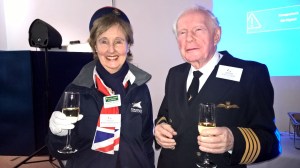
Capt John Eames (below), one of the first batch of BA’s Concorde commanders, was there to raise a glass of champagne, along with Concorde fleet senior stewardess Jeannette Hartley, both dressed in uniforms from that period. Hartley served as Concorde cabin crew from 1977 to 1998, spinning that magic that made everybody who flew on the machine feel special from the moment of check-in.

Jeannette Hartley & Capt John Eames

An event like this serves to remind aviation people – and ordinary souls – just how special Concorde was.

It was an amazing technical achievement and the ultimate adventure in commercial air transport.

Just one of the proofs is that it has no successor.

It’s extraordinary, in this world of breakneck technological advance, that I can tell my six-year-old granddaughter I flew as an airline passenger at twice the speed of sound, then add reluctantly that she can’t do that even if she chooses a career as an RAF fastjet pilot.

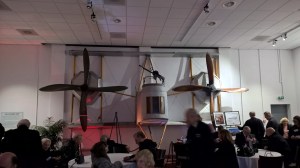
This reminder of a historic event was, itself, surrounded by history at Brookands Museum, the home of of both British motor sport and British aviation. The gathering was in the Vickers room (below), complete with the forward end of a Vickers Vimy embedded in the wall. The airscrew on the left was one of those that propelled Alcock and Brown’s first flight across the Atlantic.

Vickers Vimy room at Brooklands

A presentation by Capt Eames entitled Concorde – a pilot’s perspective, drew reminiscences from several of his peers about the event in their supersonic career that they found most memorable.

One such pilot recalled a training flight to Gander, Newfoundland, during a single 24h period. Outbound and return flights each took little more than 2h, but the phenomenon that stopped him in his tracks was seeing two sunrises and two sunsets on that day, and one of the sunrises was in the west.

Work that one out!

The first sunset was in UK before take-off. The “sunrise” in the west occurred as Concorde overtook the sun flying westbound, then after landing the sun set once more. Then, on the eastbound leg back to UK, the sun rose as one would expect it to, except that, at nearly 60,000ft above sea level, it rises incredibly early while the earth beneath the aircraft is still in darkness.

And we can’t do that any more.