Emirates flies an Airbus A380 schedule from Dubai to Moscow, the route normally used passing through Iranian and Russian airspace that is subject to European Union Aviation Safety Agency Conflict Zone Information Bulletins, a form of advice backed by the International Civil Aviation Organisation.
The CZIB is not legally enforceable for Emirates, and anyone boarding the flight in Dubai has, presumably, made a choice to fly there, whether they know the risks or not.
But a couple of weeks ago a retired airline pilot boarded an Emirates flight at Dubai, destination Oslo, Norway (EK159) and – not surprisingly given his professional history, he took an interest in his routeing. He was surprised to find himself flying through Iran, Western Turkmenistan, Western Kazakhstan, Russia and finally Estonia, before heading out over the Baltic Sea toward his destination.
Knowing there are efficient alternatives to that routeing, he was surprised that the crew flew a track that passed close to the south-west of Moscow. It was not the flight path he would have chosen for a flight under his command, because of the multitude of military conflicts currently affecting the Middle Eastern region, and particularly Iran and Russia.
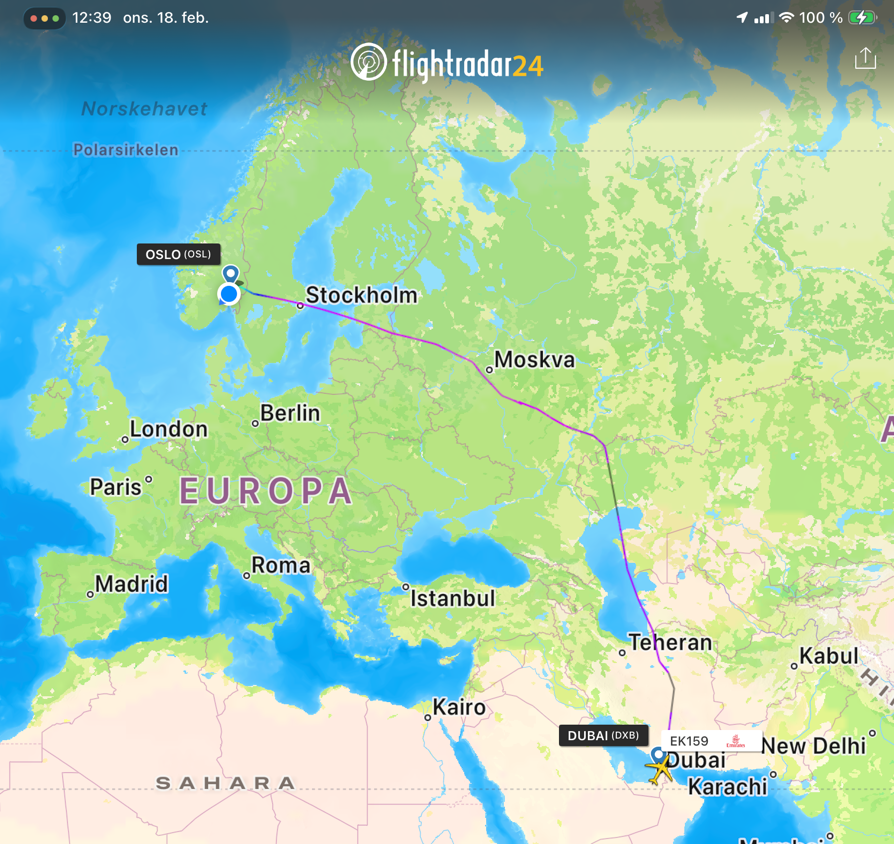
Alternatively, for example, if the aircraft were to route from Dubai north-west up the Gulf, then fly through Iraq, Turkey, Romania, Poland and Sweden into Norway it could operate the whole time in conflict-free airspace. The advantage, however, for any airline willing to take a calculated risk, is to fly through the much less busy Iranian and Russian airspace. Routes skirting – but staying outside – Ukrainian and Russian airspace to the south and west are very busy indeed.
If you watch operations through CZIBs in the region, using Flightradar24, airlines that regularly fly through Iranian airspace include Emirates, Etihad, FlyDubai, and Turkish Airlines. Interestingly, the other big long-haul Gulf carrier, Qatar takes the routes that avoid Iranian airspace.
Russian airspace is used regularly by Emirates, by Russian domestic and government flights, and Chinese carriers like Air China and China Eastern.
How much of a risk is it to ignore CZIB warnings and fly through conflict zones?
Judge for yourself. Here are the accounts of three flights that ignored conflict zone warnings. All those on board died on two of the flights, and most of the passengers in the third. There are other such regular conflict zone events in different parts of the world, but these are the most relevant here:
17 July 2014. A Malaysia Airlines Boeing 777-200ER (MH17) was shot down and destroyed in Ukrainian airspace by a Russian Buk ground to air missile system fired from Ukrainian territory held by pro-Russia militias in the country’s eastern sector near the Russian border. All 298 people on board were killed. This was the result of a deliberately launched missile, but probably the militia who launched the missile did not know – and certainly did not care about – the identification of the flight that they shot down.
8 January 2020. A Ukraine International Airlines Boeing 737-800 was shot down by an Iranian military surface to air missile while climbing away from Imam Khomeini international airport, Teheran, Iran, bound for Kyiv, Ukraine. The shoot-down was probably the result of target misidentification by Iranian military during a nervous stand-off between Iran and American military in the area. All 176 people on board died.
There is a nervous stand-off between Iran and a major American military task force in the Gulf, Red Sea and Mediterranean right now.
25 December 2024. An Azerbaijan Airlines Embraer ERJ-190, flying en route from Baku, Azerbaijan to Grozny, Russia was hit and badly damaged by military action in airspace where there was active conflict between Russian and Ukrainian forces. Some 38 of the 67 people on board were killed when the damaged aircraft eventually crashed because the crew had practically no remaining control of the flight path.
There is another relevant local event, but it took place in airspace that had not been declared a Conflict Zone despite the fact that there was, as now, a stand-off between Iran and the American military.
3 July 1988. An Iran Air Airbus A300 operating a scheduled flight from Bandar Abbas to Dubai was shot down by a missile fired from American frigate the USS Vincennes, killing all 290 people on board. The crew of the Vincennes misidentified the flight as a hostile threat to a small task force of American frigates in the Gulf.
As evident from these events, conflict zone shoot-downs are almost always the result of misidentification. But the results are just as terminal.
 Learmount.com