La Réunion, that wing flap, and MH370

The wing flap that has drifted ashore in La Réunion on the western side of the Indian Ocean may well have come from the Malaysia Airlines Boeing 777 that flew the ill-fated flight MH370.

But if it really was a part of that aircraft, does it help the search for the main wreckage?

Unfortunately no. It certainly does not mean the wreckage is near La Réunion.

This flap section has been afloat since the aircraft hit the sea on 8 March 2014, a year and four months ago. It has drifted a long way in that time, and tracing it back to its possible origin using a model of the prevailing sea currents and winds would provide such a massive approximation that it would indicate a larger search area than the one the Australian government has already searched, and which it continues to search right now.

The Indian Ocean’s main sea current system flows anti-clockwise, so if the aircraft did indeed crash in the area off the west coast of Australia where the search is taking place, the flap – and possibly other parts – would have been carried north, then westerly, then southerly, which makes La Réunion a plausible location for it to wash up. So the find certainly does not invalidate the present calculations.

Does it tell us anything new about how the aircraft was lost?

Again, unfortunately no. The experts reckon the aircraft had nothing wrong with it, and that it crashed into the sea when it ran out of fuel.

That is because an aircraft that sets off for one destination, makes a U-turn and then flies successfully for hours in the wrong direction while it could be seen on radar, and probably many more hours when it could no longer be seen, had nothing structurally wrong with it.

The favourite explanation from all the major players in the industry is that the disappearance of MH370 was a deliberate act by someone in control of the aircraft. In the light of the Germanwings crash earlier this year, deliberately carried out by the unbalanced copilot, that explanation now has additional credibility with the public.

If the flap is indeed from MH370, the discovery finally lays to rest two theories: sadly but inevitably, those who lost relatives on the flight and were still hoping that the aircraft had safely landed in a remote place, will now be confronted with the reality that the aircraft broke up, probably on impact with the sea; and finally those conspiracy theorists who reckon the CIA hijacked it to Diego Garcia – or anywhere else – are going to have to search their imaginations for an alternative explanation.
The risk of “deliberates”

In the five fatal airline accidents in the first six months of this year 65 people died, while another 150 were killed in the Germanwings aircraft, which was not an accident.

This bears comparison with the first six months of 2014, where there were five fatal accidents causing 28 deaths, plus the enigmatic disappearance of MH370 in which 239 people were lost. Although it cannot be proven, most industry experts believe MH370’s disappearance was a the result of a deliberate act by someone on board.

In terms of fatal accident numbers for the same period each year in the last decade, 2015’s accident figures equal the best. But the “deliberates” are beginning to pose new questions about airline safety, because there was one in 2013 as well – that’s three “deliberates” in three years.

The 2013 “deliberate” involved Mozambique airline LAM which lost an Embraer 190 twinjet and all 33 people on board under the same circumstances as the loss of Germanwings flight 4U9525. That is, one pilot left the cockpit, the other locked him out and deliberately flew the aircraft to impact.

The question is: do three such “deliberates” in three years constitute a trend or a coincidence?

Statistically there’s not a strong case for calling it a trend, but neither can it be ignored.

Look at similar cases before the LAM loss: Egyptair 767 in 1999, Silk Air 737 in 1997, and a Royal Air Maroc ATR42 in 1994. So, in that period 1994-1999 there was one loss every two years. Then there was a long gap – 13 years – with no deliberates. Then between 2013 and 2015 there were three: LAM, MH370 and Germanwings.

Hijacks are also “deliberates”, but since the adoption of the post-9/11 fortress cockpit, plus anti-hijack cabin crew drills, hijacks have been eliminated.

Sabotage is a deliberate act, but security is now so extensive that even those who have smuggled small quantities of explosives on board have failed to detonate them effectively.

So the only “deliberates” against which the industry has no effective defence are those that can be carried out by people in the cockpit or with authorised access to it.

The nearest the industry has come to a defence against this risk is never to leave a pilot alone in the cockpit, so if one of them leaves it, a member of the cabin crew has to replace him or her. This is a useful psychological technique for making it less likely that a pilot in a suicidal frame of mind would initiate a plan when there is a witness to it. Less likely yes, but not impossible.

What is needed is some careful study, probably across other industries also, of people – and their life circumstances – who use their workplace either to end their own life, or for a revenge motive resulting from resentment so embedded that their own survival becomes irrelevant.

If this three-in-a-row set of deliberates is a trend, is it generated by societal changes, including working cultures, or is it just a matter of chance associated with the power and opportunity that control of an aeroplane confers?

Such a study would be complex and may not be conclusive, but that is no excuse for failing to carry it out.

MH370: all they have to do is look in the right place

The MH370 search has had a morale boost.

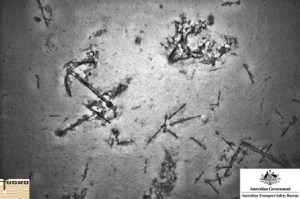
On 13 May the Australian Transport Safety Bureau revealed it had found wreckage on the seabed in the search area.

It wasn’t from the missing aeroplane, it was a shipwreck, but it proves the sonar kit they are using can find MH370 if they look in the right place.

One of the oceanic survey vessels, Fugro Equator, found small sonar contacts that looked like man-made equipment. Fugro Supporter was sent back to have a closer look using the autonomous underwater vehicle (AUV).

ATSB’s Peter Foley, Director of the Operational Search for MH370 said: “It’s a fascinating find, but it’s not what we’re looking for.

“Obviously, we’re disappointed that it wasn’t the aircraft, but we were always realistic about the likelihood. And this event has really demonstrated that the systems, people and the equipment involved in the search are working well. It’s shown that if there’s a debris field in the search area, we’ll find it.”

They’ve passed the sonar data to marine archaeologists who may have to search back many decades to work out which vessel it was because, from the debris, it looks as if it was a coal-burning ship.

Seabed wreckage 3,800m beneath the waves

But there’s more.

Remember Capt Simon Hardy, the Boeing 777 captain and mathematician who worked out where MH370 is most likely to be? Flightglobal published his calculations last December.

The ATSB called Hardy to meet them in Canberra on 15 May, and the plan was that he was to visit the survey ships in Fremantle on 20 May. This will all have happened by now. The ATSB have demanded that Hardy not disclose any discussions, although I can’t see what purpose secrecy would serve. Perhaps they just want to control the release of information themselves.

But now we know the AUV can detect even small debris, all we are waiting for is for them to find MH370.

It will just be interesting to see how close the MH370 wreck is to Hardy’s refined predictions, which he will have been sharing with the ATSB.