Ladies and gentlemen, your pilot is unconscious

An official incident report has confirmed that a Lufthansa Airbus A321 flight from Frankfurt, Germany to Seville, Spain on 17 February last year flew for 10min without any pilot supervision because the copilot, alone on the flight deck at the time, suffered a “sudden and severe incapacitation” which was defined in the report as a “seizure”.

An experience of my own many years ago was strikingly similar to this, so we will return to that subject in a moment after examining the events on Lufthansa’s Frankfurt – Seville flight last year.

Once Flight LH77X was established in the cruise over northern Spain at flight level 350 (35,000ft), carrying six crew and 199 passengers, the captain discussed pertinent weather conditions on the route with the copilot, who was the pilot flying, and then left the flight deck for a toilet break at 10:31:00 (UTC). Exactly 36 seconds after the captain had left the flight deck, the copilot suffered an epilepsy-like seizure, according to the Spanish accident investigation authority CIAIAC.

There was no immediate indication to the absent captain that anything was wrong, because the autopilot and autothrust remained engaged, despite some inadvertent switch selections by the copilot, and the fact that his right foot was pressing the rudder pedal hard – but fortunately not hard enough to cause the autopilot to trip out.

Meanwhile the sector controller for Spain’s Pau ATC region attempted three times to establish radio contact with LH77X, but received no reply.

At 10:39:00 the captain was ready to return to the flight deck, and he attempted a standard entry procedure, but there was no response from the copilot who would have had to approve it. After three further attempts he decided to employ the flight deck emergency access code, but while he was doing that the copilot, “pale, sweating and moving strangely”, opened the door from the inside.

The captain took control of the aircraft at 10:42:00, and at his request the cabin crew helped the copilot into the forward galley area, administered first aid, and obtained the help of a doctor from among the passengers. Meanwhile the captain decided to divert the aircraft to Madrid, the nearest airport, rather than continuing to Seville. The A321 landed safely and the copilot was taken to hospital, but released after examination.

The CIAIAC report quotes the definition of a “seizure” under these circumstances as “an abnormal paroxysmal excessive discharge of cerebral cortical neurons”. The copilot had no medical record of any such event previously, and said he had not experienced anything like it before. The medical judgement as reported by the CIAIAC is that, even had the copilot been tested specifically for such a condition, it would not have been detectable unless he had suffered a seizure in the presence of a medical observer.

The report’s main recommendation for the future is that, any time one of the pilots has to leave the flight deck, a member of the cabin crew should join the remaining pilot in the cockpit until the absent pilot returns. This is actually a previously established procedure which had fallen into disuse simply because incapacitation is so rare. But if it had been applied in this case, the cabin crew would have been able to alert the captain immediately about the copilot’s condition, and help him re-enter the flight deck quickly.

Meanwhile here is an account of my personal experience of airborne seizure – and precursors to it – that is highly relevant to cases like this one.

During my time as a qualified flying instructor (QFI) in the RAF I had gradually developed a condition which caused me to suffer minor seizures which, at the time, I did not recognise. They just felt like momentary mental “absences” that I attributed – for example – to having had a few drinks too many in the Officers Mess the night before. At the time I was in my late 20s, and had been flying pressurized jets and turboprops for eight years,

But my wife noticed these “absences”, and reported them to an RAF doctor who then approached me about them. I dismissed the matter as unimportant, and he did not pursue the issue further.

I recall having an “absence” while on short final approach to land a Jet Provost, solo, at RAF Linton on Ouse. I can’t actually remember the touchdown itself, but can remember rolling out at the end of the runway and turning onto a taxiway back to the pan, by which time I felt fine. But the thought of this event – now that I know more about my condition at that time – chills me.

Some months later I suffered a fully-fledged seizure during my sleep, and my wife called the doctor, who attended immediately. When I awoke I felt as if I had been beaten up.

I was taken to an RAF hospital and tested via electro encephalograph (ECG), and underwent brain scans. The diagnosis – given the evidence of the seizure – was that I was “probably” prone to epilepsy, but the condition was defined as “idiopathic”, meaning there was no medically detectable sign of it.

Continuing to fly professionally after that was not an option, so I left the RAF and became an aviation journalist.

At the time I believed my symptoms might have been caused by an sudden and unexpected application of quite high negative G during a practice aerobatic sequence flown by one of my student pilots. But the medics could find no sign of brain damage.

Over the decades since that time, in my job as an aviation journalist, I learned about “Aerotoxic Syndrome”, the name given to a condition caused by damage to the brain and nervous system by neurotoxic chemicals from aero engine lubricants and hydraulic fluids. High doses, gained via a “fume event” in the cockpit or cabin, can cause instant cognitive problems, although these may fade with time. But in other individuals, regular exposure to low doses of neurotoxins over a long time can gradually build up in the body, degrading the nervous systems of pilots and cabin crew.

These organophosphate chemicals, containing known neurotoxins, are delivered to the cockpit and cabin by aircraft air conditioning and pressurization systems, where the air is sourced directly from jet or turboprop engine compressors. Engine oil seals constantly leak fluid at low levels, so when the highly compressed – and therefore hot – air is delivered to the air conditioning system, it contains pyrolized neurotoxic aerosols. This is the air that the crew breathe.

In some individuals, that constant low-level poisoning builds up in their system until it causes visible symptoms of neurological damage. In other individuals, their systems gradually purge the chemicals, making symptoms last only a short time. But so far there is no way of knowing in advance which kind of system individual aircrew have.

In my case, today I no longer have even slight seizures, neither do I have to take any medication which, for more than 25 years, I had to do constantly to keep the symptoms at bay. Neurologists say, nonetheless, that they cannot declare me free of epilepsy or related neurological conditions because they still do not know enough about the subject to be certain. I suspect what has happened is that, since I left the RAF, I fly only occasionally, so my system has had time to purge itself of the neurotoxins that regular flying delivered to me.

I wish the Lufthansa copilot of flight LH77X on 17 February 2024 well, and hope he gets all the support he needs to continue his career, if that is deemed possible.

Meanwhile for him, and all those who want to know more about Aerotoxic Syndrome, FlightGlobal has a useful account here.
Trial and error: early pilot training for the RFC in the Great War

Research I have been conducting into my grandfather’s Royal Flying Corps/RAF service in the Great War (1914-1918) has yielded unexpected detail about basic flying training for pilots in those early days. Or, more accurately, the lack of it.

When I began the research task – some three years ago – I was focusing on WW1 front line operational flying techniques. But it gradually dawned on me – as a former RAF Qualified Flying Instructor – that very little – even now – has been written about initial pilot training in 1914 and 1915.

Just consider the training context at that time. The Wright brothers first flew in 1903, so in 1914 aviation was still in its infancy.

When mankind first ventured into the sky he didn’t know what he would find, nor how to deal with it. You cannot select “the best” prospective pilots when you don’t yet know what skills or aptitudes aviators need, nor even how to recognise them when they are present in a candidate.

Indeed, the army and navy leaders in 1914 had only a rough idea of how aeroplanes might best be employed in the military context. So, beyond the obvious need to inculcate in pilots whatever magic skills are required to get the aircraft airborne and keep it there, they didn’t have a clear idea of what mission skills the crew might need, nor how best to teach them.

Right from the start, soldiers and mariners definitely knew that the ability to see over the horizon – or even over the nearby hill – would be highly desirable, and a bird’s-eye view would enable the aviators to identify and observe enemy positions and logistical preparations, then report back to surface units.

Air-to-air combat skills did not even begin to become an issue until mid-1915, because most of the aircraft in use at that time had originally been designed as unarmed reconnaissance machines.

In order to appreciate fully why pilot training was so primitive in 1914 and 1915, it is essential for researchers to remind themselves constantly how primitive the technology was, and how little the practitioners knew about aviating. In the RFC there were no trained instructors and no formal flying training syllabus until late in 1916. Learning to fly was an exercise in trial-and-error. To learn more, you had to survive each sortie.

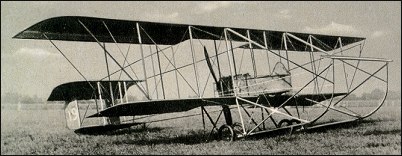
Maurice Farman Longhorn, a training machine in 1915

Estimates of the number of pilot and observer deaths in the Great War have been set as high as 14,000, with 8,000 of them occurring during training. More recent studies, combining fatalities, missing, shot down, and captured suggest 9,000 is closer to the mark for the total, and the number of specific training casualties is uncertain – but it was staggeringly high by today’s standards. A young American aviator training with the RFC at its Montrose, Scotland training base in 1913 wrote home that “there is a crash every day and a funeral every week.” And that was just on his base.

At the end of my grandfather’s training course in June 1915, his flying log book recorded exactly 24 hours airborne time. To train for a private pilots licence today you would need 35 hours or more to gain the necessary skills to satisfy the examiner, and today’s aeroplanes are far more reliable and much easier to fly.

In the remarks column against the entry for Learmount’s last training flight at Brooklands aerodrome, Surrey, on 9 June, he wrote the following: “Pancaked over sheds, smashed undercarriage and one wing landing.” That was clearly good enough for the RFC, because three days later he joined No 7 Squadron at Saint-Omer in France “ready” to fly and survive in the hostile skies over the Western Front.

Evidence abounds that, until mid-1916, young aviators were sent to the front-line squadrons with the basic ability to get airborne, fly cautiously, and recover safely to their base aerodrome. The pilots were little more than drivers for the observer/gunners who would gather the intelligence the army needed. Mission training took place “on the job”. Pilots who survived multiple sorties, possibly by luck, acquired additional skills and knowledge by default, but almost certainly picked up many bad habits and misconceptions too.

Major Raymond Smith-Barry – a graduate of the very first course at the Central Flying School, Upavon in 1912 – and today credited with being the founder of modern aircrew training standards in the RAF – had served as an RFC pilot in France from August 1914. By 1916 he realised that the standard of flying among the arriving aviators was simply appalling, and he decided something had to be done. By late 1916 he had compiled a formal pilot training syllabus, which he first introduced at Grange airfield, Gosport, on England’s south coast near Portsmouth, where he was appointed Commanding Officer of No 1 (Reserve) Squadron – a training unit – and took up his appointment there in December 1916.

Smith-Barry also invented the Gosport Tube, a tube through which the instructor could speak to the student, which was widely fitted to training aircraft from June 1917 onward. The new flying training syllabus, plus the improved instructor communication, benefited training hugely.

Smith-Barry was clearly not the only RFC aviator who had noticed how inadequately trained the young arrivals in France were because, by mid-1916, some training bases back home were beginning to provide basic mission training for pilots who had completed their primary flying tuition. 2nd Lieutenant LW Learmount, my grandfather, who had only graduated from his primary training a year earlier, was made commanding officer of a training unit, No 15 (Reserve) Squadron, at Doncaster, South Yorkshire, in May 1916. Within days he was promoted to Lieutenant, then Acting Captain, to provide him with the authority to carry out the task.

There was clearly a realisation by then that German machines were getting faster and better armed, and that pilots were not only going to have to be drivers, but fighters and also bombers. Smith-Barry’s controversial (at first) insistence that pilots should be trained to fly their aeroplanes to the very edges of their flight envelope, and to recover successfully if they strayed outside it, was gaining ground.

Fast-forward a year or so to September 1917, and by that time Learmount – now an Acting Major – had been the commander of No 22 Squadron for about 9 months, flying Bristol Fighters over the Western Front in France, and he made it clear that he was not happy with the skills of the pilots arriving on his unit. He complained in a letter to HQ 9 Group that arriving pilots had no training in aerial gunnery, formation flying and navigation.

The written response – almost a rebuke – came direct from Brigadier General Hugh Trenchard, Officer Commanding the RFC in France, who made it crystal clear to Learmount that that the resources to do more were simply not available, and that he considered it the squadron commander’s task to bring the skills of his new pilots up to standard where they were found lacking.

You can find much more in my nine-part serial “Leonard’s War”, which traces Learmount’s path through the RFC/RAF from training in 1915 to demob in 1919. For any of you who have read it before, since then it has been considerably expanded and edited as new historic material has come to light, and it remains a work in progress to this day!

The RAF goes green

With a 90min Airbus Voyager test flight out of its Brize Norton base, it seems the Royal Air Force has chalked up a world first.

On 16 November the Voyager, the military tanker/transport version of the A330-200, took off with its Rolls-Royce Trent 772B turbofans burning pure, 100% sustainable aviation fuel. Many airlines have operated different types with a mix of standard aviation fuel and SAF – usually less than 50% – but no-one is believed to have used pure SAF before.

On board were an RAF crew supplemented by representatives from the SAF manufacturer BP, Airbus Defence & Space, and engine manufacturer R-R. FlightGlobal has reported a statement by Airbus experimental test pilot Jesus Ruiz, who was the aircraft commander for the test: “From the crew perspective, the SAF operation was ‘transparent’, meaning that no differences were observed operationally. The test plan was exhaustive and robust and has allowed us to compare SAF with JET [A]1.”

RAF Voyager tanker/transport (Crown Copyright)

BP crafted the SAF from used cooking oil. This being a flight operated in British airspace by my alma mater, the RAF, I have an unaccountably earnest desire to learn that the cooking oil came from the deep-fryers of English Fish & Chip bars. Given that Capt Ruiz confirms the flight went without a hitch, it seems BP successfully ensured the fuel was not contaminated with salt and vinegar!

Joking aside, this is a very welcome achievement, as is the RAF’s stated objective for sustainable flight. Chief of the air staff Air Chief Marshal Sir Mike Wigston says the RAF is committed to achieving net-zero air operations by 2040, a decade ahead of the present global aviation target.

Bringing their legacy to Life

On 12 June 2015 I visited the old aerodrome of Saint-Omer in far north-eastern France. The date was the 100th anniversary of my grandfather’s arrival there to join No. 7 Squadron Royal Flying Corps as a new pilot.

This aerodrome was chosen by the First World War Aviation Historical Society to be the site of a memorial to all British military aviators, judging Saint Omer to be “the spiritual home of the RFC”.

My 12 June 2015 visit to Saint-Omer aerodrome

Now airman and film producer Tristan Loraine is to make a film honouring the historic contribution of aviators to our freedom, and he’s inviting people who care about these things to get involved in its creation.

It’ll be a homage to all lost aircrew called Angel Fleet. If you click on the link above you’ll see this:

My grandfather, Major Leonard Learmount RFC, was lucky. He survived, but many in the Squadron he eventually commanded in 1917-18 didn’t.

Until the First World War Aviation Historical Society decided – in 2004 – to erect the memorial at Saint-Omer, there was no single monument to honour all lost military aviators from all conflicts. Until Tristan makes this film there will be no single silver-screen tribute to them all.

Leonard’s War, episode 9: the Battle of Cambrai, Christmas 1917, a blighty for the Boss, and a springtime marriage

(For previous episodes scroll down)

Dateline: Mid-November 1917, Estrée Blanche, north-eastern France.

The weather at Estrée Blanche aerodrome worsened in mid-November (1917), and fog made reconnaissance in the whole area extraordinarily difficult. 22 Squadron, still under the command of Major Leonard Learmount, was tasked with finding out what the enemy was up to around German-held Cambrai, information which headquarters badly needed for the planned British assault there on the Hindenburg Line, a heavily fortified German defensive line to the west of the town.

The Cambrai assault, which began on 20 November, was conceived by General Sir Julian Byng as a surprise attack from the west, across terrain suitable for tanks – unlike the Ypres area – and RFC close air support was part of the plan. The latter had proved highly effective toward the end of the Passchendaele battle.

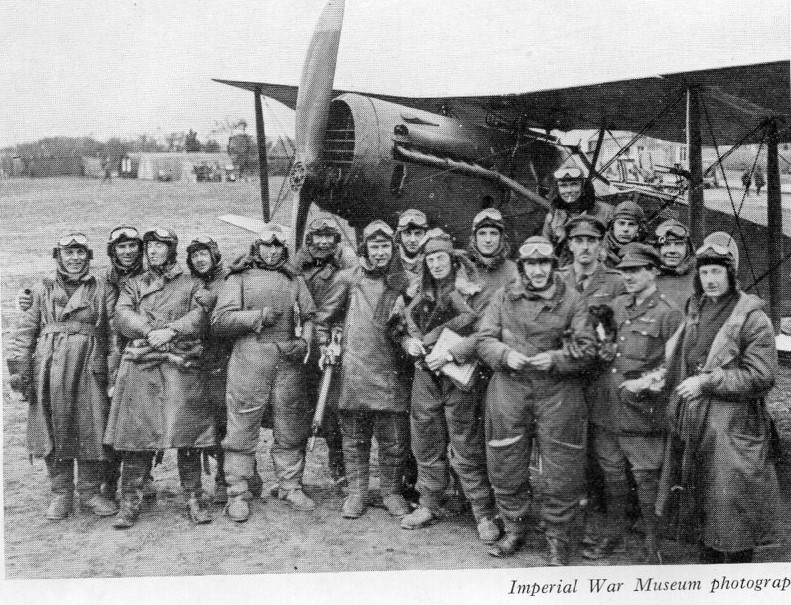
A and B Flights of 22 Squadron with a Bristol Fighter early in 1918.

Fog made 22 Sqn’s preparatory reconnaissance sorties dangerous and reduced their effectiveness. Crews transited to the Cambrai area at about 3,000ft, then descended gingerly through the fog as low as they dared, hoping to get sight of the ground and evidence of enemy movements before colliding with church spires or rooftops.

This patch of grass was the location of the Estrée Blanche mess buildings in the corner of the aerodrome, looking south west over the village. This was an agricultural and coal-mining area, and the now-grassed-over coal slag heaps are visible in the middle distance. Mounds like them took the lives of low-flying airmen when the weather was foggy.

On 20 November the Cambrai offensive began, and yielded a suspiciously successful British six-mile advance over nine days, after which it was brought to a halt. It was still short of the town, but had breached some of the defensive lines. Very quickly, however, the advantage of surprise was lost and the Germans successfully counter-attacked. By the 6th December, they had retaken much of the ground that had been won.

Air Gunner Archie Whitehouse described 22 Sqn’s role at Cambrai: “We had the unenviable job of blowing up the enemy observation balloons, strafing road transport, and making a general nuisance of ourselves. We were down low, flying through our own shell-fire to hammer Cooper bombs on the German anti-tank gun emplacements. We strafed the roads and chased horse-drawn transport all over open fields, and generally played merry hell…

“We fired hundreds of rounds of ammunition and burned out our gun barrels. We returned again and again for fuel, bombs and the reviving encouragement of Major Learmount. Thank God for the Major during those days!”

This, it seems, was about the time when the air gunner and the squadron commander reached an unspoken awareness that they had become the only two remaining aircrew from what Whitehouse called “the Chipilly mob” who were still flying on 22 Sqn. He was referring to the location at which he had joined the squadron about six months ago, in April.

It left them with a feeling of emptiness, against which the only antidote was the adrenaline summoned up by the next sortie. Whitehouse wrote: “We flew, slept, flew, slept and flew some more. We staggered back and forth to our machines, too tired to eat. No-one spoke, no-one laughed, no-one argued. Faces were lined with weariness, pitted with cordite, and daubed with whale-oil.”

Back at Estrée Blanche there was a lull in the fighting because the weather was so bad, the Cambrai advance had petered out, and Christmas was approaching. Whitehouse wrote: “The patrols were dull…compared with the hair-raising experiences of the summer. But I was feeling the strain. I did not sleep well and went off my food completely. It was only when we settled down to put on a show for Christmas Eve that I forgot my troubles.”

Whitehouse described the festive preparations: “We got up a programme that was a honey for wartime humour. Among the mechanics we had a wealth of talent, so we could put on a show worthy of any outfit out there!” They rigged up lights powered from a dynamo lorry and searched out decorations to put up.

Finally, the dinner on Christmas Eve: “The officers, led by Major Learmount, came in and served the Christmas dinner, bundled up in aprons and mess jackets and suitably armed with towels and napkins. We sang and gave cheers for everyone we could think of. There never was such a dinner or so much fun!”

Learmount in his RAF uniform. The RFC, a corps of the army during most of the war, became the nation’s autonomous air arm on 1 April 1918.

Then they put on the show, with “the inevitable slightly bawdy female impersonator”, tricks, recitations and plenty of songs accompanied by piano. Marie and Annette, waitresses from the small estaminet in the village – and their mother – were guests of honour, along with quite a few other “puzzled-looking” civilians from Estrée Blanche, and they were given seats at the front near the piano. It all ended with God Save the King and the Marseillaise.

Then back to business. C Flight had to go on patrol on Christmas Day, but nothing much came of it. The Hun had chosen to be quiet for Christmas too, apparently.

On 20th January 1918 Archie Whitehouse, whose ambition all along had been pilot training and a Commission, was sent back to England to achieve both, wearing the ribbons for his newly-awarded Military Medal and a chest-full of campaign gongs. He reported in his memoire: “I lived to wear pilot’s wings and fly a single-seater fighter. I lived to see the Armistice!” He clearly felt lucky. He definitely was.

The squadron commander who had bid Whitehouse farewell was now the very last of the aircrew left from January 1917, but he had his work to keep him sane. He still had to lead 22 Squadron’s mechanics, armourers, stores-wallahs, cooks and caterers whose names he knew well, and to encourage the new, barely-trained young pilots and observers to believe in their roles and in their ability to carry them out.

On 22 January 1918 the Squadron moved briefly from Estrée Blanche to Auchel/Lozinghem, then again on 2 February to Treizennes, where losses were high and increasing. The Geman air force was venturing more over the Allied lines than they had been accustomed to do, seeking intelligence for planning purposes. It was on a patrol from Treizennes, on 9 March, in his Bristol Fighter, that Learmount got his blighty while attacking a German aircraft that was being far too successful at directing German fire onto British artillery positions. Although losing blood fast, his remarkable luck still held, and he got his Biff back to base. He was stretchered away from his mount.

From March 1918, No. 22 Squadron found itself dealing with German preparations for the imminent – ostensibly successful but short-lived – Spring Offensive. The German army, commanded by Gen Erich Ludendorff, had benefited from the transfer of huge numbers of troops from the Eastern to the Western Front, and consequently appeared to have assembled the means to mount an attack on a wide front. On 21 March the first of three separate chronologically sequenced attacks took place on different parts of the British sector of the Western Front. Ludendorff’s objective was to drive the British to the Channel coast and cut them off from French forces before the newly-arrived Americans were able to put their full weight behind the Allies.

The final push of the Spring Offensive, in late May, was aimed further south on the French-defended part of the line near the Champagne. But Ludendorff had dissipated his forces too widely and, despite gaining a significant amount of ground, he had failed to defeat the retreating British and French armies, which were able to re-group. By July the attack had ground to a halt without achieving any of its aims. This marked the beginning of a progressive collapse within the exhausted, demoralised German military.

The RFC shipped the badly wounded Learmount back to England, where he was sent to St Bartholomew’s hospital, London, for treatment. France awarded him the Croix de Guerre avec Palme.

At “Bart’s”, Learmount met “Peggy” Ball, a young nursing auxiliary charged with looking after him. Less than two months later – on 7th May – he married her in a church in Muswell Hill, north London, where her parents lived.

While Leonard and Peggy were exchanging vows, the German Spring Offensive was still advancing, but the Allied victory that (we now know) was to come in November was nowhere in sight at that time. Nevertheless, the newlyweds took a few days off to honeymoon at a pub on the banks of the River Thames, at Staines, 15 miles west of London – very rural in those days – and they went rowing together. Wedding photographs show Learmount left the church still using a walking stick.

A cutting from the Daily Mirror. Learmount, leaning on a walking stick, is leaving St James’s Church, Muswell Hill, London with his bride. He was 28 then, but looks much older. Convalescence would have to continue on honeymoon.

He was taken off the sick list on 22 August 2018 and posted to No 33 Training Depot Station at Witney near Oxford as an instructor on Bristol Fighters.

Upon his demobilisation in February 1919, Learmount returned to his trading job in the Far East. Once he was established there, his new wife and baby son, travelling by ship (of course), joined him there a few months later.

The marriage lasted a lifetime.

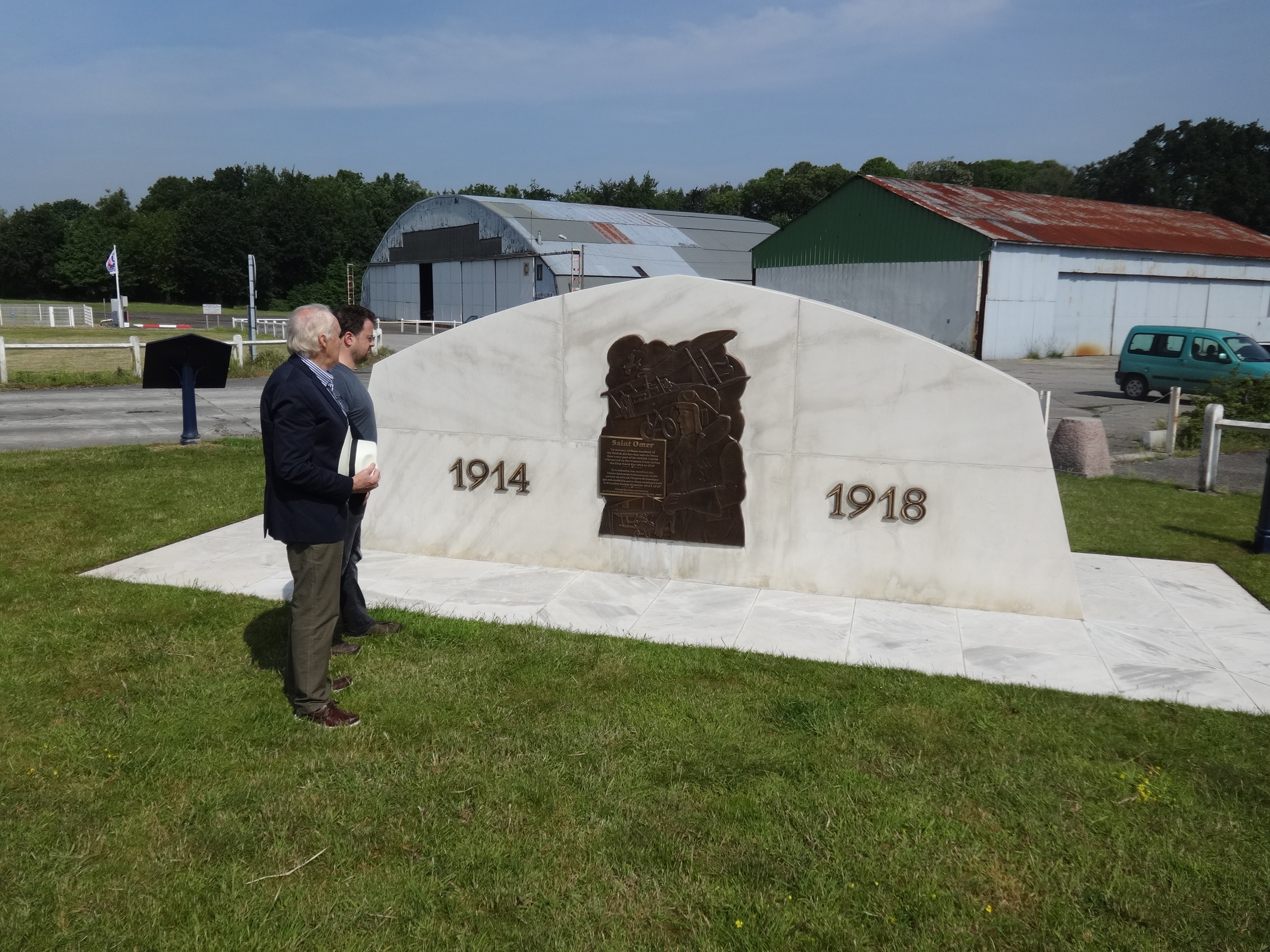
Author and son at the British Air Services Memorial, Saint-Omer aerodrome in June 2015. The memorial was erected by the First World War Aviation Historical Society in 2004. None of the buildings in view were in place during the Great War. The hangar on the left was built by the Germans in the Second World War and today is occupied by the Aéro Club de Saint-Omer. The Club keeps a museum of Great War aviation history at Saint-Omer in their hangar, and visitors are welcomed.
Learmount’s decorations. From Left: Distinguished Service Order, Military Cross, 1914-15 Star, British War Medal, Victory Medal, Colonial Auxiliary Services Long Service and Good Conduct Medal, Croix de Guerre avec Palme
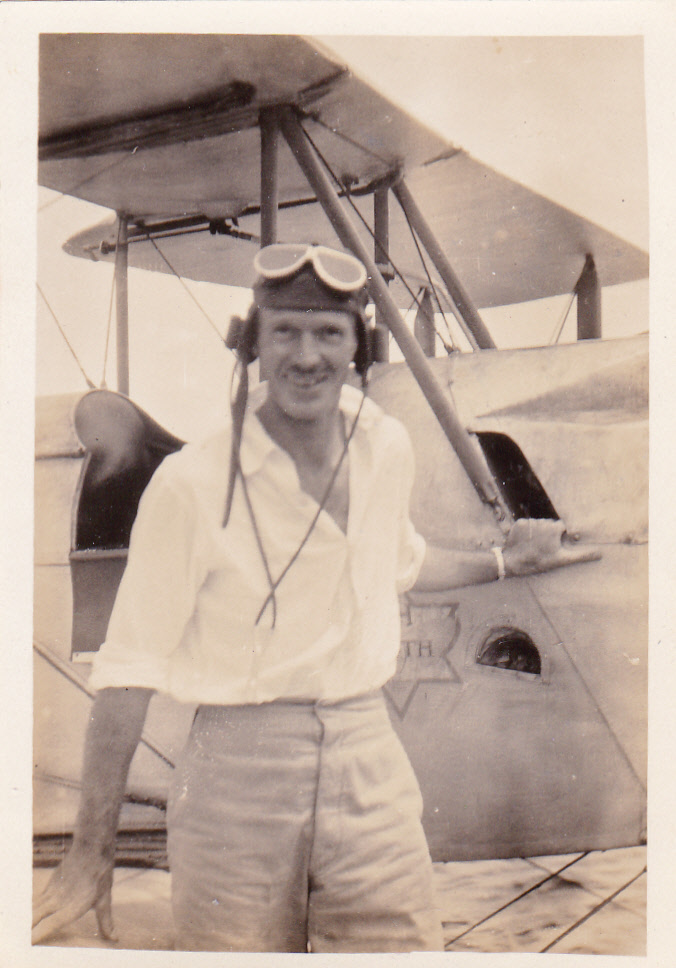
Learmount did keep flying, but for leisure. Here he is – in the late 1920s – with a De Havilland Cirrus Moth float-plane at Seletar Creek, Singapore, where he was one of the founder members of what was then called the Royal Singapore Flying Club. He also founded what was known as the Royal Selangor Flying Club in Malaysia. Both clubs still operate today under different names.

ENDS

Click here to go to Episode One of “Leonard’s War” and read it all again!

Out of the ordinary

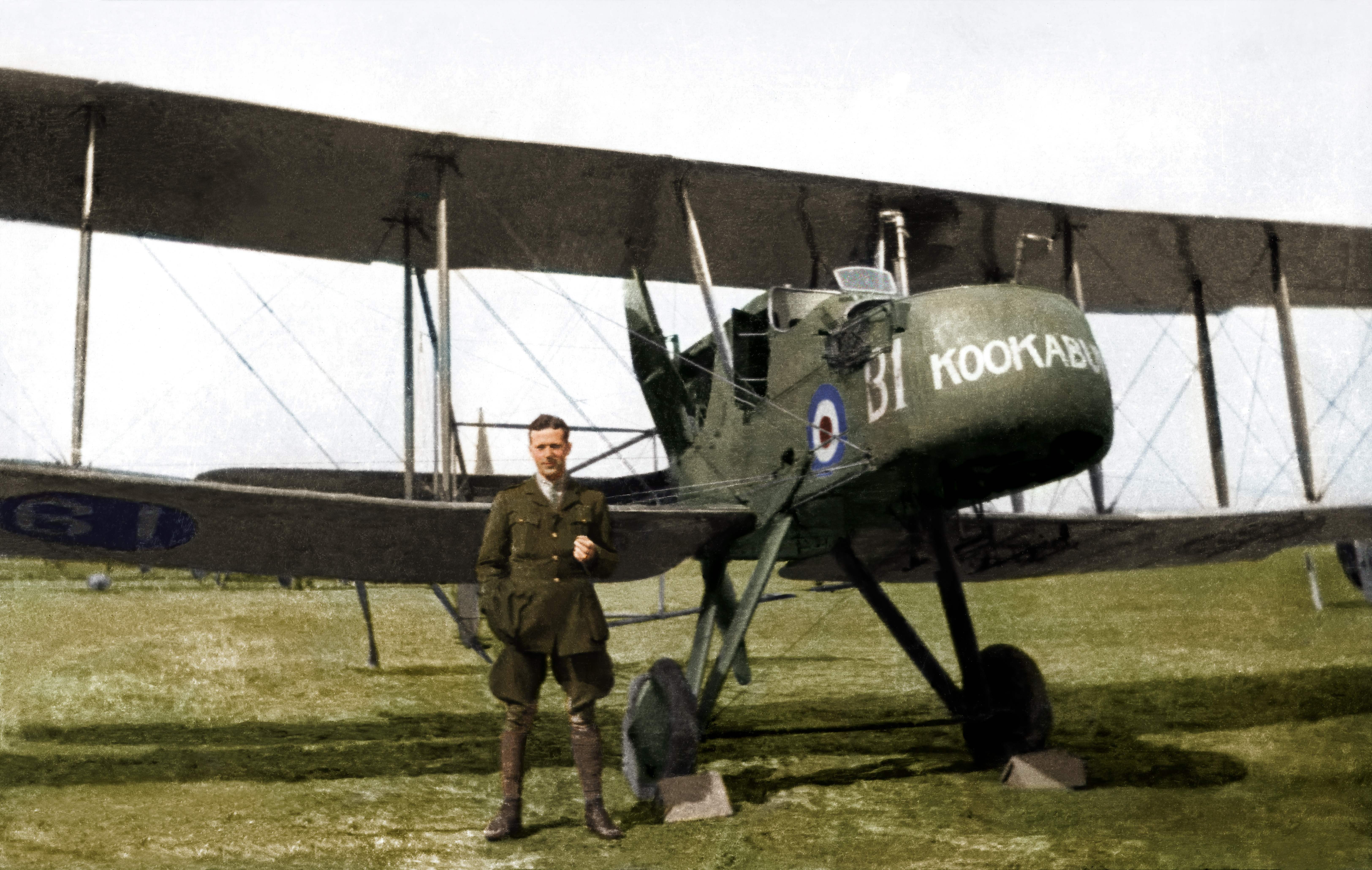
Major Leonard Learmount DSO, MC, RFC, Squadron Commander of No 22 Squadron January 1917-March 1918, and one of his mounts, a FE2b “Fee”

This man did not die for his country. He just came within a whisker of doing so countless times between June 1915 and March 1918 when he was flying over the hellish battle lines of the Western Front in the Great War.

Leonard Learmount is not listed as an ace, but he was an RFC pilot and squadron commander. When I, as his grandson, began researching his military life, I discovered a man who had been a businessman in the Far East before the war, and returned to the same business after it in 1919. He kept no records of his military flying and never talked of it, but clearly retained a love of flying, because he founded flying clubs that still exist in Kuala Lumpur and Singapore.

As this entry in the RAF Museum’s blog points out, his dogged persistence as a multi-role aviator for nearly three years over the front line, facing high risk every mission and being wounded in action twice, is as much a representation of the spirit of the RFC and RAF as the stories of the aces.

His story, and that of his squadron – No 22 – are told in more detail in the Summer 2020 edition of Cross & Cockade International, the quarterly journal of the First World War Aviation Historical Society. For anyone interested in the history of aviation – indeed the origins of aviation – and history of the Great War, I cannot recommend the Society highly enough. Membership doesn’t break the bank.

Having researched the detail of a specific low-altitude photo-reconnaissance sortie Learmount flew over the Hindenburg Line on 10 May 1917, I commissioned aviation artist Tim O’Brien to paint the scene of the preparation for departure. The return from the mission was more messy, because the aeroplane had been shot-up and Learmount wounded. To get clear photographs of the enemy lines the pilot had to fly the aircraft so low it was within easy range of small-arms fire, let alone “archie” – anti-aircraft fire. And the flying had to be steady, making the aeroplane a sitting duck. But they got the photos back to base, and their quality was high, rendering vital information about enemy readiness states.