MH17 and the denial option

The Dutch-led international inquiry into the MH17 shootdown has clearly anticipated the organised denial that would follow its publication.

This is evident from the extraordinarily degree of thoroughness in its forensic examination of the wreckage of the Malaysia Airlines Boeing 777.

The inquiry was far more thorough than would have been required simply to confirm that an unidentified missile brought the aircraft down.

But as far as Russia and the eastern Ukrainian rebels are concerned this careful work is irrelevant. They can claim truthfully – although not with honest intent – that the wreckage was not secured, and that it could have been tampered with.

That makes them untouchable in law unless even more detailed evidence is uncovered that proves precisely where the missile was launched from.

Actually, there is a chance that evidence may be found.

But even if it’s not, the care to which the Dutch-led investigation has gone to identify the precise physical damage to the aircraft and chemical traces on the airframe is such that the report has real credibility: it makes clear that a Russian-built Buk missile did to the Malaysia 777 and its passengers and crew what Buk missiles are supposed to do.

The consequence of this report’s credibility is that the credibility of the deniers will be fatally damaged in the eyes of the global community as a whole.

So what else has the world learned as a result of MH17?

The day that MH17 happened the world’s airlines learned that intelligence about the safety of high level airspace is not guaranteed. Ukraine had closed its airspace below 32,000ft in the belief the rebels only had limited-performance weaponry. They were wrong.

ICAO has since set up a system for improving the communication of intelligence about conflict zones to airlines. But they could be wrong too.

So should airlines, from now on, avoid airspace over a zone in which – it is believed – small arms only are being used?…on the grounds that they might be misinformed about that too.

No easy answers here.


A new approach to airline pilot training

Ryanair has found, consistently over the years, that half the licensed pilots who apply for first officer jobs fail its entry tests.

That’s not because the tests are particularly demanding, or because Ryanair springs unexpected things on them in the simulator. Wannabes all get a month’s warning of everything they’re going to face, and all the data they need to prepare for it.

Ryanair’s head of training Andy O’Shea told me his airline had recently considered backing future pilots via the MPL route, because that’s designed to deliver airline-ready pilots complete with a type rating.

But they’ve abandoned that idea because they think the MPL – as it’s organised right now – is too inflexible to cope with the vagaries of market demand. It locks the airline and the student into an 18 month relationship that may not survive market changes.

On the other hand the CPL/IR route prepares pilots to fly a light piston twin all on their own. It’s really only preparation for a good general aviation job, which is fine if that’s what you want to do.

Even if the twin is EFIS-equipped, it’s a million miles away from preparing a pilot for the right hand seat in a Boeing 737. And bolt-on multi-crew and jet-orientation courses are clearly not delivering, or Ryanair wouldn’t have that high failure rate.

O’Shea is looking for a way of plugging the skills and knowledge gap effectively between the CPL/IR and the right hand seat of a jet. If that can be done well – and he has been working on it with EASA and a working party called the Airline Training Policy Group  – the students and the airlines would be able to enjoy the flexibility of the CPL/IR route, but it would produce the flight-deck-ready pilots that the MPL is designed to create.

He summarises what’s missing in those who fail their tests. They lack – to a greater or lesser degree – knowledge and understanding, flight path management skills, crew resource management ability, and what he calls “maturity and attitude”.

Basically, what O’Shea and the ATPG propose is a CPL/IR course extended to embed quality MCC and JOC components, including sessions closer to airline line oriented flight training than is done currently, plus some more advanced knowledge training. The result would be a course known as the Airline Pilot Certificate Course.

One of the possibilities is that the APCC would be available to students as one of the choices, as well as the MPL and CPL/IR as they exist today. That would not demand any more flight crew licensing regulatory work, but EASA could – and seems likely to – endorse the APCC as a valid qualification.

The question is, if the APCC is successful in attracting students and airlines, what would the future of the MPL be?

The CPL/IR could continue to be a stepping stone, via GA, into the airline world, and the MPL incorporating a JOC might be an alternative equivalent to the APCC.

This is still a work in progress, but something along these lines looks likely to win approval in Europe.


Shoreham air display accident – interim report

According to the UK Air Accident Investigation Branch’s interim factual report on the Shoreham air show crash, nothing detectable was wrong with the Hawker Hunter at any point in the display.

It has been confirmed that the aircraft entered the fatal vertical manoeuvre at a height of 200ft when 500ft would have been the normal minimum – and certainly wiser – thus leaving very little room for misjudgement in a trajectory that is frighteningly easy to get wrong, even for a skillful and experienced pilot.

The intent in a normal vertical manoeuvre like this loop-with-roll would be to complete it at the entry height, but certainly not less when the aircraft began the manoeuvre close to the ground. In fact the aircraft began to pull up from 200ft above ground level and finished by impacting the surface.

There may yet be more to this story than the AAIB has just revealed, but there were cameras and a microphone in the cockpit which should confirm most of what it is possible to know.

Air displays contain risk, like Formula 1 and other sports do. If they didn’t, nobody would go to watch them. But they are not intended to extend the risk to non-participants. That is the part that needs examination.

The risk to air shows

Following the 22 August Shoreham air show crash, in which at least 11 people on a public road have been killed by a display aircraft, the Civil Aviation Authority has promised a complete review of air display safety.

Since comprehensive rules and guidelines already exist and – until now – have protected the public (if not the display pilots) successfully for some sixty years, what can the CAA realistically do except ban air shows over land?

You can find a description of the existing discipline imposed on air display organisers on the Flightglobal website.

After the devastation and loss of life caused on the busy A27 dual carriageway road section next to Shoreham airfield when the Hawker Hunter crashed on it, the media has – understandably – been posing questions about the issue of public roads passing very close to airport runways.

In fact Shoreham aerodrome – the UK’s oldest airport, founded in 1910 – was not constructed next to the existing A27. The part of the A27 road that, today, skirts the airfield at its northern boundary was laid nearly half a century after the airfield was constructed, as part of a bypass for the south coast towns.

Further along the same trunk road to the west, the A27 becomes the M27 as it swings around the Portsmouth/Southampton conurbation. When the M27 was built, it was placed right slap bang at the end of Southampton airport’s runway. The airport had been there for 73 years when that section of the motorway was opened in 1983. When, in May 1993, a Cessna Citation 500 business jet overran the Southampton airport runway onto the M27 it hit two cars, but fortunately no-one was hurt.

Journalists reporting such events, however, quite reasonably ask why runways are built near roads. But their question needs reversing. Planners, in positioning roads close to runway ends, by implication do not consider landings and take-offs to be a risk worth worrying about.

Until something happens. Then all of a sudden, according to reporters who don’t know the history, the airport is the bad guy.

As an immediate measure following Shoreham, the CAA has grounded all Hawker Hunters, and required that vintage jets at displays will not conduct “high energy aerobatics”. That is a reasonable precaution until the investigations report into the recent display crashes of the Hunter and the Folland Gnat that came down killing its pilot about three weeks before.

But in considering further restrictions for the long term the CAA must consider how much pleasure public air displays provide, and that one of the functions they perform is to enthuse the country’s youth with the possibilities of high technology. Air displays are not only the biggest spectator sport in the country apart from football, they generate the future’s pilots, engineers, mechanics and aerodynamicists.

So rather than shutting down events like the Shoreham air show, or dumbing down its displays because of a proximate road, the CAA might consider other possibilities.

Like looking at the statistics that demonstrate what a one-off event this was, and not imposing further restrictions.

Or – if the CAA feels that such a tragic event must generate a visible reaction of some kind – like imposing road traffic diversions while the display is active, or putting traffic lights on the road to keep traffic clear of the perceived risk zone when a particular display is being performed.

The statistics prove that air displays may put pilots at risk, but the risk to the public is infinitesimally low. The CAA’s decisions, hopefully, will reflect that.


The Shoreham Hunter crash unravelled

A lot of misleading comment about the 22 August Shoreham air show crash has already been written. Here’s an attempt to put the event into context.

First, these are some topical issues surrounding the short aerobatic flight by the Hawker Hunter T7.

It’s clear that when this Hunter was on its run-in towards Shoreham aerodrome from the north, following the Adur river valley in line with the airfield’s runway 20, it was very low. My estimate is 300ft or even less as it approached its pull-up point close to the airfield boundary, and other experienced aerobatic pilots say it was lower still.

Most pilots would choose – or be ordered to adopt – a minimum of 500ft above airfield level as a base for their pull-up into a looping manoeuvre, because they need that height to give them room for error in judging the exit height at the base of the manoeuvre.

Five hundred feet (150m) is not high – it does not give spectators a crick in their necks to watch the aircraft pass at that height. It only allows a small margin for height error when exiting from vertical manoeuvres. But 300ft or lower at entry provides even less.

A pilot intending to carry out a vertical manoeuvre like aerobatic looping – or simultaneous looping-and-rolling as in a barrel roll – normally aims to complete it at the same height he enters it. As well as being common sense, that makes it look precise and disciplined to spectators.

Coming out of a vertical manoeuvre lower than the entry height – unintentionally – has probably killed more display pilots than any other single category of air display accident. Loops, barrel rolls, stall-turns, wing-overs and chandelles are not difficult to perform safely at a high level where there’s lots of room to correct errors. But to carry them out with precision at low level requires tight discipline, and constant monitoring of the aircraft’s pitch and roll rates in conjunction with the rapidly changing airspeed in the climb and descent phases. It is incredibly easy to let the pitch rate – or the pitch-and-roll rate – decay slightly during the descent phase, and that can be terminal. It was for the T7 at Shoreham, whatever the reason.

Meanwhile there have been actual criticisms from pilots of several other aspects of the conduct of this flight.

The Hunter had drop-tanks beneath its wings. These are fuel tanks that are used when the aircraft needs to extend its range or airborne endurance, and are ideally removed for aerobatic displays because the aircraft is then lighter and has less aerodynamic drag. But the existence of these drop tanks, empty of fuel, would not have been the cause of this accident.

The aircraft also could be seen to have flaps deployed during all – or most – of its short sortie. This low flap-setting is used at take-off, and can be used when airborne to tighten the aircraft’s turning radius in combat, but at the cost of increasing drag considerably and thus reducing speed. A former RAF Hunter pilot I know well told me he would not have used any flap for the manoeuvres we watched, but he agreed that flap deployment would not, alone, have been a cause for this accident. But other Hunter pilots have posted on the Professional Pilots’ Rumour Network that flap was commonly used in aerobatic manoeuvres, including by the Black Arrows, the predecessors to the Red Arrows.

An observation that has come out of a video released today suggests the pilot had trouble getting this aircraft off the runway at take-off. The video shows the ill-fated aircraft carrying out a very long take-off run, lifting off right at the far end of the runway at its North Weald base and then staying low before climbing away. It has been suggested that the aircraft’s engine was under-performing.

If there had been something wrong with the engine, especially in a single-engine aircraft like this, no pilot would continue the flight, especially into an aerobatic sequence.

It’s a common tactic for display pilots to hold the aircraft on the runway for a little longer than necessary during take-off, and then hold it low above the runway for a while after unstick, so the aircraft accelerates more rapidly and can then be manoeuvred more dramatically for crowd-pleasing purposes.

It’s also worth remembering that the Hunter may have been a fast and agile aircraft for its time, but is not a patch on modern jets like the Typhoon and Tornado. It’s a 1950s aeroplane with a single, un-reheated Rolls-Royce Avon jet engine. It does NOT have the afterburner engines that can power a jet vertically into the sky.

Aeroplanes like the Hunter need empathetic pilots to get the best performance out of them, because the brute force of a modern jet engine is not there to get them out of trouble when they need it.

More than any other factor in this accident, the puzzle for me is why the aircraft crash-landed on the busy main road when the pilot – if he was conscious – seemed to have had a choice of veering left from that fatal descent toward the A27 and landing on the west side of the airfield, if not the runway itself (the spectators were on the runway’s east side).

On its final approach toward the road the aircraft was descending steeply out of a looping manoeuvre, so it should have had sufficient speed to bank safely to the left and head for the open grass of the airfield. It would only have required a turn left through about 45deg to have lined up parallel to the runway.

That presupposes the pilot was fully conscious and there was nothing else wrong with the aircraft. In 2011 one of the Red Arrow pilots suffered G-induced loss of consciousness during a high speed, high-G turn close to the ground, and crashed fatally.

Was something wrong with the aircraft? In the video footage, nothing is seen falling off it, no puffs of smoke from the engine, and in some footage of the aircraft’s last moments there is visible heat haze behind the engine jetpipe, and engine noise could clearly be heard, suggesting the engine was at least running even if not generating full power.

But in a video released later there appear to be a couple of visible flashes near the aircraft just before the apex of the looping manoeuvre, when the aircraft was completely inverted. But there were no associated bangs, the engine noise was unchanged, and the flashes did not show on any other videos of the same sector.

The pilot, if he suspected engine trouble, would have had the option of rolling upright and abandoning the display. The fact he didn’t suggests he saw no trouble at that point.

It will take all the forensic magic of the Air Accident Investigation Branch to find the answers, because there are no black boxes on an aircraft like this.
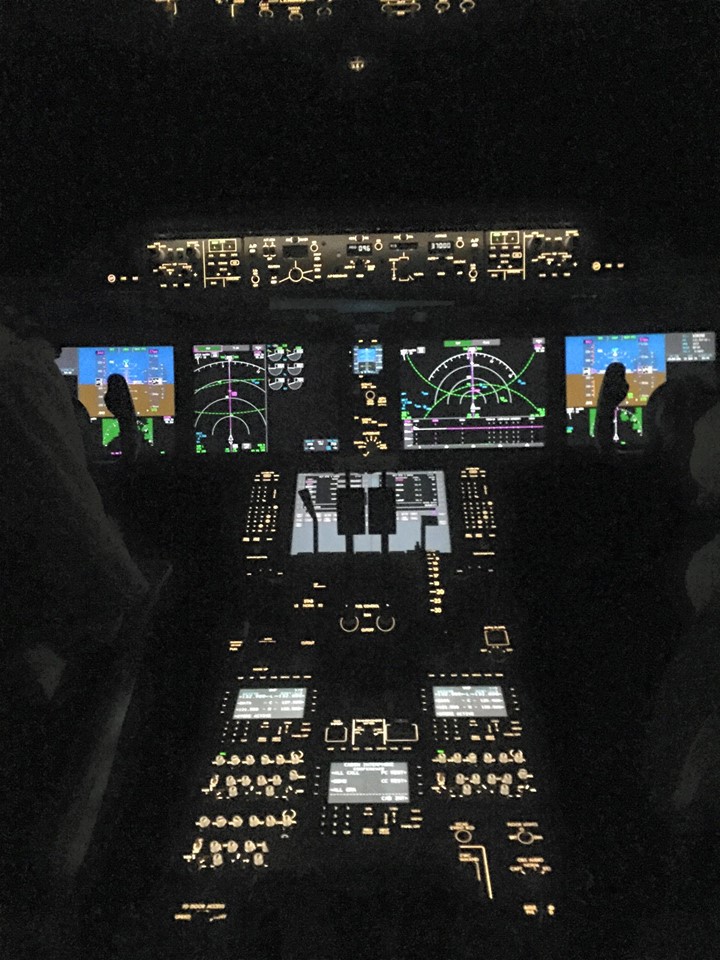


On the night shift

All's quiet on the night shift
All’s quiet on the night shift

A pilot friend put this up on FB. Isn’t it a work of art?

It’s a Boeing 787-9 flightdeck, taken at FL370 over Russia at 19:09Z about 4h 30min into a London-Shanghai flight.

The crew had darkened the cockpit hoping to see the Perseids meteor shower, because it was due that night. One of the cabin crew entered the cockpit, liked the visual effect, and asked to take a picture.

Voila!

La Réunion, that wing flap, and MH370

The wing flap that has drifted ashore in La Réunion on the western side of the Indian Ocean may well have come from the Malaysia Airlines Boeing 777 that flew the ill-fated flight MH370.

But if it really was a part of that aircraft, does it help the search for the main wreckage?

Unfortunately no. It certainly does not mean the wreckage is near La Réunion.

This flap section has been afloat since the aircraft hit the sea on 8 March 2014, a year and four months ago. It has drifted a long way in that time, and tracing it back to its possible origin using a model of the prevailing sea currents and winds would provide such a massive approximation that it would indicate a larger search area than the one the Australian government has already searched, and which it continues to search right now.

The Indian Ocean’s main sea current system flows anti-clockwise, so if the aircraft did indeed crash in the area off the west coast of Australia where the search is taking place, the flap – and possibly other parts – would have been carried north, then westerly, then southerly, which makes La Réunion a plausible location for it to wash up. So the find certainly does not invalidate the present calculations.

Does it tell us anything new about how the aircraft was lost?

Again, unfortunately no. The experts reckon the aircraft had nothing wrong with it, and that it crashed into the sea when it ran out of fuel.

That is because an aircraft that sets off for one destination, makes a U-turn and then flies successfully for hours in the wrong direction while it could be seen on radar, and probably many more hours when it could no longer be seen, had nothing structurally wrong with it.

The favourite explanation from all the major players in the industry is that the disappearance of MH370 was a deliberate act by someone in control of the aircraft. In the light of the Germanwings crash earlier this year, deliberately carried out by the unbalanced copilot, that explanation now has additional credibility with the public.

If the flap is indeed from MH370, the discovery finally lays to rest two theories: sadly but inevitably, those who lost relatives on the flight and were still hoping that the aircraft had safely landed in a remote place, will now be confronted with the reality that the aircraft broke up, probably on impact with the sea; and finally those conspiracy theorists who reckon the CIA hijacked it to Diego Garcia – or anywhere else – are going to have to search their imaginations for an alternative explanation.

The risk of “deliberates”

In the five fatal airline accidents in the first six months of this year 65 people died, while another 150 were killed in the Germanwings aircraft, which was not an accident.

This bears comparison with the first six months of 2014, where there were five fatal accidents causing 28 deaths, plus the enigmatic disappearance of MH370 in which 239 people were lost. Although it cannot be proven, most industry experts believe MH370’s disappearance was a the result of a deliberate act by someone on board.

In terms of fatal accident numbers for the same period each year in the last decade, 2015’s accident figures equal the best. But the “deliberates” are beginning to pose new questions about airline safety, because there was one in 2013 as well – that’s three “deliberates” in three years.

The 2013 “deliberate” involved Mozambique airline LAM which lost an Embraer 190 twinjet and all 33 people on board under the same circumstances as the loss of Germanwings flight 4U9525. That is, one pilot left the cockpit, the other locked him out and deliberately flew the aircraft to impact.

The question is: do three such “deliberates” in three years constitute a trend or a coincidence?

Statistically there’s not a strong case for calling it a trend, but neither can it be ignored.

Look at similar cases before the LAM loss: Egyptair 767 in 1999, Silk Air 737 in 1997, and a Royal Air Maroc ATR42 in 1994. So, in that period 1994-1999 there was one loss every two years. Then there was a long gap – 13 years – with no deliberates. Then between 2013 and 2015 there were three: LAM, MH370 and Germanwings.

Hijacks are also “deliberates”, but since the adoption of the post-9/11 fortress cockpit, plus anti-hijack cabin crew drills, hijacks have been eliminated.

Sabotage is a deliberate act, but security is now so extensive that even those who have smuggled small quantities of explosives on board have failed to detonate them effectively.

So the only “deliberates” against which the industry has no effective defence are those that can be carried out by people in the cockpit or with authorised access to it.

The nearest the industry has come to a defence against this risk is never to leave a pilot alone in the cockpit, so if one of them leaves it, a member of the cabin crew has to replace him or her. This is a useful psychological technique for making it less likely that a pilot in a suicidal frame of mind would initiate a plan when there is a witness to it. Less likely yes, but not impossible.

What is needed is some careful study, probably across other industries also, of people – and their life circumstances – who use their workplace either to end their own life, or for a revenge motive resulting from resentment so embedded that their own survival becomes irrelevant.

If this three-in-a-row set of deliberates is a trend, is it generated by societal changes, including working cultures, or is it just a matter of chance associated with the power and opportunity that control of an aeroplane confers?

Such a study would be complex and may not be conclusive, but that is no excuse for failing to carry it out.

2015 airline safety at the half-way point

With just a couple of days to go to 2015’s six-month point, global airline safety stats for the period are looking pretty good but – depending on how you interpret them – not as good as 2014 at the same point.

Before you decide how to interpret the accident/incident figures you have to make a decision on whether MH370 last year (missing Malaysia 777) and the Germanwings A320 crash this year were accidents or deliberate acts. They were certainly fatal.

Leaving both those events out, neither year has much left to declare in terms of conventional airline accidents. There were five fatal accidents in 2014 at this point, and there have been four in 2015 so far, but the accidents killed more people this year – if still a small number in historic terms.

Accidents, gratifyingly, continue to get fewer, but it is fascinating to see how the types of accidents are changing. If the industry is to continue getting better it has to understand what’s going on.

In the 28 July issue of Flight International I will still be responsible for the magazine’s customary global airline safety analysis at the half-year point. The figures will be complete, of course, and all the accident details will be listed and described.

Meanwhile there are two days to go between now and midnight 30 June. A lot can happen in that time.


Perspective on a century of military aviation history

Defense d'entrer sign

A few days ago, on 12 June 2015, I arrived at St Omer aerodrome near Calais, France.

The date was not accidental: exactly 100 years before – on 12 June 1915 – my grandfather Second Lieutenant Leonard Wright Learmount, reported to St Omer aerodrome for active service on completion of his pilot training for the Royal Flying Corps.

Log book arrival in FranceThe page in my grandfather’s flying log book that records his arrival in France and his first sorties from the St Omer aerodrome. I left a scanned copy of this page with the Aero Club members who welcomed us there.

St Omer has been a continuously active airfield since it became the RFC’s main air base for operations in support of the British military on the Western Front in the 1914-1918 Great War. It is still active today courtesy of the Aero Club de St Omer.

St Omer taxiing for take-off on rwy 09-27Taxiing along runway 27 for take-off on 09. The other runway is grass

Less than two years after his arrival in France with exactly 24h flying time in his log book, Major LW Learmount became commander of No 22 Squadron in 1917. He survived the war. Most aviators didn’t.

It took a long time for the significance in military aviation history of St Omer to be recognised publicly. But now it has been. The aerodrome is the site of the recently created British Air Services Memorial.

Air Services Memorial and aerodromeI take my hat off to those who survived and those who didn’t

Air Services Memorial

In its heyday in 1917 and 1918 St Omer was the biggest RFC aerodrome anywhere. It was the RFC headquarters and main support base for the entire airborne effort over the Western Front. About 5,000 personnel were based there – mechanics, fitters, pilots, and all the support and logistic trades.

Now it is the home of the small but proud Aero Club de St Omer. Its runways are too small to support any form of commercial aviation, but the Club members have a powerful sense of the history of their aerodrome and have set up a mini-museum in the WW2 Luftwaffe-built hangar that houses the Club and its aeroplanes.

In the St Omer hangar

St Omer Aero Club museumThe Aero Club de St Omer historic record on display

St Omer & the RFC

Below: Sqn Ldr LW Learmount RAF ( I have no pictures of him in RFC uniform)

LW Learmount in RAF uniform 2

While he was operating over the Western Front he was clearly asked – or perhaps ordered – to write an account for the folks back home of what it was like to be doing his job. This appeared in a newspaper: I think probably the Daily Mirror during 1916 but no detail was written on the cutting.

RFC at the frontNewspaper cutting (1916?)

Capt WE Johns, author of the Biggles series of adventure books for boys, could not have put it better himself.

LW Learmount was wounded twice, but his account is written in such a casual way that it is difficult to feel the danger, the fear, and to imagine the horrors he saw each day when he flew over battlegrounds like the Somme, Passchendaele and Cambrai.

Air Services Memorial 1914-1918My son Charles and I complete our St Omer pilgrimage

But fear he must have felt. In the citation for his award of the Distinguished Service Order, it says this about a photo-reconnaissance flight on 10 May 1917, on which he was wounded, but managed to fly his machine back to base: “On nearly all the other occasions on which this officer took oblique photographs his machine was literally shot to pieces and his escape from injury really miraculous.”

 (Below) My grandfather after the war. Here he is standing next to a de Havilland Cirrus Moth floatplane at Seletar Creek, Singapore, in about 1930, where he was a founder member of the flying club there.

Poppa with DH MothLeonard Learmount