Learmount.com’sseries on awful airline experiences today looks at a European carrier’s attempt to persuade booked passengers that their trips will not be as bad as the online reviews.
Holidaying passengers flying Vueling are promised that they can start winding down – or up – as soon as they’re airborne. Here’s the just-announced pan-Europe mix of goodies in the Barcelona-based carrier’s bespoke summer cocktail, dubbed “Vueling in the Clouds”: Cava, ratafia (a sweet dessert wine), gin, limoncello, and elderflower liqueur.
This chilled delight is topped, according to Vueling’s press release, with a “cloud of candyfloss” – presumably supplying the promised “instagrammability”. If that doesn’t put the stressed travellers in a good mood, nothing would.
Looking at Tripadvisor reviews for Vueling, nearly half score in the “terrible” category, and if you add the “poor” votes as well the total comes to well over half. Complaints range widely from delay, cancellation and overbooking to awful customer service. On the other hand, adding the “excellent” voters to the “good”, together they make up less than a third of the total. Very few fliers seem to tick “average”.
In “Overview”, Vueling scores 2.5 out of 5. The only categories where scores beat 2.5 are value for money, cleanliness and check-in/boarding. Even those, however, don’t exceed 3 out of 5. However, there are nearly 4,000 (out of about 35,000 reviews) who rated Vueling excellent, so at least some passengers get lucky.
Don’t kid yourself: luck is what gets you a “good” low-cost flight. You’re not expecting much, so if absolutely nothing goes wrong, the trip will feel excellent. On budget airlines margins for everything, commercially and operationally, are so tight that it is rare for everything to go right for every passenger.
Sad though it is to have to admit it, alcohol can indeed do the trick. A trip I took with EasyJet recently was pretty stressful at every stage from check-in to disembarkation, and I found myself shoe-horning my creaking frame into the tightest seat row I have ever experienced. Once seated, I felt awful about the prospect of the 3h flight ahead.
Normally, if I choose to drink on flights, my purpose is pleasure and relaxation. This time I wanted oblivion. One G&T later I was feeling slightly better, and after a second I felt ready to forgive EZY and its crew. It had worked, and EZY’s bar had profited.
That’s what Vueling hopes to achieve, but there are risks. Alcohol doesn’t always pacify passengers, and it’s the cabin crew who are left with the task of managing the results.
Maybe the answer is a general anaesthetic delivered via the cabin air conditioning. Meanwhile, “Vueling in the Clouds” will have to do.
On second thoughts, maybe it was irresponsible of me to make that suggestion, because Michael O’Leary (Ryanair’s boss) might yet sell it to you as an option!
Ryanair has been identified in the UK Consumers Association publication “Which?” as the air carrier against which airline awfulness is benchmarked, and it has found that – by one particular measure, British Airways is even worse.
Airlines examined in this survey are among those offering services to or from British airports, and Which? says it is based upon a survey of 6,500 passengers who travelled in the last year. The consumer champion reports “a gulf in standards between the best and the worst”, and it places Jet2 comfortably at the top of short-haul ratings, with Ryanair at the bottom (and Wizz almost as bad).
In long-haul, Singapore Airlines tops the league, with British Airways firmly at the bottom of the nineteen carriers listed, and Air Canada close to it. Indeed, the mighty American Airlines scores much the same as BA, but can claim a Customer Score of 65% against BA’s 62%.
Which? scores all the airlines on 12 categories across the service spectrum. In each category airlines can win from one to five stars, and an overall customer score out of 100. As an example, Jet2 (short-haul) earned five stars for customer service, four in several categories, and in none of the cateories did it win fewer than three stars. Ryanair, on the other hand, didn’t earn more than two stars for anything, and scored one for boarding, seat comfort and food.
Asked by Which? to comment on the survey results, Ryanair had this to say: “Ryanair this year will carry 200m passengers…Not one of our 200m passengers wish to pay “higher prices” as Which? falsely claim.”
Indeed, Ryanair has always been totally unapologetic, as I pointed out in my recent obituary for enjoyable air travel “Surly Bonds (Part 2)”. Quote: “One of the industry’s extant personalities, Ryanair’s chief exec, Michael O’Leary, almost encourages the impression that he chuckles at the pain he can persuade his passengers to undergo to knock a Euro or two off their fare! They just keep coming, he crows. And he’s right, they do – in ever larger numbers!”
But what excuses can British Airways field? It scored lower even than Ryanair on its response to customers who ask for assistance of any kind. Meanwhile on short-haul its highest score was three stars, with a mere two for boarding, seat comfort, food and value for money. On its long-haul routes BA earned four stars for its booking process, but only two on seat comfort, food, cleanliness and value for money.
The UK flag carrier responded: “This research from Which? is entirely at odds with comments from the hundreds of thousands of customers who we know do travel with British Airways and then tell us about their experience.” BA then, in a style reminiscent of recent UK politicians attempting to mitigate dire poll results, lists all the investment it has recently made in cabins and customer service, finally adding: “This [feedback] is also reflected in a recent independent study from Newsweek, which surveyed 17,000 people who voted us their Most Trusted Airline Brand.”
Great brands – and British Airways was indeed a great brand not long ago – can survive a period in the doldrums, but trust can quickly be squandered.
This blog has already vented about the deadly tediousness of air transport today, and the complacent acceptance by the industry of mediocre standards. Flying used to be considered a glamorous and exciting mode of travel, and could be again if spiced with a little imagination.
If that imagination is not invested, the air travel industry will be self-limiting, and environmentalists will be able to celebrate its shortcomings.
Most airlines no longer attempt to sell air travel as exciting or glamorous, because these days it usually isn’t. We examined that indisputable fact here quite recently.
Air France, however, is trying a new marketing idea to inject some romance into its product. I don’t believe this trick has been tried before – at least not by an airline.
Indeed, I’m not sure any other carrier could even hope to make this idea fly.
But Air France flies the flag of a country that’s home to the concept of Haute Couture, and home also to LVMH, by a massive margin the biggest luxury goods purveyor in the world. And its hub is Paris!
If ever there was a magic metropolitan brand name, Paris is it.
LVMH may not mean anything to most people, but its brands do. It owns Dior, Givenchy, Louis Vuitton and Moët Hennessy, to mention but a few. It doesn’t own Chanel, but that name evokes Paris anyway.
So what is Air France trying to fly?
Its own perfume. Or, as the British upper classes prefer to call it, scent.
It’s called AF001, the flight number of the legendary Air France Concorde departure from Paris Charles de Gaulle for New York JFK.
If the glamorous associations with Paris France don’t sell it to ordinary passengers, that magic flight number will ensure romantic aviation buffs buy it for their wives and girlfriends!
Let’s test the power of an idea, because British Airways flew Concorde too. Couldn’t they try it?
What images does the name of BA’s base, London, evoke? Not a scent, surely, nor romance. Maybe energy, like New York? And Burberry may be famous, but isn’t up there with Hermès and Chanel.
And the airline names: Air France proudly uses its country’s name, whereas British – as in Airways – is an adjective. In branding, these things matter.
Meanwhile other companies have tried to harness the sense of smell, but usually for the purpose of exploiting an already strong brand name to generate a side-hustle that might be a good earner. Harley-Davidson tried it, for example, but would you buy the stuff? If it didn’t smell of oil and come packaged with a guttural sound-track, what’s the point?
Anyway, what does Air France have to say in its press release about its AF001 fragrance?
The airline hired Francis Kurkdjian, master perfumer and artistic director of Maison Francis Kurkdjian, to create the new scent: ‘I’m very proud to have created Air France’s first signature home fragrance. It was the illusion of a ray of sunshine on the wings of an aircraft that inspired me to create this light, fresh and comforting home fragrance’.
Fabien Pelous, the airline’s Customer Experience Manager, waxes lyrical: ‘The Air France travel experience now elevates all five senses: sight, with the haute couture uniforms of our staff, our cabin interiors, and the meticulous design of our lounges, taste with the delicious dishes on the menu on board, touch with the soft fabrics of our seats, sound with our playlists on board, and now smell with this prestigious signature fragrance’
The marketing department says the fragrance will become part of the AF ambience: “Air France will be gradually using AF001 in its lounges in Paris and around the world over the coming months. Evoking a feeling of space, calm and light, AF001 accompanies travelers in style. Its comforting musky scent, combined with mimosa from the south of France, adds a sunny, natural vibrancy. Created with hints of jasmine and rose, its delicate floral aura takes travelers on a real olfactory journey, capturing a specific moment in time.”
Personally, I salute any move to bring glamour back to airline travel – or at least to attempt it.
Here’s another test of the idea: what would a perfume called Ryanair or Southwest Airlines smell like?
“Oh I have slipped the surly bonds of earth and danced the skies on laughter-silvered wings” (Pilot Officer John Gillespie Magee Jr RCAF)
There are probably millions of people aged in their twenties who have flown many times and never felt the magic. Before the new century arrived, almost all air travellers would have felt that frisson at the moment of unstick.
What has changed? That is the question.
Where is the excitement? Where is the airfield? Where are the aeroplanes?
For at least two decades now, economy air transport has been far cheaper than it was twenty or 30 years ago. But, Humble Traveller, you sacrifice much for that privilege! Almost certainly far more than you realise, especially if you are less than 30 and have never experienced anything different.
Today, from the moment of clicking into the online booking process to the point of your expulsion into your destination arrivals hall, the total air travel experience feels as if it is designed to humiliate air travellers. There are definite parallels between the way the low cost carriers (LCCs) treat their passengers and the way reality television shows test minor celebrities’ capacity to cope with public acts of debasement for the entertainment of viewers.
But it doesn’t have to be like this! Dear Ryanair (et al), it’s quite possible to deliver the absolute basics of air travel without making passengers feel they they are being punished for their parsimony!
Indeed one of the industry’s extant personalities, Ryanair’s chief exec, Michael O’Leary, almost encourages the impression that he chuckles at the pain he can persuade his passengers to undergo to knock a Euro or two off their fare! They just keep coming, he crows. And he’s right, they do – in ever larger numbers!
Why do passengers accept it?
Consider, Humble Traveller, what you are persuaded to undergo to purchase this flight.
At the website, you choose your departure point and destination, then scan the flights for the best value trip. That done, you decide what baggage – if any – you will check in, and what you may carry on board. Both these choices will add to your fare.
Then select the seat you want. Airlines, of course, are obliged to provide seats, but choosing a specific seat may drive your fare yet higher.
Finally, you are asked whether you want to pay a premium for the privilege of boarding ahead of other passengers. Quite why anyone would want to occupy a cramped seating space for any longer than necessary is not clear, but some people volunteer to pay for it, which adds to the impression that the airline, having successfully captured you, is playing with you like a bored cat.
You may, by now, have paid a total price for your trip that is up to three times the face-value of a luggage-free flight. And you haven’t even made it to the airport.
Airports, once exciting places to visit, with open-sky vistas of aeroplanes doing what aeroplanes do, are now a challenge to reach, hidden within concentric zones of increasing security designed to deter all but the most determined passengers.
Friends or family delivering you to the airport by car are confronted, on approach, with signage directing drivers to specific lanes for short-stay parking, long-stay parking, public transport drop-off lanes, VIP drop-off lanes, private drop-off lanes, all monitored by video-cameras with number-plate recognition software. Don’t dare get into the wrong lane or security men will swarm your vehicle and direct you around the system a second time to collect a second drop-off charge – or at least the fear of it!
Finally, when you drop off your passengers, the terminal entrance is several hundred metres away, with no porterage. Trolleys – if available – are distant.
A particularly awful airport to deliver to is London Gatwick North Terminal. It used to be light and easy, but now the infrastructure surrounding it has burgeoned, and innocent passengers find themselves dropped off in a skyless concrete chasm between the row of multi-storey car-parks and the terminal itself. This underground labyrinth feels like one of those abandoned warehouses in which criminals and cops have their final shoot-out in the movies.
Within this scary underworld the hapless travellers – rapidly abandoned by their driver who fears being charged for exceeding the permitted drop-off duration – are challenged to find a terminal entrance that will, hopefully, deliver them to a well-lit space for check-in.
The relief, when they do make it to the check-in hall, is overwhelming.
But that’s only the first hurdle. Now they have to negotiate the self-service bag-drop and baggage-labelling process, plus hefting 23kg bags onto a raised belt. Heaven help people who are old, frail, or partially sighted, because the airline won’t.
Having dispatched their bags – an act of faith – to god knows where, the travellers submit to robot-managed identity checks followed by security searches. Bags and belongings need to be hefted into trays, laptops separated, valuables exposed to public view, jackets off, watches off, pockets emptied, belts, shoes and spectacles removed, and all this personal kit is travolated away from you into the dark maw of the X-ray machine. Will you see it again, you wonder?
You, meanwhile, have to stand in a scanner arch with your hands held high, then undergo a pat-down check while your shoes are prodded by a hand-held sniffer wand designed to detect explosive traces.
All this is immediately followed by getting dressed again, in public, and recovering and re-packing your scattered possessions.
You have now made it to “airside”.
The assaults on your senses are not yet over. Immediately you are forced along a long and winding path through blindingly floodlit displays of costly bottles of scent, malt whisky, and other non-essentials before making it to the departure concourse, where you are confronted with the information that your flight has not yet been allocated a gate.
In most terminals, at this point, there is still no view of the outside world. There is still no sense that you will soon be “slipping the surly bonds of earth” in your sleek, 21st century version of a magic carpet. Still absolutely zero sense of anticipation.
Suddenly your flight is allocated a stand, and you have ten minutes to walk about a kilometre along blind corridors to a gate lounge which may – if you are lucky – provide a first glimpse of your flying machine.
At this point the boarding charade begins. The passengers all know they have an allocated seat, yet many choose to stand in a queue for the final security check before shuffling slowly down a blind, steeply sloping boarding pier toward the door of an aeroplane they are – seemingly – not permitted to see.
The last act before take-off is stowing bags and getting into a seat row so tightly spaced that, once there, the ability to move any appendage is painfully limited.
Remember, all this suffering has been entirely voluntary on your part. You knew it would be like this, but you chose it. Don’t blame O’Leary!
Or should you?
Yes you should. This has to change. You don’t have to endure this.
The LCCs have made their point, and have delivered cheap flying. We, the passengers, are educated now, and will not demand expensive privileges on the basic A to B service we can reasonably expect.
But the airlines and the airports have now to deliver that service with respect for their customers. They could. It would cost little, and improve business.
For the airlines, that will start with respecting their crews. A happy airline attracts happy customers, and that’s good business.
The airports have more work to do, starting with better design of the passenger spaces from drop-off to boarding. Retail maximisation should not dominate policy. Stressed, bored passengers are not in the mood for spending money en route.
Finally, make use – once again – of the natural glamour of flying to attract people back to the sky, by letting them see the airfield and its activity. Give them space to dream – along with Pilot Officer John Gillespie Magee – of “topping the wind-swept heights with easy grace”.
Well, not quite. But something promising has emerged on the pilot training market just as the world’s airlines are beginning to slip the surly bonds of earth once more.
The newly created Airline Pilot Club (APC) offers free registration, and a whole range of advice, guidance, professional aptitude assessment, airline pilot standard e-learning course and tech webinars, for all of which there is no charge.
To access this, all that aspiring pilots have to do is join the club.
APC is a kind of marketplace which brings together selected Approved Training Organisations (ATO), airlines and other operators, and aspiring pilots. As at all marketplaces, they are there to eye each-other up.
The downside? There isn’t an obvious one.
But free flying training? Now you’re getting greedy!
No, it doesn’t offer that, but by the time aspiring APC pilots reach the airborne stage of their preparation they will know their own potential, and be as well prepared as they can be to enter an approved training course from which they will almost certainly graduate.
APC doesn’t provide the flying training, but it vets its short-listed ATOs according to a set of strict criteria.
As for financing, next year the Club expects to launch its pilot training funding system. This is designed to enable students who pass their professional aptitude assessment to get financing without having to rely on the bank of mum and dad, which will democratize access to flight training, thus benefiting the entire industry.
The guy who came up with the APC idea is well-known in European pilot training and recruitment circles: Captain Andy O’Shea. He was head of training at Ryanair for 18 years and chairman of the European Union Aviation Safety Agency (EASA) Aircrew Training Policy Group (ATPG). You can learn more about him and the training innovations he pioneered at the ATPG here.
It was O’Shea who shocked the airline and training establishment by revealing a few years ago that more than 50% of fully licensed pilots applying for Ryanair jobs consistently failed flying tests in a simulator session for which they had been given plenty of time to prepare. Other airlines then admitted their experience had been similar.
The author and O’Shea in his days as Ryanair Head of Training
Not many people know this, but there are about 7,000 fully licensed pilots in Europe who have never been able to get a job. Not because they were casualties of the recent pandemic – this phenomenon pre-dates that. They were simply trained to license minima, and passed. It was like someone passing their driving test and looking for a job in Formula One.
So when O’Shea, having introduced several highly innovative recurrent training systems at Ryanair, finally left the carrier, he wanted to set up a system that introduced aptitude-tested, motivated, technically prepared wannabe pilots to ATOs that would then put them through a training programme that prepares them to do more than scrape through their license.
This is the course that would see them pass the acceptance check-ride at his old airline.
There’s more, but you’ll find it at the link I provided earlier, and at APC.
Air travellers are dreaming nostalgically of the golden age of flying.
No, not the Pan Am Stratocruisers of the 1950s for which the boarding pass was elegant millinery for the ladies and trilbies for the chaps. The golden era ended two years ago, at the end of 2019. And we’re talking about the whole air travel range from Wizz Air A320s to Emirates A380s.
Guests at hip dinner parties now compete to see who can claim to have gone the longest since they last got airborne. This is not, dear reader, a “who is the greenest” competition. Their agonising anecdotes drip with nostalgia. Even Ryanair customer-service horror stories qualify for full-on “those were the days” treatment. It seems memories of a 17-inch seat-pitch with no seat-back pouch to hold your stuff are recalled fondly.
Anything for a sniff of aviation fuel.
To listen to them, you’d think these intrepid voyagers would kill to get aboard any aircraft given permission to get airborne since the Covid pandemic’s grip slackened last summer. So why don’t they? Why are the winning dinner party anecdotes those that claim the longest grounding?
The long-suffering airlines are doing their best to win passengers back, but the principal barrier preventing them returning to anything like normal service is uncertainty, particularly on international routes. Domestic routes in big markets like the USA are almost normal, since they don’t face differing national rules on how to manage borders in a pandemic.
In the Good Old Days of 2019, business leaders could get on with running their businesses. Now nationalism is in – and treaties/alliances are suddenly uncool – they have to negotiate continually with governments both at home and abroad, to agree ways of meeting the ever-changing rules that limit what they are permitted to do today.
Unfortunately, uncertainty is with us to stay, even when the pandemic is brought under control, because nationalism has been on the rise since the Trump presidency in the USA, Brexit in the UK, and the influence of increasingly belligerent governments in Moscow, Budapest, Warsaw and Beijing.
However hard they try, cabin crew and pilots cannot entirely disguise the stresses they face in this new working environment. And when stressed cabin crew meet stressed passengers who have been juggling for days with Covid tests and providing proof of them on arrival at the airport, the golden age seems far away.
There has been a severe shortage of happy stories about air travel, but a few glints from the golden age may yet be in the offing.
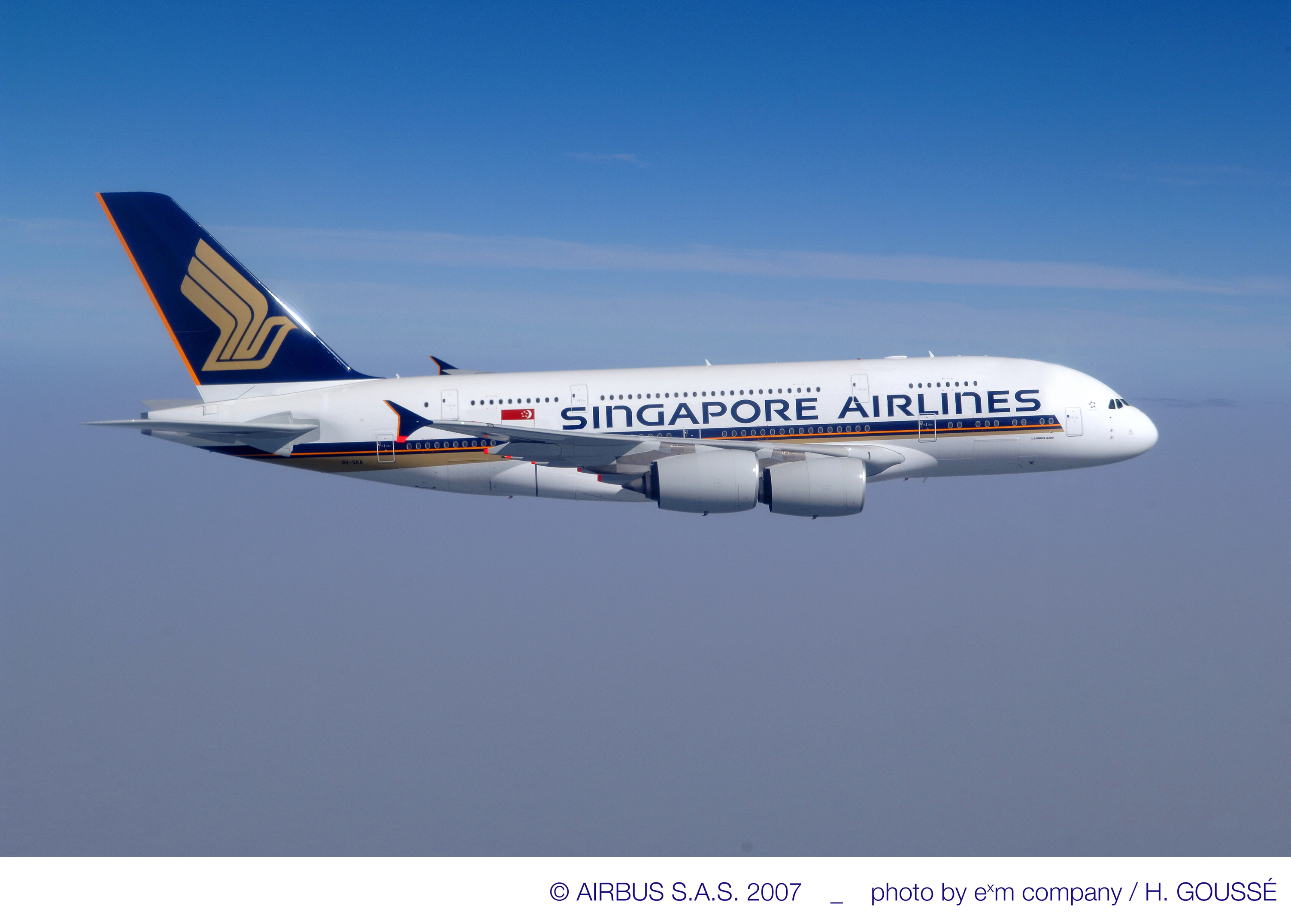
Airlines like Emirates, Singapore Airlines, British Airways and Qantas are wheeling A380s out again, their press offices fondly reminding passengers that this huge machine provides perhaps the best air travel experience available – even in the economy cabin.
Marketing air travel is not easy right now, but one thing is for sure: selling air travel nostalgia is one of the few tactics likely to work.
A radical change in pilot training philosophy is being implemented in Europe over the next four years, overseen by the European Aviation Safety Agency (EASA).
A few airlines and approved training organisations (ATO) are ahead of the curve, but most are struggling to keep up.
The present systems for airline pilot training and recruitment have been under scrutiny for many years, and for good reason: they were designed for an earlier era.
Despite the scrutiny, however, nothing much has changed. But it is about to.
When airline accidents happen these days it is the result – more often than not – of a mistake or misjudgement by a person. Often by the pilot. But airline pilots are the product of the system that trained them and the airline that conducted an assessment before hiring them.
The fact that a new pilot has passed the existing exams and flying tests to win a commercial pilot licence (CPL) means he or she can be legally hired by an airline, but it does not mean he or she is a good pilot. It just demonstrates that a minimum legal standard was achieve on the days the tests were taken.
EASA puts figures on the relationship between pilots and accidents: “An analysis of fatal aircraft accidents worldwide for the period 2010–2011 shows that in more than 50% of these accidents the actions of the flight crew were the primary causal factor. This analysis shows that flight crew handling skills were a factor in 14% of the accidents, whereas flight crew non-technical skills were a factor in more than twice as many (32%).” Non-technical skills, basically, are knowledge, understanding and problem-solving.
Since 2011 the fatal accident rate has slightly decreased, but human factors causality in the accidents that occurred is as strong as it was in the earlier EASA study results.
During training for the commercial pilot licence and instrument rating (CPL/IR), some pilots pass the theory exam with the minimum score in the multiple-choice exam questions, and marginally pass the flying test – perhaps on the third attempt – but at a time of pilot shortages the temptation to hire anyone with a licence will inevitably increase.
Everyone in the industry knows this, but solving the problem will entail a cash investment in additional training. Few people – whether self-financing cadets or sponsoring airlines – are prepared to pay. It is easy to argue that accident rates are low, the attrition rates are therefore acceptable, and accidents happen to other people, so there is a temptation to do nothing.
In Europe the option to do nothing is evaporating. In January this year EASA triggered its plan for phasing in a total change in pilot training philosophy over four years, and by 31 January 2022 “at the latest” all airline training departments and ATOs in EASA countries must have implemented the changes. By that date, successful pilots will be graduating with their theoretical knowledge tested against a completely updated question bank.
The training philosophy changes entail moving away from “silo learning and testing” toward competency-based training, and from rote learning toward scenario-based teaching that confers understanding, not just factual knowledge. A new EASA concentration on “Knowledge, Skills and Attitudes” (KSA) embodies this philosophy change, the reference to “Attitude” indicating the need to select students for their approach to the learning process, which may speak volumes about their personal suitability for the job.
EASA observes: “Current teaching and learning tools are not sufficiently developed to encourage future pilots to use analytic and synthetic thinking or to challenge student pilots to enhance their decision-making skills, their problem-solving ability, and their level of understanding of assimilated knowledge.”
These are massive attitudinal changes. The preparation for them has been set up at ICAO level, but the practical changes EASA is overseeing have been driven, above all, by changes that have their origin in Ryanair’s training department. That airline’s head of training, Capt Andy O’Shea, also chairs EASA’s Aircrew Training Policy Group (ATPG), which has been working with the agency, the airlines and the training industry for several years now, and it has driven the changes now in the pipeline.
Now the largest European carrier by most measures, and still growing rapidly, Ryanair has a voracious appetite for new pilots, and became aware some years ago that there were problems obtaining the high quality crew they insisted upon. O’Shea revealed publicly that more than 50% of pilots who applied for Ryanair jobs were simply not good enough, whether ab-initio trained or even with airline experience. EasyJet has since confirmed it has had a similar recruiting experience.
A few years ago, despite this failure rate, Ryanair could still find enough good pilots among the applicants to meet its needs, but this is no longer true. It couldn’t wait for EASA and the industry to come up with solutions, so it set up its own in-house enhanced training schemes at entry for newly licensed pilots, simply because the raw CPL/IR product was not good enough, and even many of those who had added a standard multi-crew cooperation and jet orientation course (MCC/JOC) to their CPL/IR were not proving ready for a Ryanair Boeing 737 type rating course.
The result of Ryanair’s experience has been the evolution of a course – approved at EASA via the ATPG – called the Airline Pilot Standard MCC. O’Shea describes it as an enhanced MCC/JOC which takes in the KSA philosophy, and consolidates knowledge, skills and understanding through scenario-based learning. It adds about 20h to the training pilots get but, says O’Shea, a successful APS graduate is more or less guaranteed to pass the 737 type rating, and become a quality line pilot.
In the last few days Ryanair has gone further, and set up a mentored cadetship programme, working with Cork, Ireland-based Atlantic Fight Training Academy, which will produce 450 Ryanair-ready copilots over the next five years.
AFTA training fleet on its pan at Cork International Airport
O’Shea says Ryanair will be announcing more such alliances with European ATOs soon, driven by the need for large numbers of new flight-deck-ready pilots.
Meanwhile back on the line, Ryanair the employer is having to change too. It is evolving from the rabidly anti-union carrier it has traditionally been, into a company that recognises retention is as important as recruitment. Pilot and cabin crew union recognition is gradually being set up. This is not taking place without some hitches, but it looks as if they will get there in the end.
Most airline pilots approach their annual recurrent training simulator time in a rather apprehensive mood. After all, it’s more about testing than training, isn’t it?
That’s the image simulator training still has with line pilots.
But imagine if, at no cost to themselves, pilots could book a fully capable flight simulation training device (FSTD) for the type they fly on the line, and practice the skills they know they need to improve, with just a colleague in the other seat, but no instructor, and no Big Brother oversight.
The question is: would pilots choose, in reality, to book “private” simulator time, even if it were free of charge? Perhaps they would be tempted when a bi-annual recurrent training session was looming, or if they were preparing for command training.
Ryanair is offering a scheme like this to its pilots, and early trials show it’s popular with the crews who’ve tried it. More of that later.
Increasingly, feedback from crew reporting systems and operational flight data monitoring (OFDM) is identifying areas where additional training is needed, but most of these needs are not met by the recurrent training syllabus required by national aviation authorities (NAA), which is based on flying the way it used to be in the pre-digital era.
Despite the fact that good airlines increasingly conduct training based on an Advanced Qualification Programme (AQP), which allows the airline some flexibility to react to evident training needs, there tends to be insufficient time in recurrent training sessions for actual training once all the statutory exercises have been performed to meet the regulator’s requirement for testing.
A normal recurrent training session is not so much a case of being trained and then being tested on the skills learned, but of undergoing a test, then calling it training if you pass it.
The psychological circumstances of a test – or even a training exercise perceived as a test – are not conducive to learning.
As the concept of “evidence-based” – rather than syllabus-based – training becomes the recommended philosophy for recurrent training, the airlines are still jammed between the rock of the mandatory recurrent syllabus, and a hard place – namely the mounting cost of additional evidence-based training that goes well beyond the legal minimums.
Good airlines already go beyond the training minimums, but most just do what the law requires and stop there.
Ryanair already beats the minima, but is now extending that advantage by bringing on-stream a planned nine additional advanced fixed-base – but sophisticated – FSTDs beyond those needed to cope with growth.
These will be used for a combination of type-rating, remedial and voluntary additional training, effectively adding a full day to the annual total of recurrent training simulator time available to all pilots. Ryanair already has three of these devices – made by Utrecht-based Multi-Pilot Simulations – in operation: one at its Dublin HQ and two at its East Midlands, UK training base.
Ryanair’s head of training Capt Andy O’Shea has long wanted to give pilots the opportunity to develop their skills in their own time if they choose to.
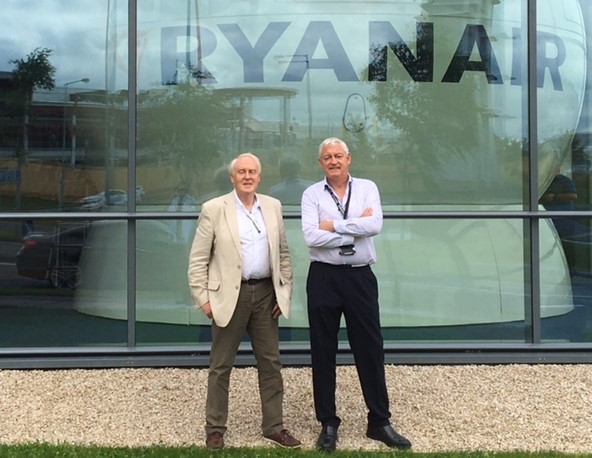
Learmount (L) and Capt Andy O’Shea in front of Ryanair’s Dublin training centre, the new Controlled Training simulator visible through the glass
At the same time the Ryanair investment in the sophisticated equipment has to be justified, and O’Shea was concerned that some pilots might use the kit for experiment, and end up with what he calls a “negative training” experience from a session.
So how do you give pilots the freedom to learn – and to consolidate their learning- in the areas they want to work on, but discourage them from barrel-rolling a 737-800 for fun, and at the same time convince them that Big Brother is not watching them?
O’Shea’s solution is a compromise. The hint is in the programme’s name: Ryanair Controlled Training.
Sure, the pilots who voluntarily book the simulator time are alone and unwatched in the device. It has a normal instructor operating station (IOS), but it doesn’t have to be manned. When they book the session, the pilots can choose from a menu of “lesson plans” entailing an origin, destination, and flight plan, and they upload it to the simulator when they start the session.
Before the pilots start the session they are provided with the instruction they need to operate the simulator, and then with payload and weather data to derive performance figures for the “flight”, and enter these into the FMS as they normally would.
Then they go through the normal checks, and “take off” using the standard instrument departure in the flight plan.
They just don’t know what else will happen en-route. But things will.
If they have trouble with a scenario they are presented with, they can freeze the simulator and discuss it, or try again, but there is a time limit for the sortie, so they have to get on with it.
Sessions are recorded, but O’Shea explains his philosophy: “We have no desire or intention to review each session for video or OFDM events. Our hope is that crews come to the FTD, practice their skills, improve their knowledge and leave feeling good about themselves.
So if OFDM exceedences will not trigger the curiosity of the Ryanair training department, what does? Straying outside the Boeing 737 flight envelope freezes the simulator, which then has to be re-set. Of course why that occurs would matter. For example upset prevention training (UPT) is programmed into some lesson plans, but recovery from extreme attitudes is not.
O’Shea says the new system provides an whole array of possibilities for voluntary pilot bookings, including: maintaining handling skills, UPT, left-hand seat practice for prospective captains, RHS practice for prospective instructors, and recurrent simulator training core competencies improvement.
But O’Shea says the kit also provides Ryanair with additional flexibility to test corporate safety strategies, carry out new airfield evaluation, assess FMC database updates, and familiarise pilots with new flight crew operating manual procedures.
It can also carry out follow-ups for real OFDM events on the line, because the simulator can replay them for crew to experience.
At present Ryanair Controlled Training is new, and there are only five lesson plans on the menu.
But there will be many more, promises Capt O’Shea.
UK-headquartered aviation law specialist Clyde & Co has gone public with basic advice on how the Brexit referendum vote could affect British registered carriers. At a time when shares in UK commercial air transport have been harder hit by the referendum vote than almost any other sector, this advice is apposite and helps the un-initiated to understand why they have taken such a hit on their equity values.
Clyde makes clear that the legal landscape is complex, and here I am only presenting the simplest part of their advice relating directly to intra-EU and UK-EU services. Exit from the EU also affects British carriers’ bilateral air service agreements with North America and the rest of the world.
This is what Clyde says: “The most significant consequence will be that air carriers which have been granted their operating licence by the UK CAA will no longer be “Community carriers” for the purposes of EU Regulation 1008/2008 (“Regulation 1008”), and thus will no longer be able to enjoy the right to fly between any two points in the EU/EEA that is conferred by such status under the Regulation.
“In the absence of any other arrangements, the old bilaterals between the UK and the other EU Member States, which have been overtaken by EU liberalisation and hence dormant for years, would become effective again, and should provide a sufficient legal basis for most 3rd and 4th freedom services, but in most cases only those two freedoms.
“The services most affected will be 7th and 9th freedom services – in other words, between two non-UK points in the EU (eg, Amsterdam – Barcelona) and between two points in the same EU Member State (eg, Rome – Milan), which would no longer be automatically permitted.” End of quote.
On the other hand the EU has been pretty much an Open Skies organisation toward Norwegian regarding its intra-EU services. Norway is not in the EU but is in the European Economic Area, and its most rapidly growing airline has been permitted the kind of freedoms most EU-based carriers enjoy.
That does not mean the EU is compelled to be liberal toward British carriers’ intra-EU services, but they might be.
EasyJet would be the most affected of all British carriers because of the huge number of intra-EU and UK-EU services it offers. While it had always made clear its wish for the referendum vote to favour remaining in the Union, it clearly has Brexit plans up its sleeve and isn’t panicking.
And although it says it doesn’t want to move its HQ out of Luton and into an EU state, if it had to do so it could. Then it would be able to register its company and its fleet outside the UK, like its arch-rival Ryanair, which is registered in Ireland, an EU state.
The issues regarding services from the UK to the rest of the world are manifold, because the EU has, for many years now, overseen – and used its negotiating weight in – bilateral agreements between all EU states and the outside world. And some of Norwegian’s applications to serve the USA from European countries other than Norway have bounced off a rubber-brick wall on America’s eastern seaboard, because it is not the EU’s job to support non-EU airlines’ applications. Norwegian’s negotiations with the USA over services by its UK division have become even more difficult since the Brexit vote.
There will be a lot of talking to do during the next two years while the UK continues to enjoy the privileges of EU membership, but in the meantime the uncertainty generated by this limbo situation is causing considerable stress in the industry.
Ryanair has found, consistently over the years, that half the licensed pilots who apply for first officer jobs fail its entry tests.
That’s not because the tests are particularly demanding, or because Ryanair springs unexpected things on them in the simulator. Wannabes all get a month’s warning of everything they’re going to face, and all the data they need to prepare for it.
Ryanair’s head of training Andy O’Shea told me his airline had recently considered backing future pilots via the MPL route, because that’s designed to deliver airline-ready pilots complete with a type rating.
But they’ve abandoned that idea because they think the MPL – as it’s organised right now – is too inflexible to cope with the vagaries of market demand. It locks the airline and the student into an 18 month relationship that may not survive market changes.
On the other hand the CPL/IR route prepares pilots to fly a light piston twin all on their own. It’s really only preparation for a good general aviation job, which is fine if that’s what you want to do.
Even if the twin is EFIS-equipped, it’s a million miles away from preparing a pilot for the right hand seat in a Boeing 737. And bolt-on multi-crew and jet-orientation courses are clearly not delivering, or Ryanair wouldn’t have that high failure rate.
O’Shea is looking for a way of plugging the skills and knowledge gap effectively between the CPL/IR and the right hand seat of a jet. If that can be done well – and he has been working on it with EASA and a working party called the Airline Training Policy Group – the students and the airlines would be able to enjoy the flexibility of the CPL/IR route, but it would produce the flight-deck-ready pilots that the MPL is designed to create.
He summarises what’s missing in those who fail their tests. They lack – to a greater or lesser degree – knowledge and understanding, flight path management skills, crew resource management ability, and what he calls “maturity and attitude”.
Basically, what O’Shea and the ATPG propose is a CPL/IR course extended to embed quality MCC and JOC components, including sessions closer to airline line oriented flight training than is done currently, plus some more advanced knowledge training. The result would be a course known as the Airline Pilot Certificate Course.
One of the possibilities is that the APCC would be available to students as one of the choices, as well as the MPL and CPL/IR as they exist today. That would not demand any more flight crew licensing regulatory work, but EASA could – and seems likely to – endorse the APCC as a valid qualification.
The question is, if the APCC is successful in attracting students and airlines, what would the future of the MPL be?
The CPL/IR could continue to be a stepping stone, via GA, into the airline world, and the MPL incorporating a JOC might be an alternative equivalent to the APCC.
This is still a work in progress, but something along these lines looks likely to win approval in Europe.



 Learmount.com