Amazon has been promising drone package delivery for a while, but the British Post Office is doing it.
This exercise has a certain experimental feel about it, with the remote Orkney Islands to the north of Scotland as its testing ground. Not exactly a high-rise urban environment, but a good start.
Brazilian drone manufacturer Speedbird Aero is working with operator Skyports Drone Services and Orkney I-Port, a partnership involving Royal Mail, the Orkney Islands Council Harbour Authority and regional carrier Loganair. Together they will conduct a three-month inter-island parcel delivery service trial. Speedbird’s DLV-2 cargo drones will be able to operate often in weather that confines the normal ferry services to harbour.
It will be easy to extend the trial period if necessary, because it is being carried out under existing regulations permitting extended visual line of sight operations.
Skyports has also been carrying out operations with California-based UAV maker Pyka using its Pelican Cargo electrically powered, fixed wing autonomous cargo drones.
The Airbus A380 is 15, and Emirates, the world’s largest operator of the type by far, is celebrating the success it has brought.
While aviation geeks delight in comparing its looks with those of Boeing’s great classic, the 747 – which usually wins in the popular beauty stakes – nobody who has flown the A380 as a passenger doubts that it provides an unparalleled travel experience. The first operator of the type, Singapore Airlines, and the biggest – Emirates – both quickly discovered that regular passengers would ask for the A380 departures on their chosen route if they could get them.
But will this last? I think so.
By the time Airbus stopped the A380’s production in 2021 it didn’t have anything like the sales success that the 747 had chalked up. As a result there aren’t many A380s out there. Because there are so few, the travel cognoscenti seek them out, and Emirates has most of them. It might even get to the point where A380s become collector’s items among the airlines. There’s nothing like scarcity to generate envy.
Simply put, the cabin is much quieter. It’s unnerving, because you can not only hear that fellow travellers are talking, you can hear what they’re saying. During mealtimes you can hear the chink of cutlery on plates.
The sheer size changes things. The A380 feels more like a ship than an aircraft, the internal space more like a deck than a cabin. The spaciousness makes you feel like taking a walk – priceless on long-haul routes. In Business Class you can stand at the bar and chat to the bartender.
Emirates will say things have been updated since 2014 when I took this photo
Airbus stopped production of the A380 in 2021 having sold 250. Compared to the 747’s sales of 1,500 (albeit over 50 years), it looks like a failure.
It was not a failure, more a misjudgement. At the time Airbus was developing the A380, Boeing was watching sales of the 747 gradually reduce and orders for the big twins burgeon. The US manufacturer forecast – correctly as it turned out – that the big twins would provide viable direct services to secondary cities, bypassing the big hub airports that the Jumbos had so ably linked, and making the great trunk routes less-travelled.
Meanwhile there has been a massive resurgence in air travel since the pandemic. People want to get out again. And for airlines lucky enough to be based at the world’s natural travel hubs, like Singapore, Dubai and London or Paris, the A380s that had been put into storage are out there working again.
Many competing pressures will vie to determine the future shape of long haul travel: consciousness of climate change is one of them, and in fuel-burn per seat the very latest big twins do better than the jumbo quads.
But all the signs are that people want to travel, for pleasure and for trade, and on the big trunk routes the A380 comes into its own. And when it’s full, it does achieve good unit fuel efficiency.
Given the A380’s advantages – popularity with passengers, and its sheer carrying capacity – watch this space to see how the A380’s place in modern air travel develops beyond its first 15 years.
Hundreds of airline pilots and cabin crew who have had their health permanently damaged by neurotoxins in aircraft cabin air joined a three-day multinational conference in late June to hear about the latest technical and legal solutions to the problems they face.
Hosted in London, England, the online Aircraft Cabin Air Conference drew in speakers and delegates from all time zones. Developments revealed at the event include a new blood test that scientifically confirms exposure to the specific organophosphates in jet engine oils that cause the harm by leaking into the engine bleed air that ventilates the cabin.
Also revealed was a new regulation to aid exposed crews and passengers: the US Cabin Air Safety Act. The purpose of the Act is to “improve the safety of the air supply on aircraft”, and it requires that all flight crew, maintenance technicians and airport first responders are to be given training – at least annually – on how to respond to “incidents onboard involving smoke or fumes”.
Meanwhile, in recent years, many medically harmed crew-members have – individually – been financially compensated by their employers for consequential health damage, but the air transport industry as a whole is still able to turn a blind eye to this fully understood phenomenon.
The reason the industry – the airlines themselves and the aircraft and engine manufacturers – appear to get away with tolerating such a recurring phenomenon is simple. Whenever they are challenged in the courts over cases of human health damage caused by contaminated cabin air, the companies settle out of court with the plaintiffs, who desperately need the compensation money because their career – as well as their health – is in ruins. So, the court does not get as far as delivering an actual verdict on the harm, the cause, or the blame.
Meanwhile a US law company, Littlepage Booth and Athea, has assembled a formidable body of technical and medical evidence on the effects of contaminated cabin air while representing harmed individual clients. The specific evidence these lawyers have gathered implicates only Boeing. That is purely because – they say – Airbus is a more complex legal task to take on in the USA.
Ironically, the only modern airliner in service today that does not use engine bleed air for air conditioning and pressurization is Boeing’s own 787, the most recent entirely new aircraft off its production line. The company explains it has abandoned the bleed air system in the 787 for fuel consumption reasons. But the 787 – also uniquely – does not use bleed air from its auxiliary power unit (APU) for cabin air ventilation, although there is no fuel consumption advantage in so doing. Law company partner Zoe Littlepage confirmed that the body of evidence against the manufacturer may be extensive, but until a trial has gone all the way through the courts and a verdict is reached, the status quo will remain.
The organophosphate contamination of cabin air is caused when aero-engine oil and/or hydraulic fluid leaks into the cabin air conditioning system, the air supply for which is drawn from the jet engine compressors. This contamination is not supposed to happen, but from time to time “fume events” occur when an engine bearing fails and the vaporized synthetic lubricants are “pyrolized” – partially burned – by the hot compressed air – and mixed into the cabin air that the pilots, cabin crew and passengers breathe. There is no filtration of this “bleed air” supply, and no detection systems to warn those on board when contamination is present. There is, however, usually an unpleasant smell, and sometimes visible smoke.
Pilots and cabin crew are more at risk than passengers, because even undamaged oil seals are not perfect, and there is constant leakage of the heated oil vapors in the bleed air into the cabin air at a very low rate. In some individual crew, the inherent toxins can slowly build up in their metabolism through repeated exposure, and because “aerotoxic syndrome” is still not legally recognized by the authorities, non-specialist medical doctors are unlikely to make a correct diagnosis of the resulting symptoms.
The authorities claim these very low rates of leaked fumes are acceptable, but that cannot be so because there is no designated rate or dose of these organophosphate-based neurotoxins that is defined as acceptable.
Fume events, on the other hand, are potentially dangerous to all. Passengers, however, are not generally warned of the risks when an event has occurred, and frequently the occurrence is not reported. And if – later – passengers suffer symptoms like persistent excessive tiredness, dizziness or “brain fog”, they may not connect their problems to their flight, and their doctor is unlikely to diagnose the problem accurately.
Evidence suggests the chance of a polar reversal of Earth’s magnetic field – a phenomenon known to have happened many millennia ago – may be particularly high right now. But the truth is, no-one knows for sure.
What is known is that, since 1990, the previously gentle migration of Earth’s North Magnetic Pole across the Arctic region of north-eastern Canada has accelerated significantly. Such an acceleration has not been recorded before, so whether this is a precursor to a magnetic polar “flip” is simply not known.
Meanwhile the Polytechnic University of Bucharest’s Faculty of Aerospace Engineering – an observer at the Attitude and Heading Reference Transition Action Group (AHRTAG) – has decided this possibility needs to be investigated, if only to come up with a case study to determine what the world’s navigators would have to do if the “flip” happens before the aviation industry transitions to navigation by True North.
The tentative date for that changeover is 2030. The marine industry is insulated against this problem because it transitioned to navigation by True North in the early 1970s.
Bucharest’s studies so far indicate that a polar reversal, according to geological data about a previous such event, could take place over a period of about 100 years, the poles tipping at a rate of about 3deg per year. Such a rapid polar migration would make the continuing use of the earth’s magnetic field as a heading reference totally impractical.
But no-one knows for sure whether the next “flip” will take as long as 100 years.
With this possibility in mind, it is tempting to re-orientate the studies of bodies like AHRTAG (a working group of the International Association of Institutes of Navigation) – so they move away from persuasion backed by data, and move toward simply agreeing the methodology for a transition to True as soon as possible.
But the plan right now is to continue persuading all the global players – airlines, aircraft manufacturers, avionics manufacturers, airports, air navigation service providers and aviation authorities – to come voluntarily on the journey to the “Mag2True” transition. After all, Bucharest University has not reported – yet – on its polar reversal case study!
Apart from potentially confounding aviators, no-one knows what the terrestrial effects of a magnetic polar reversal could be. Will all seasonally migrating animals, birds and fish be similarly confounded? We don’t know.
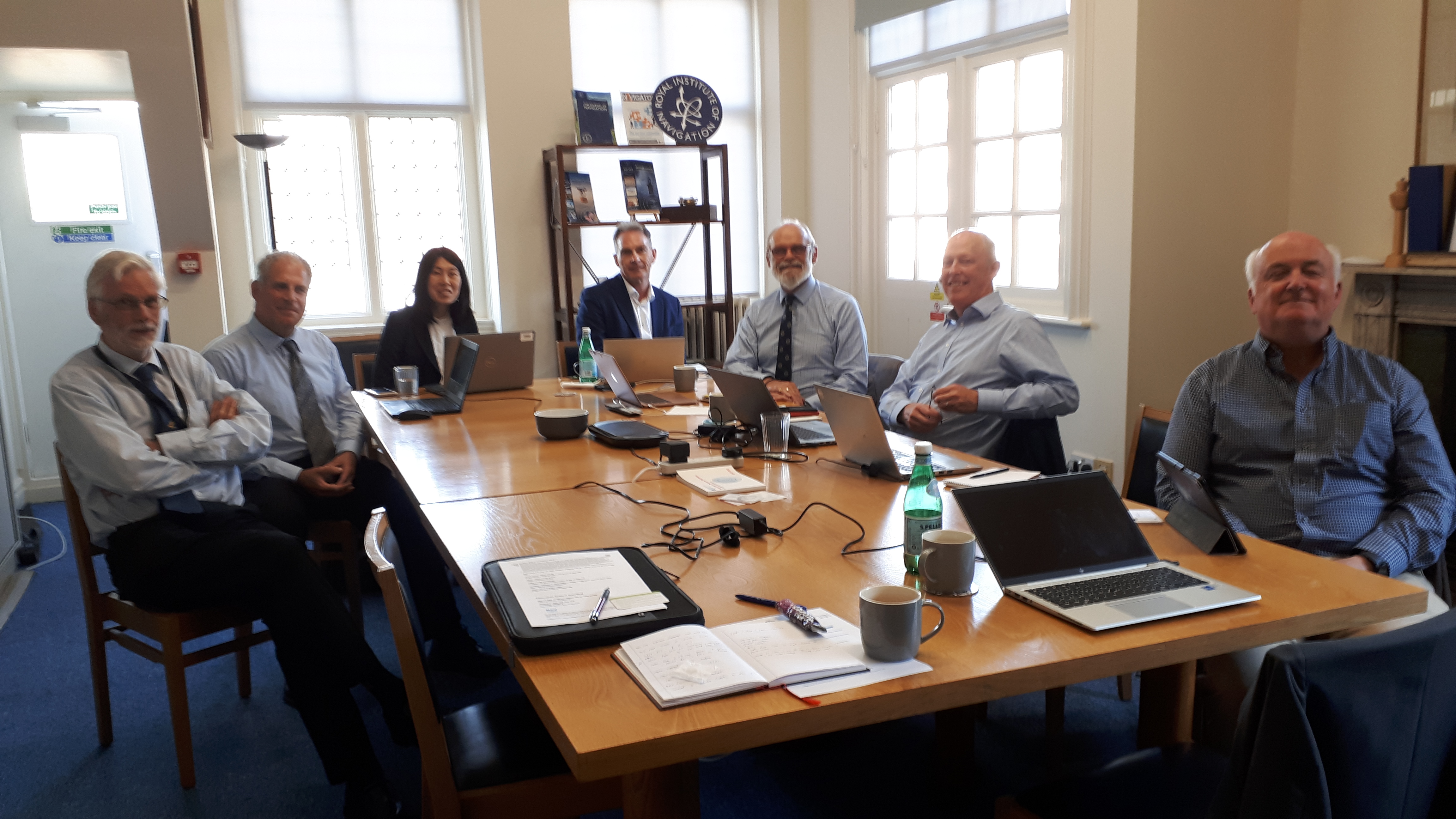
Above: a gathering of some of AHRTAG’s members meeting on 5 June at the Royal Institute of Navigation, London, England. At the head of the table on the left is Susan Cheng of Boeing, and to the right is Anthony MacKay of Nav Canada, AHRTAG’s chairman.
The Nepal authorities have released information from the crashed aircraft’s flight data recorder (FDR) which shows that both propellers feathered – and the engines stopped delivering power – seconds before the aircraft went out of control.
“Feathering” propellers is an action normally carried out if an engine fails. Selecting “feather” turns the propeller blades into line with the oncoming airstream, so that the propeller on the failed engine causes as little aerodynamic drag as possible, making the aircraft easier to control.
When this accident happened, the Yeti Airlines ATR72-500 twin turboprop aircraft was lining up for the final approach to runway 12 at Pokhara International airport, Nepal on 15 January, at the end of a short domestic flight from Kathmandu. As captured on a local video camera just before the crash, the aircraft’s left wing dropped dramatically and it plunged to earth about 2km from the runway threshold. Just before the aircraft disappeared from view, the propeller rotation visibly began to slow down. None of the 72 people on board survived.
The photograph below is the flight deck of an ATR72 like the crashed aircraft.
Much of the focus of the accident investigators is going to be on what happened to the levers on the “throttle quadrant”, shown in the cockpit centre, in line with the front edges of the pilots seats.
There are six levers in the quadrant. Left to right, these are as follows: the parking brake, the left engine power lever, the right engine power lever, the left engine condition lever, the right engine condition lever, and the flap lever.
The levers are each designed to look and feel different according to their purpose. For example the power levers tops are rounded, the condition levers have a rectangular feel, and all are black except the flap lever. The latter is topped with a distinctive white shape that is supposed to represent the aerodynamic cross-section of the flaps.
The controls that can order the propellers to feather are the condition levers, just to the left of the flap lever. When fully retarded, the condition levers shut off the supply of fuel to the engines. When the pilots want the engines to run normally, the condition levers are set to AUTO, which is where they are set in this picture. The setting between fuel shut-off and AUTO is marked FTR, meaning FEATHER.
Now to examine the sequence of events on the flight deck according to the investigators’ preliminary factual report.
A minute and 20 seconds before the crash, the aircraft was flying normally, and the pilot flying (PF, left hand seat) called for flaps to be set to 15deg and undercarriage down. The pilot monitoring (PM) carried out these actions. Seconds later the PF disconnected the autopilot.
Exactly a minute before the crash the PF ordered flaps to 30deg, and the PM responded “flaps 30 and descending”. But the flaps were not descending. Instead the propeller rotation speed on both engines reduced to 25% and the torque dropped to zero.
The crew did not remark on the power loss, but carried out the before-landing checklist and began the left turn toward final approach. After a few seconds the PM suggested that the PF apply a little more power, and just after that the flaps were set to 30deg without any command or status report.
ATC cleared the ATR72 to land, and in response the PF stated twice that there was no power from the engines. A few seconds later the stick-shaker activated twice, the second activation coinciding with the dramatic left-wing drop that sealed the aircraft’s fate. The stick-shaker indicates the imminent risk of stalling.
ATR propellers can auto-feather in the event of an engine power failure, but the system is designed to prevent auto-feather from happening to both props at once.
If the Nepalese investigators confirm that both propellers in the Yeti Airlines accident were indeed feathered simultaneously, it looks as if both condition levers were moved to FTR, or perhaps to fuel shut-off.
For additional context regarding accidents like this, read the immediately preceding story on this blog.
Whatever the cause of the recent Yeti Airlines ATR72 fatal crash in Nepal, it will turn out to have been preventable.
I don’t make this prediction lightly. It’s based on years of global airline accident data, which shows that almost all serious crashes over the last decade or more involve small or medium-sized propeller-driven aircraft operated by commuter, regional or freight operators.
It’s not the propellers that are the problem. Other indicators provide clues as to what that might be.
Year after year, most such accidents take place in nations – like Nepal – that have, statistically, a below-average safety score in terms of serious events. So it is a cultural problem. Not national culture, but safety culture within the national industry. That culture relates to how seriously safety is taken within the government’s transport department, the national aviation authority, and the individual airlines, right down to the training of individual pilots and engineers which influences their attitudes to their job.
Among countries with below-average aviation safety performance, Nepal and its aviators face particularly serious challenges, given the country’s extraordinary terrain and the fickle weather that goes with it.
Having challenges to face, however, should not degrade safety. Nepal has a duty to its air travellers to become the world’s expert in navigating its local terrain and flying safely despite its extreme conditions. All countries whose aviators routinely face extreme or unusual conditions have a duty to become experts at the challenges unique to their environment, and to be proud of that expertise.
FlightGlobal.com, and the February issue of Flight International, examine what regional and commuter operators can do to raise their safety standards to those of the best in the world. They also review what the world’s best did to raise their game from relative mediocrity in the 1990s and early 2000s to the zero-accident status they can now demonstrate almost every year.
There are other accounts of what happened to the disappeared Malaysian Airlines flight MH370, but Capt Verne Pugiev’s just-published book is about as close as you can get.
Pugiev, a nom de plume, is quite obviously the experienced Boeing 777 captain he claims to be, which is a good start if the truth about this “mystery” is what you seek.
The thing that intrigues me about this book is the way he has chosen to describe what happened. Just as the much-lauded writer Hilary Mantel, in her trilogy about King Henry VIII’s life and times, chose to write history in the form of a novel so that she could join all the recorded historic dots, bringing humanity to old academic narratives about the Tudor court, so Pugiev has taken the facts we know about MH370 and woven them into a chilling account of what – more or less certainly – happened.
He could, of course, have written a technical report as if he were an accident investigator, but the form would not have allowed him to fill in between the dots, and it would have been a dry-as-dust read. Meanwhile, as the story of the doomed aircraft recedes further into history, Pugiev clearly wants to fire up readers’ imaginations to keep public curiosity alive.
His book, rather predictably entitled “The Missing Plane: A Chilling Novel Based on the Real-Life Loss of Malaysia Airlines MH370”, is out in paperback.
The factual dots joined up in Pugiev’s story show the author to be a convinced follower of Capt Simon Hardy, a real 777 captain whose mathematical calculations and practical flight simulations of what happened to MH370 represent, in my opinion, the most accurate description of reality available. Back in 2016, Hardy was working with the Australian authorities who were leading the sea-bed search for the wreckage in the southern Indian Ocean.
Anyway, Pugiev’s narrative takes you as close to what really happened as we can get until MH370s wreckage is finally located and recovered, as it will be for sure.
The US airline pilot shortage is not exactly breaking news, it’s a problem that has been developing as a result of the post-pandemic resurgence in air travel, but it continues to worsen.
The shortage hits the regional and small commuter airlines hardest, because the national carriers poach their captains and copilots, especially those with experience. They have always done this, but the situation for the regionals is particularly dire right now.
In a statement in its just-published end-of-year report, the US Regional Airlines Association’s CEO Faye Malarkey Black, has warned: “If policymakers fail to do their job, and do not give the pilot shortage the urgent attention it warrants, small community air service will be a thing of the past, and air travel will soon be a privilege reserved for those residing in our urban centres.”
The report reveals that about 500 regional aircraft types are grounded across the country for lack of pilots to fly them. In November the RAA had estimated that the US airline industry had a shortage of about 8,000 pilots overall. Some of the larger regionals like Piedmont and PSA have been offering tempting joining bonuses, but these and the need to boost pay to retain pilots is becoming another factor in making marginal regional operations un-viable.
Voicing a familiar theme, Malarkey Black highlights the sky-high cost of training for professional pilots, and calls for legislation focused on “equitable access to aviation careers”, adding that the government “should be moving heaven and earth to make it easier for aspiring pilots from all backgrounds to access affordable, high-quality training”. Black urges: “We need to bring forward legislation to allow the next generation of pilots and mechanics to obtain student loans and grants.”
America is not the only part of the world where post-pandemic pilot shortages exist, but it does have a unique rule that makes it impossible for licensed pilots to enter the airline industry immediately following training, even if the training was airline-specific. This rule makes the pilot shortage – particularly for the commuter carriers where many rookie copilots would normally begin their professional careers – far worse.
This rule, requiring that pilots must have 1,500h in their log book before they can fly for commercial airlines, was the result of a kneejerk political reaction to a fatal commuter crash in February 2009 near Buffalo, in upstate New York. A Colgan Air Bombardier Dash 8 stalled during the night-time descent toward Buffalo airport, the crew lost control, and all 49 people on board were killed.
The National Transportation Safety Board’s main verdict was that the crew had not monitored the airspeed and had failed to lower the nose to un-stall the wings when the stickshaker activated. There were many other circumstances that were arguably contributory factors, including crew fatigue and the matter of crew training performance records, but federal politicians saw fit to attribute the whole thing to a lack of flying hours, so they mandated the 1,500h rule.
Thus, in America, a pilot with a full commercial license at the end of training – which normally means he or she has about 400 hours in their log book – cannot fly as copilot for an airline even if the carrier thinks they are good enough. They have to become flying instructors, obtain any kind of general aviation job, or fly single-pilot Cessna Caravan freighters for a small package delivery company until they have notched up 1,500h.
Many in the industry believe the 1,500h rule was never appropriate, but even more so now when modern pilot training programs take advantage of today’s much smarter flight simulation training devices to render a newly-trained pilot ready for the right hand seat in a commercial airliner. Change, however, does not look likely.
Whether an aspiring pilot is an ab-initio trainee, or a qualified pilot looking for a job, visibility in the recruitment marketplace is better than knocking on doors. But how do you make yourself visible?
The Airline Pilot Club (APC) has now developed a software tool that makes all its candidates for pilot employment or training courses visible to airlines and approved training organisations (ATO).
Airlines’ traditional ways of finding pilots are direct advertising and working with agencies. Advertising is a shot in the dark, but can be effective because those who apply have made a specific choice to do so. The only trouble is the applicants are self-selected and unfiltered. Agencies, meanwhile, can supply lots of names, but the qualifications and experience are self-declared and need checking.
Licensed pilots may reply to advertising, but in the end that’s a passive approach – a waiting game. Meanwhile ab-initio students/wannabes have traditionally had to trawl the flying schools and their promises, and hope.
Imagine joining a forum that brings the three industry components together – pilots, flying schools and airlines. There they meet, in a joint marketplace, where they can all see each other and where all the participants’ claims have been checked for accuracy.
That’s what APC members can do. Having proven themselves worthy of APC membership via indicative assessment, and having trod the pathway to pilot competence, their completed APC profile becomes their shop window to the ATOs and airlines, who can then contact them – direct – with individual proposals.
This smart new APC service takes the leg-work out of finding a training pathway, and makes it easier for airlines to fill crew vacancies.
With a 90min Airbus Voyager test flight out of its Brize Norton base, it seems the Royal Air Force has chalked up a world first.
On 16 November the Voyager, the military tanker/transport version of the A330-200, took off with its Rolls-Royce Trent 772B turbofans burning pure, 100% sustainable aviation fuel. Many airlines have operated different types with a mix of standard aviation fuel and SAF – usually less than 50% – but no-one is believed to have used pure SAF before.
On board were an RAF crew supplemented by representatives from the SAF manufacturer BP, Airbus Defence & Space, and engine manufacturer R-R. FlightGlobal has reported a statement by Airbus experimental test pilot Jesus Ruiz, who was the aircraft commander for the test: “From the crew perspective, the SAF operation was ‘transparent’, meaning that no differences were observed operationally. The test plan was exhaustive and robust and has allowed us to compare SAF with JET [A]1.”
RAF Voyager tanker/transport (Crown Copyright)
BP crafted the SAF from used cooking oil. This being a flight operated in British airspace by my alma mater, the RAF, I have an unaccountably earnest desire to learn that the cooking oil came from the deep-fryers of English Fish & Chip bars. Given that Capt Ruiz confirms the flight went without a hitch, it seems BP successfully ensured the fuel was not contaminated with salt and vinegar!
Joking aside, this is a very welcome achievement, as is the RAF’s stated objective for sustainable flight. Chief of the air staff Air Chief Marshal Sir Mike Wigston says the RAF is committed to achieving net-zero air operations by 2040, a decade ahead of the present global aviation target.