Lee-on-Solent airfield, originally the site of the Royal Naval Air Services’ first seaplane base in 1917, was also a Fleet Air Arm training base in WW2 as HMS Daedalus . The picture, looking east, shows its coastal location between Portsmouth harbour (seen in the distance) and Southampton Water
The historic Daedalus airfield, still operating as Solent Airport (EGHF), is a CAA-licensed general aviation aerodrome, with airline traffic served by Southampton airport to its north-west and Bournemouth to the west.
It is also home to Britten-Norman, which proudly calls itself the UK’s only independent aircraft manufacturer, still churning out updated civil and military variants of the perennially popular Islander/Trislander series more than 50 years after the type first flew.
More than 1,250 Islander series aircraft have been produced, and B-N operates a specialist MRO support service for them at Lee-on-Solent. But as an aeronautical engineering company it also carries out sophisticated mission systems integration for the Defender variant and other aircraft.
Now the base is under threat as an aviation site.
Fareham Borough Council, which owns it, is tempted to accept offers to locate a massive National Grid electrical supply interconnector terminal close by. This 10-acre, 25m-high terminal will be an electrical power supply interconnector with France, and if it goes ahead many extremely high voltage electrical cables will run underneath Daedalus’ runways and taxiways.
This will seriously mess up simple things like compass swings, but the calibration of mission systems and any other equipment affected by powerful electromagnetic fields will also be threatened.
Considering the interconnector terminal could equally efficiently be located the other side of Southampton Water at Fawley on a site that has always been industrial, threatening Daedalus, Britten-Norman and local general aviation in this way just because Fareham Borough Council likes the colour of National Grid’s money is, to put it mildly, short-sighted.
Most airline pilots approach their annual recurrent training simulator time in a rather apprehensive mood. After all, it’s more about testing than training, isn’t it?
That’s the image simulator training still has with line pilots.
But imagine if, at no cost to themselves, pilots could book a fully capable flight simulation training device (FSTD) for the type they fly on the line, and practice the skills they know they need to improve, with just a colleague in the other seat, but no instructor, and no Big Brother oversight.
The question is: would pilots choose, in reality, to book “private” simulator time, even if it were free of charge? Perhaps they would be tempted when a bi-annual recurrent training session was looming, or if they were preparing for command training.
Ryanair is offering a scheme like this to its pilots, and early trials show it’s popular with the crews who’ve tried it. More of that later.
Increasingly, feedback from crew reporting systems and operational flight data monitoring (OFDM) is identifying areas where additional training is needed, but most of these needs are not met by the recurrent training syllabus required by national aviation authorities (NAA), which is based on flying the way it used to be in the pre-digital era.
Despite the fact that good airlines increasingly conduct training based on an Advanced Qualification Programme (AQP), which allows the airline some flexibility to react to evident training needs, there tends to be insufficient time in recurrent training sessions for actual training once all the statutory exercises have been performed to meet the regulator’s requirement for testing.
A normal recurrent training session is not so much a case of being trained and then being tested on the skills learned, but of undergoing a test, then calling it training if you pass it.
The psychological circumstances of a test – or even a training exercise perceived as a test – are not conducive to learning.
As the concept of “evidence-based” – rather than syllabus-based – training becomes the recommended philosophy for recurrent training, the airlines are still jammed between the rock of the mandatory recurrent syllabus, and a hard place – namely the mounting cost of additional evidence-based training that goes well beyond the legal minimums.
Good airlines already go beyond the training minimums, but most just do what the law requires and stop there.
Ryanair already beats the minima, but is now extending that advantage by bringing on-stream a planned nine additional advanced fixed-base – but sophisticated – FSTDs beyond those needed to cope with growth.
These will be used for a combination of type-rating, remedial and voluntary additional training, effectively adding a full day to the annual total of recurrent training simulator time available to all pilots. Ryanair already has three of these devices – made by Utrecht-based Multi-Pilot Simulations – in operation: one at its Dublin HQ and two at its East Midlands, UK training base.
Ryanair’s head of training Capt Andy O’Shea has long wanted to give pilots the opportunity to develop their skills in their own time if they choose to.
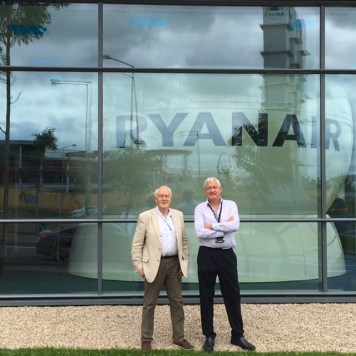
Learmount (L) and Capt Andy O’Shea in front of Ryanair’s Dublin training centre, the new Controlled Training simulator visible through the glass
At the same time the Ryanair investment in the sophisticated equipment has to be justified, and O’Shea was concerned that some pilots might use the kit for experiment, and end up with what he calls a “negative training” experience from a session.
So how do you give pilots the freedom to learn – and to consolidate their learning- in the areas they want to work on, but discourage them from barrel-rolling a 737-800 for fun, and at the same time convince them that Big Brother is not watching them?
O’Shea’s solution is a compromise. The hint is in the programme’s name: Ryanair Controlled Training.
Sure, the pilots who voluntarily book the simulator time are alone and unwatched in the device. It has a normal instructor operating station (IOS), but it doesn’t have to be manned. When they book the session, the pilots can choose from a menu of “lesson plans” entailing an origin, destination, and flight plan, and they upload it to the simulator when they start the session.
Before the pilots start the session they are provided with the instruction they need to operate the simulator, and then with payload and weather data to derive performance figures for the “flight”, and enter these into the FMS as they normally would.
Then they go through the normal checks, and “take off” using the standard instrument departure in the flight plan.
They just don’t know what else will happen en-route. But things will.
If they have trouble with a scenario they are presented with, they can freeze the simulator and discuss it, or try again, but there is a time limit for the sortie, so they have to get on with it.
Sessions are recorded, but O’Shea explains his philosophy: “We have no desire or intention to review each session for video or OFDM events. Our hope is that crews come to the FTD, practice their skills, improve their knowledge and leave feeling good about themselves.
So if OFDM exceedences will not trigger the curiosity of the Ryanair training department, what does? Straying outside the Boeing 737 flight envelope freezes the simulator, which then has to be re-set. Of course why that occurs would matter. For example upset prevention training (UPT) is programmed into some lesson plans, but recovery from extreme attitudes is not.
O’Shea says the new system provides an whole array of possibilities for voluntary pilot bookings, including: maintaining handling skills, UPT, left-hand seat practice for prospective captains, RHS practice for prospective instructors, and recurrent simulator training core competencies improvement.
But O’Shea says the kit also provides Ryanair with additional flexibility to test corporate safety strategies, carry out new airfield evaluation, assess FMC database updates, and familiarise pilots with new flight crew operating manual procedures.
It can also carry out follow-ups for real OFDM events on the line, because the simulator can replay them for crew to experience.
At present Ryanair Controlled Training is new, and there are only five lesson plans on the menu.
But there will be many more, promises Capt O’Shea.
A ballot on industrial action by pilots at Virgin Atlantic is taking place now. The union seeking the strike mandate is the Professional Pilots Union which claims its membership includes a large majority of pilots at the airline, but it is not recognised by the company.
PPU members at Virgin number 543, which is 70% of the pilot workforce, says the union.
The British Airline Pilots Association, which is recognised by Virgin Atlantic, says the PPU takes part in “single-table bargaining”, and calls the proposed action “counter-productive”. The PPU says so-called single-table bargaining does not, in fact, include them, and its members want recognition for their association, not representation partly by Balpa.
Internal union politics, and growing pilot dissatisfaction with Balpa representation at Virgin, has led over the last few years to the formation of the PPU, which in June took a “consultative ballot” of Virgin pilots about whether they would take some form of industrial action to back their demand to be recognised as the bona fide pilot representative body at the airline.
The PPU says it got a 95.5% vote in favour of some form of industrial action, with the majority within that total voting for action up to and including stoppages.
The independently conducted ballot now being held, the results of which will be known by 18 August according to the PPU, asks for a mandate to conduct a work-to-rule.
Virgin has commented: “We value our pilot workforce enormously and have offered to have dialogue with the unrecognised union. We like to reassure customers all Virgin Atlantic flights continue to operate as normal.”
Flights are indeed unaffected at present, but if the PPU gets its mandate a work-to-rule can be highly disruptive. As the PPU points out, running a smooth schedule on time depends a great deal on pilot goodwill.
The Australian Transport Safety Bureau, coordinating the multinational search for flight MH370, the missing Malaysia Airlines Boeing 777, had planned to complete the mission this month.
But winter weather has slowed down the sea-bed search for the main aircraft wreckage.
The ATSB says: “It is now anticipated it may take until around August to complete the 120,000 square kilometres, but this will be influenced by weather conditions over the coming months, which may worsen. More than 105,000 square kilometres of the seafloor have been searched so far. In the event the aircraft is found and accessible, Australia, Malaysia and the People’s Republic of China have agreed to plans for recovery activities, including securing all the evidence necessary for the accident investigation.”
The ATSB statement continues: “Consistent with the undertaking given by the Governments of Australia, Malaysia and the PRC in April last year, 120,000 square kilometres will be thoroughly searched. In the absence of credible new information that leads to the identification of a specific location of the aircraft, Governments have agreed that there will be no further expansion of the search area.”
The investigators have now examined half a dozen pieces of floating wreckage that washed up on beaches, mostly on the shores of islands in the western Indian Ocean or off south-eastern Africa. The have all been determined either to be definitely or almost certainly from the missing Malaysia 777. They include a flaperon, a wing flap section a flap track fairing, a part from a horizontal stabiliser, a piece of engine cowling, and a section of laminate material from the cabin trim of the aircraft.
So the aircraft is in the Indian Ocean, but if it is not found in the area where the sparse data the authorities have at their disposal suggest it should be, they have decided that the search will stop there.
UK-headquartered aviation law specialist Clyde & Co has gone public with basic advice on how the Brexit referendum vote could affect British registered carriers. At a time when shares in UK commercial air transport have been harder hit by the referendum vote than almost any other sector, this advice is apposite and helps the un-initiated to understand why they have taken such a hit on their equity values.
Clyde makes clear that the legal landscape is complex, and here I am only presenting the simplest part of their advice relating directly to intra-EU and UK-EU services. Exit from the EU also affects British carriers’ bilateral air service agreements with North America and the rest of the world.
This is what Clyde says: “The most significant consequence will be that air carriers which have been granted their operating licence by the UK CAA will no longer be “Community carriers” for the purposes of EU Regulation 1008/2008 (“Regulation 1008”), and thus will no longer be able to enjoy the right to fly between any two points in the EU/EEA that is conferred by such status under the Regulation.
“In the absence of any other arrangements, the old bilaterals between the UK and the other EU Member States, which have been overtaken by EU liberalisation and hence dormant for years, would become effective again, and should provide a sufficient legal basis for most 3rd and 4th freedom services, but in most cases only those two freedoms.
“The services most affected will be 7th and 9th freedom services – in other words, between two non-UK points in the EU (eg, Amsterdam – Barcelona) and between two points in the same EU Member State (eg, Rome – Milan), which would no longer be automatically permitted.” End of quote.
On the other hand the EU has been pretty much an Open Skies organisation toward Norwegian regarding its intra-EU services. Norway is not in the EU but is in the European Economic Area, and its most rapidly growing airline has been permitted the kind of freedoms most EU-based carriers enjoy.
That does not mean the EU is compelled to be liberal toward British carriers’ intra-EU services, but they might be.
EasyJet would be the most affected of all British carriers because of the huge number of intra-EU and UK-EU services it offers. While it had always made clear its wish for the referendum vote to favour remaining in the Union, it clearly has Brexit plans up its sleeve and isn’t panicking.
And although it says it doesn’t want to move its HQ out of Luton and into an EU state, if it had to do so it could. Then it would be able to register its company and its fleet outside the UK, like its arch-rival Ryanair, which is registered in Ireland, an EU state.
The issues regarding services from the UK to the rest of the world are manifold, because the EU has, for many years now, overseen – and used its negotiating weight in – bilateral agreements between all EU states and the outside world. And some of Norwegian’s applications to serve the USA from European countries other than Norway have bounced off a rubber-brick wall on America’s eastern seaboard, because it is not the EU’s job to support non-EU airlines’ applications. Norwegian’s negotiations with the USA over services by its UK division have become even more difficult since the Brexit vote.
There will be a lot of talking to do during the next two years while the UK continues to enjoy the privileges of EU membership, but in the meantime the uncertainty generated by this limbo situation is causing considerable stress in the industry.
A recent statement by the National Aeronautical Centre says this: “The operation of unmanned cargo aircraft (UCA) moved closer to reality as delegates from the aerospace and logistics industry met recently to discuss the way forward.”
Where did this come from?
“The unique initiative, organised by the National Aeronautical Centre, West Wales Airport, took place at the Lancaster Hotel in London, in the form of a round-table discussion. It was a world first event and an important step on a road that will lead to unmanned cargo aircraft being used throughout the global logistics chain.”
It’s true that, for years, the industry has been talking about the practicality of freight aircraft being operated pilotlessly, on the grounds that the technology to do it exists, and unlike pilotless passenger airliners, the public wouldn’t care.
This group discussion reportedly included Thales, BAE Systems, Leonardo Finmeccanica, Avio Aero, IATA, Lufthansa, Heathrow cargo “and other airline representation”, and the agenda included “a wide range of potential UCA operations from intercontinental air freighters to local deliveries by small drones.”
Ray Mann, Managing Director of West Wales Airport, said, “The past 20 years has seen the evolution of unmanned aircraft and although initially developed for military operations, they have demonstrated the means of having far greater potential for all sorts of civilian use. As UCA can be constructed in any size and shape depending on the task required, this first round-table discussion has been invaluable for both industries to understand how they can best respond to this growing demand.”
Global Head of Cargo at IATA Glyn Hughes commented that – while it looks like a great opportunity: “For the full economic and social benefits of commercial drone technology to be realized the groundwork needs to be done now to ensure their safe integration with existing air traffic and infrastructure.”
The latter will not be a rapid process.
My personal guess is that, for large freighters, single-pilot operations will precede zero-pilot ops.
That idea could really be very close, because the aircraft can be fitted with a system that enables remote piloting of the aircraft in the event of the onboard pilot becoming incapacitated or needing help.
And as the NAC says: “The initiative is set to continue with further meetings planned in the coming months.”
Airbus is not, at present, able to give specific advice to A320 operators based on information available from the Egyptair MS804 investigation, according to a report by Flightglobal senior journalist David Kaminski-Morrow.
Data transmitted by the aircraft’s ACARS messaging unit to the Egyptair operations centre is insufficient to point to a cause, he reports, explaining: “Airbus has already informed operators, via two accident information bulletins, that the available data is limited and that the analysis of the transmissions does not contain enough data to determine the accident sequence, Flightglobal has established.”
The Flightglobal report continues: “With the inquiry unable to conclude whether a technical flaw contributed to the crash, the airframer has been unable to provide any immediate advisory to operators.
“Although seven ACARS maintenance messages transmitted in the space of 3min – between 02:26 and 02:29 Egyptian time – hint at the possibility of smoke and heat in the forward fuselage, there is no confirmation that the time-stamp of the messages correlates with the order of the trigger event and no clear indication of the precise time interval between them.”
The unknown factor is the “trigger event” referred to. The ACARS messages (see earlier blog entries) and the circumstances of the crew’s loss of control over the aircraft do not provide specific evidence to indicate either sabotage or a fault as the trigger event. But whichever it was, it appears to have generated fire that caused progressive electrical failures, and the crew’s loss of control over the aircraft ensued soon after that.
Floating wreckage and body parts recovered from the water where the aircraft crashed into the Mediterranean Sea north of Alexandria, Egypt, so far provide no clue as to whether sabotage or another cause brought the aircraft down. And the search coordinators have released no information about how widely the wreckage field is spread. This can be an indicator of whether the aircraft came down in one piece or had broken up in the sky, but after time the clues can be lost because the floating wreckage can be spread by sea currents and wind.
All this makes the recovery of the main wreckage and the flight data and cockpit voice recorders from the sea bed vital for the understanding of what caused the loss.
French television news channel M6 reports that Egyptian air traffic control sources have told them the crew of Egyptair flight MS804 radioed to Cairo control that there was smoke in the aircraft and that the crew intended to make a rapid descent.
There was indeed a rapid descent, but one over which the crew lost control for reasons that are still being investigated (see previous blog entry).
If the M6 report is confirmed as accurate, this would contradict official statements by the Egyptian authorities that there had been no emergency call or reports to ATC of trouble in the aircraft.
All communications about this tragic event are sensitive because the friends and relatives of the passengers and crew, despite their distress, are hungry for information about what happened to cause their death.
So if the Egyptian authorities were indeed withholding simple but established facts about the flight, such a policy of silence needs to be reviewed.
It’s already known that Egyptair held ACARS data (see previous blog entry) about MS804’s technical troubles just before the aircraft was lost, and the authorities did not release these facts, although they were leaked two days after the accident and confirmed by the French accident investigator BEA as accurate.
In contrast, following the loss of Air France flight 447 over the South Atlantic in 2009, Air France and the investigator BEA quickly released information from ACARS about an airspeed-reading anomaly that occurred at the beginning of the sequence of events that led to the loss of the aircraft, although it was not known until much later what part that anomaly played in the crash.
About 30 years ago there was a universal policy by air accident investigators all over the world to tell the press and people that they should wait for the final report, and no facts would be released until then, because they might be understood out of context.
But for the last 15 years or so it has become practice in most advanced economies to release significant facts when they have been established, even if the full context is not yet clear, and to release interim reports when a basic picture of the situation – or a part of it – becomes known. Usually interim reports are issued with caveats about what is not yet known or understood.
The latter policy treats the friends and relatives of accident casualties with respect, and credits the general public with enough intelligence to interpret incomplete but factual information as what it is – incomplete information.
Not only has policy about the release of information changed in these countries, but the communications environment has been transformed by the internet, 24h news coverage, and social media.
That change in communications has radically altered people’s expectations about being able to access information quickly. So if – during investigation of an issue of public interest – it becomes clear that the authorities have been withholding information, or simply not processing it efficiently because of bad internal communication systems, it tends to engender a failure of public trust in those authorities.
It is far better for the authorities themselves, let alone for those whom they serve, to release established facts officially as soon as possible rather than to see them – inevitably in today’s communications environment – leak out unofficially.
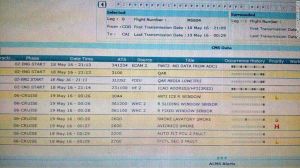
This is a screenshot of ACARS messages automatically datalinked from Egyptair flight MS804 to the airline’s operations headquarters shortly before the aircraft appeared – on radar – to go out of control.
News of the ACARS datalinked message first appeared in the Aviation Herald, a respected Salzburg, Austria-based journal that publishes on aviation safety issues. The French accident investigator BEA, which is helping Egypt with the inquiry, has confirmed the existence of the information. (ACARS = Aircraft Communications Addressing and Reporting System).
The printout/screenshot shows that all was more-or-less well in the aircraft until smoke was recorded in the forward lavatory just behind the flight deck.
A minute later smoke was recorded in the avionics bay, which is below the flightdeck floor, therefore close to the forward lavatory. The avionics bay contains all the electronic sensors and computers that provide the pilots with the information they need, and connections to the computers that direct the flight controls.
Two minutes after the smoke warning for the avionics bay the FCU 2 (second flight control unit) recorded a fault, and the SEC 3 (the N0 3 spoiler/elevator computer) also recorded a fault.
According to the Aviation Herald’s source, the ACARS feed then stopped.
Warnings about all these would have appeared on the pilots’ instrument panel.
There were other symptoms in the ACARS messages that popped up before the smoke was sensed by the system. These related to cockpit window de-icing and related window sensors, and were nothing to do with the aircraft controls but may have been yet another symptom of early fire damage to electrical systems.
The question now is whether the fire that caused the smoke was the result of an electrical fault – for example a short-circuit caused by damaged wiring – or whether some form of explosive or incendiary device was used – for example by a terrorist – to generate a fire or other damage.
The fire appears to have propagated fast. Flight control computers were failing within two minutes of the avionics bay smoke warning. If more of them failed subsequently the pilots would have limited means for controlling the aircraft, and with fire present, crew stress would have been extremely high.
That might explain the fact that there was no distress call. The pilots were trying to understand what the cause of the fire warnings was, where the source of the fire was located, whether they could do anything to stop it, and coping with a gradual degradation of their ability to control the aircraft.
These facts, providing they are not some kind of macabre coincidence, may have provided the basic reason why the aircraft went out of control and crashed.
But it is still not clear whether this situation was the result of terrorist action or an aircraft fault. Certainly no terrorist group has claimed responsibility.
And that answer is unlikely to be forthcoming soon. Even the recovery of the cockpit voice recorder and flight data recorded may not provide absolute proof of terrorist action – or lack of it – although the data will probably provide compelling circumstantial evidence.
It’s tempting to speculate that the loss of Egyptair MS804, an A320, was caused by sabotage because that’s what happened to the Metrojet flight out of Sharm el-Sheikh last year.
But, in the last decade, several aircraft have quietly gone missing during cruising flight without being brought down by explosives or in-flight break-up. The most obvious example was an Air France A330 that went missing in the south Atlantic in 2009, but there are others. And there is no information yet which would rule in or rule out either of those scenarios.
Greece’s Defence Minister Panos Kammenos has told a news conference that soon after entering Egyptian airspace, the A320 had turned “90 degrees left and 360 degrees to the right” before descending and disappearing off radar at 15,000ft. If that information is confirmed – and I have no reason to doubt it – the flight had clearly been destabilised, but the cause of the destabilisation is not known.
The aircraft’s last known position is over the Mediterranean south-east of Crete and south-west of Cyprus, but still more than 100nm off Egypt’s northern coast. Fairly soon some useful information is likely to become available because several military units – ships and aircraft – have been committed to a search of the area.
If, for example, there is a floating wreckage field and it is very widely dispersed, it will suggest an in-flight break-up.
But breakup can happen for reasons other than an explosion – although history and modern experience says that’s highly unlikely.
The aircraft and its “black box” recorders are almost certain to be found because, after other aircraft losses in the sea, recorders have been recovered in working condition from deeper waters than this.