The Professional Aviation Safety Specialists (PASS) union says 133 of its members at the Federal Aviation Administration (FAA) have just been fired following a review of the agency by the new Department of Government Efficiency (DOGE). They include aeronautical information managers, who update domestic and international information about the whole aviation environment, including routes, charts, procedures and flight paths, and maintenance mechanics, who maintain air traffic control facilities.
Others sacked include aviation safety assistants, who maintain office records, and environmental protection specialists, who evaluate environmental impacts, ensure compliance with environmental requirements and monitor environmental protection plans. The latter are believed to be particularly threatened by DOGE.
In the case of the FAA, Elon Musk, appointed by president Trump as head of the DOGE, is responsible for finding areas where he believes efficiency can be improved or costs cut, and for reporting these to the Transportation Secretary Sean Duffy. Duffy has since commented, in response to the PASS report on dismissals, that the FAA employs 45,000 people, and those few dismissed were all staff on probation.
As for the acknowledged long-term shortage of air traffic controllers, he blames this on his predecessor at the DoT, Pete Buttigieg, whom Duffy also blamed for doing nothing about “our outdated, World War II-era air traffic control system”. Finally, he alleges that the FAA’s budget is being used as “a slush fund for the green new scam and environmental justice nonsense”.
Just as President Donald Trump rushed to claim that the 29 January mid-air collision over the Potomac River was the result of air traffic control incompetence resulting from the Federal Aviation Administration’s application of DEI (diversity, equity and inclusion) policies in controller recruitment, so others have lined up to point out that there has been an unusual cluster of serious US fatal air accidents since his appointment as POTUS.
Anyone with a brain knows that neither claim has any causal connection with reality.
But I am serving notice today that this blog will examine any proposals that emerge from the Trump-appointed DOGE (Department of Government Efficiency) regarding the funding or reorganization of the FAA, and I invite senior executives and employees of the FAA, the airlines and general aviation bodies to report on substantive changes ordered by DOGE by responding to this blog.
Like others who care about maintaining and advancing aviation safety, I am wary of politically-inspired tinkering with an important oversight agency by leaders who have no expertise in the management of aviation safety. Trump’s first lieutenant Elon Musk, a man of many talents, has been entrusted with heading DOGE. He has a businessman’s appetite for risk-taking.
As Boeing acknowledges, business skills wielded by those for whom safety and quality control is an important concern, but whose primary objective has become shareholder returns, can get the balance wrong and damage both.
The USA has led the post-war world in advancing civil aviation safety, with the FAA being its general and the Flight Safety Foundation its standard-bearer. If the FAA’s ability to oversee industry safety performance and to manage the USA’s airspace is diminished in the name of “efficiency”, it affects global aviation, so the world will be watching with its own interests at heart. The FAA is an agency, a public service, it is not a business.
This appeal for reader feedback will have to be carefully managed, because at this stage the proposed Trump/Musk policies inspire apprehension without advancing any substance worthy of appraisal.
But soon actions will loom, and appraisal must begin.
Can artificial intelligence (AI) provide the factors behind aviation accidents? Maybe we should find out, because people can suddenly believe they are experts as a result of using it.
A reader contacted me on February 1st with the answer that an AI app provided when he asked it what caused the 31 January fatal Learjet air ambulance crash in Philadelphia.
Before discussing the AI’s verdict, here is what we actually know about the short flight: the Learjet 55 took off in the evening dusk (18:06:10 local time) from Philadelphia Northeast Airport runway 24, bound for Springfield, Missouri, with a stretchered patient and five other people on board. The temperature and dew point were both 9deg, the cloud-base was at 400-500ft, light wind and reasonable visibility.
When airborne the aircraft was told to turn right onto heading 290deg, and the pilot received an instruction from Tower to change frequency to Philadelphia Departure Control. He read the new frequency back correctly, and bid the Tower controller a good day.
According to ADS-B data, the Learjet had climbed rapidly to a maximum 1,650ft by about a minute after take-off (18:06:56) , then the aircraft entered a steep, uninterrupted descent to impact with the ground. The impact point was in a suburban area about 2.5nm from the airport, close to the runway extended centreline. The pilot never did make contact with Departure Control, and broadcast messages addressed to the flight by Departure did not receive a response.
According to initial reports by Philadelphia police, no-one on board survived the Learjet crash, one person on the ground was killed and 19 were injured, That is my summary of the basic known facts of what happened.
Meanwhile my reader who asked AI to provide him with an explanation for the crash told me he had, in his question, given the AI app (which he didn’t name) all the facts known at that point.
The executive summary part of the AI answer said this: “Preliminary data from ADS-B tracking, witness reports, and aviation system analysis suggest that Learjet 55 XA-UCI suffered a catastrophic runaway trim event (nose-down), leading to an unrecoverable dive and high-speed impact.” It also supplied what I would describe as cogent arguments to back this verdict up, but no actual evidence for the alleged runaway trim or the electrical fault that it proposed was the reason for it. The whole proposal, however, was delivered in a decidedly confident style.
I decided to take a different approach to test AI on the same subject. Given what we know happened, I asked Chat GPT whether the pilot suffering spatial disorientation as a result of somatogravic illusion could be the explanation for the Learjet accident? ChatGPT’s response first explained what somatogravic illusion is, then responded that, yes, it could indeed be a plausible explanation, but advised me to wait for the National Transportation Safety Board’s report.
Somatogravic illusion is an illusion generated by the delicate human inner ear balance organs when they are subjected to acceleration, linear or rotational. For example, passengers seated in the cabin of an aircraft beginning its acceleration along the runway for take-off can feel that the whole aircraft has tilted slightly nose-up, especially if they are looking straight ahead. But a glance out of the cabin window during the take-off run will prove that no such upward tilt has taken place.
Pilots experience the same somatogravic effect during take-off that passengers do, but since they are looking ahead out the cockpit windscreen – and providing the external visibility is good – their powerful visual sense will overcome the misleading feedback from their balance sensors.
If, however, the acceleration continues after take-off and the crew lose sight of the outside world because of darkness or entering cloud, the misleading feedback from their balance sensors returns. And the natural reaction to believing the aircraft’s nose is higher than it should be is to push forward on the control column, pushing the nose down. The physical feeling that a nose-down push is demanded can entirely overcome the intellectual information presented by the pilots’ flight instruments, because the latter is artificial, unlike powerful instinctive feelings or sight of a natural external horizon.
The Learjet series has a reputation for sporty performance. Its take-off acceleration and rate of climb when airborne are impressive. And the point in this short flight where it all appears to have gone wrong happens to occur at the moment when the pilot is likely to have taken his eyes off the flight instruments for a moment to change the radio frequency. The latter may be just coincidence, however.
There is no data here that could be regarded as evidence about the reasons for the Philadelphia crash, but I do know that the runaway trim explanation is plausible, and so is the pilot spacial disorientation theory.
There could be other reasons, however, and I know well after 45 years in this business that listing “what if” explanations is a waste of time because there are too many. The truth will out, via actual evidence. These days it does not take long, because investigators now strive to provide periodic interim factual reports which signpost the emerging truth.
But full understanding – and thus the ability confidently to act to prevent repetition – only comes with the full facts.
The fatal mid-air collision over the Potomac River next to Washington Reagan airport on 30 January is seen by many industry commentators, including myself, as an accident waiting to happen. Today it happened.
A PSA Airlines Bombardier CRJ700 twinjet (N709PS), operating as American Eagle flight 5342 from Wichita to Washington, collided with a US Army Sikorsky H-60 Blackhawk over the Potomac. Authorities now say there are not expected to be any survivors among the 64 people on board the PSA flight or the three crewmen in the Blackhawk.
The collision occurred at night but in good visibility, at a height of about 300ft, just as the PSA CRJ turned onto short final approach for runway 33 at Reagan. The airport is right next to the west bank of the Potomac, and the CRJ had been tracking north following the river. Washington tower asked the CRJ crew if they could accept a landing on runway 33, instead of 01 which they had been expecting. A CRJ pilot confirmed that they had visual contact with runway 33 and could accept it. When they approached the extended centreline for runway 33, the crew turned left to position on final approach, and the collision occurred just as they started to cross the river.
Reagan airport is very much a downtown airfield, with the heart of Washington just across the river to the north east, the Pentagon with its helipad immediately to its north west – and Arlington beyond that, and Alexandria to the south. The river is one of the principal corridors for helicopter traffic, most heavily used by the military and White House movements, and Reagan airport itself operates most of the time close to capacity. It is popular with politicians, business people and lobbyists because it is much closer to the heart of power than the city’s international airport at Dulles, more than an hour away in Virginia.
It is not clear whether any party to this accident made a classifiable mistake. It was nighttime, but visibility was good, and air traffic controllers were relying on pilots being able to make visual contact with other close aircraft when they had been advised of their relative position. But it would be easy for the navigation and anti-collision lights of the two aircraft to be lost among the city lights on both river banks, and easy to identify the wrong set of lights before confirming to ATC that they believed they had the other aircraft in visual contact.
In other words, this is a very busy environment, and because of political pressure to keep a downtown airport constantly available for use, Reagan airport and the terminal area around it operates knowingly with risk margins that seriously need reviewing. They probably will be reviewed as a part of the investigation into this accident, but the warnings have been there for years, and still the politicians want their downtown airport to continue doing business at a rate that entails serious risk.
In March 2024 the President and CEO of the US-based Flight Safety Foundation Hassan Shahidi remarked on the fragility of the US air traffic control services in the face of continually escalating demand. He wrote then: “The ongoing issues with runway incursions and other serious safety and quality concerns signal that safety buffers within the industry are being stretched thin. The industry is grappling with numerous challenges, including the recruitment, sourcing, and training of tens of thousands of new workers, the rising demand for travel, and the need to accommodate new and diverse types of operations within the airspace system.”
Speaking about the Washington accident today, President Trump has already been critical of air traffic control, but sees the problem as being caused by the Federal Aviation Administration’s (FAA) adherence to diversity recruiting policies, which he has now stopped. The FAA, a government agency, is responsible for providing America’s air traffic control, and it depends for its funding on the government and congressional approval. If it is under-funded, as the Flight Safety Foundation’s Shahidi implies in his quotation above, President Trump has the power do something about it beyond stopping a diversity recruiting policy.
Birdstrikes on airliners are not rare, but they don’t usually cause crashes, let alone fatal ones.
The most famous birdstrike accident before the Jeju Air crash at Muan, Korea a little more than a month ago was the “Miracle on the Hudson”, in which a US Airways Airbus A320 climbing away from take-off at New York LaGuardia airport in January 2009 hit a flock of large geese that disabled both engines. What followed captured the public’s imagination to the extent that Hollywood made a movie about it.
When the geese collided with his aircraft, Captain “Sully” Sullenberger made the decision not to attempt a turn-back to land on the runway, but to glide down for a ditching in the Hudson River. All 155 passengers and crew survived the ditching in the river’s freezing water.
Moving forward 15 years, the Korean aviation and railway and accident investigation board (ARAIB) interim report on the 29 December 2024 Jeju Air crash at Muan International Airport has now confirmed that the chain of events leading to the accident also started with a birdstrike on both engines. The Boeing 737-800, on final approach to runway 01 at Muan, ran into a flock of small ducks which caused the engines and the aircraft extensive damage. Details of the extent and nature of the damage have not been established, but it is clear that some of the aircraft’s electrical systems stopped working.
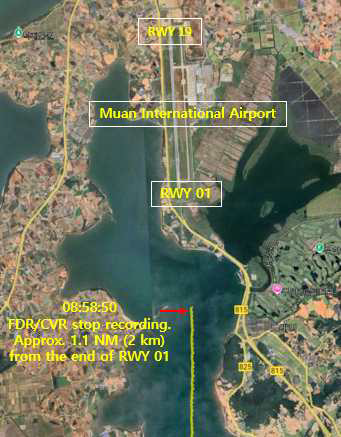
Much more would normally be known at this stage, but the flight data recorder (FDR) and cockpit voice recorder (CVR) stopped operating at the time of the birdstrike (08:58:50 local time), depriving the investigators of extensive data about the last four minutes of the flight that would otherwise have been captured. Simultaneously the aircraft’s ADS-B transmissions that enable the its three-dimensional trajectory to be tracked in real time also stopped, so it will be more difficult to establish the precise course the crew flew in order to line up for the emergency landing they chose to make.
It was at 08:54:43 that Jeju Flight 7C2216, inbound from Bangkok, Thailand, had first contacted Muan Control Tower and received clearance to land on runway 01. If they had not already done so, at that point they would have selected the undercarriage down and set the flaps for landing.
The first hint of the problems the flight was about to face came four minutes later when the Tower warned the Jeju pilots of bird activity ahead (08:57:50). At that point they were about 3nm from their anticipated landing. The electrical failure that stopped the two recorders occurred a minute later at 08:58:50, at which time the aircraft was still 1.1nm away from the threshold of runway 01, according to the ARAIB report.
The crew saw the flock of ducks ahead and below them just before the birdstrike, it seems, so they decided to abandon the approach and carry out a go-around, increasing engine power and starting to climb away. Six seconds later, at 08:58:56 local time, they declared a Mayday emergency, citing a birdstrike, and announcing their go-around, which had now become far more difficult to carry out because of reduced power from the damaged engines.
The report emphasizes that recordings during the last 4min 7sec of the flight are missing. That is the time that elapsed between the electrical failure that stopped the recorders and the moment of the 737’s violent collision with the earth and concrete mound beyond the end of the landing runway in which the ILS localizer antenna array was embedded (09:02:57).
Image from ARAIB interim report
As they initiated their go-around, the pilots felt – and heard – the birdstrike and witnessed a loss of engine thrust just after they had advanced the throttles to climb away. As a part of the go-around drill the crew retracted the undercarriage and selected the flap fully up. There is no recording to confirm this, but they must have done so, as events in the next few minutes make clear.
The attempt to save the flight
The crew knew they had to get the aircraft on the ground fast in case the damaged engines failed completely, but by this time they were losing sight of the runway 01 threshold below the nose as they initiated their go-around, so landing ahead on 01 was no longer an option. Circling back to set up a new approach to the same runway was risky because they might not have sufficient power to maintain height for that long. The ARAIB report says that the last pressure altitude recorded was effectively 500ft (498ft to be precise), and indicated airspeed was 161kt.
At such a point the pilots would want to gain any height and speed they could with the remaining engine power so as to increase their gliding range in the event of total engine failure, and to stay withing gliding range of the runway. So their decision was to fly ahead, then turn through 180deg to land on the same runway but in the opposite direction – that is designated runway 19. Because, during the go-around, they were positioned to the left of runway 01 and parallel to it, they were committing to a right turn to reverse their heading and line up for the approach to 19.
The workload and stress on the pilots at that moment were massive. They did not know how much engine power they would have, or how long they would still have it, so the temptation to turn early to line up on the runway was high. Video of the aircraft’s arrival on runway 19 at Muan shows the aircraft touching down gently with its wings perfectly level, but nearly 2/3rds of the way along the tarmac, travelling very fast with no flaps set, the undercarriage still retracted, and no spoilers deployed.
With the data available at present there is no way of knowing whether the crew failed to get the flap and gear down because of hydraulic problems, or whether the high workload and lack of time made them forget to deploy them. Apart from the failure of electric power to the flight recorders, the investigators don’t know what other problems the pilots faced.
It’s even difficult to work out why an external collision with relatively small birds (Baikal Teals, average weight given as 400g) would cause an electrical supply to fail, unless the undercarriage was still down at the point of birdstrike, leaving electrical wiring and hydraulic tubing in the gear bay vulnerable to impact damage.
Almost all the 181 people on board the Jeju 737 were killed, the only survivors being two cabin crew strapped into their seats in the tail of the aircraft. Everyone on board would still have been alive until the high speed impact with the solid foundations for the ILS localiser antenna array about 200m into the runway overrun, which caused the aircraft to break up and catch fire.
Most airlines no longer attempt to sell air travel as exciting or glamorous, because these days it usually isn’t. We examined that indisputable fact here quite recently.
Air France, however, is trying a new marketing idea to inject some romance into its product. I don’t believe this trick has been tried before – at least not by an airline.
Indeed, I’m not sure any other carrier could even hope to make this idea fly.
But Air France flies the flag of a country that’s home to the concept of Haute Couture, and home also to LVMH, by a massive margin the biggest luxury goods purveyor in the world. And its hub is Paris!
If ever there was a magic metropolitan brand name, Paris is it.
LVMH may not mean anything to most people, but its brands do. It owns Dior, Givenchy, Louis Vuitton and Moët Hennessy, to mention but a few. It doesn’t own Chanel, but that name evokes Paris anyway.
So what is Air France trying to fly?
Its own perfume. Or, as the British upper classes prefer to call it, scent.
It’s called AF001, the flight number of the legendary Air France Concorde departure from Paris Charles de Gaulle for New York JFK.
If the glamorous associations with Paris France don’t sell it to ordinary passengers, that magic flight number will ensure romantic aviation buffs buy it for their wives and girlfriends!
Let’s test the power of an idea, because British Airways flew Concorde too. Couldn’t they try it?
What images does the name of BA’s base, London, evoke? Not a scent, surely, nor romance. Maybe energy, like New York? And Burberry may be famous, but isn’t up there with Hermès and Chanel.
And the airline names: Air France proudly uses its country’s name, whereas British – as in Airways – is an adjective. In branding, these things matter.
Meanwhile other companies have tried to harness the sense of smell, but usually for the purpose of exploiting an already strong brand name to generate a side-hustle that might be a good earner. Harley-Davidson tried it, for example, but would you buy the stuff? If it didn’t smell of oil and come packaged with a guttural sound-track, what’s the point?
Anyway, what does Air France have to say in its press release about its AF001 fragrance?
The airline hired Francis Kurkdjian, master perfumer and artistic director of Maison Francis Kurkdjian, to create the new scent: ‘I’m very proud to have created Air France’s first signature home fragrance. It was the illusion of a ray of sunshine on the wings of an aircraft that inspired me to create this light, fresh and comforting home fragrance’.
Fabien Pelous, the airline’s Customer Experience Manager, waxes lyrical: ‘The Air France travel experience now elevates all five senses: sight, with the haute couture uniforms of our staff, our cabin interiors, and the meticulous design of our lounges, taste with the delicious dishes on the menu on board, touch with the soft fabrics of our seats, sound with our playlists on board, and now smell with this prestigious signature fragrance’
The marketing department says the fragrance will become part of the AF ambience: “Air France will be gradually using AF001 in its lounges in Paris and around the world over the coming months. Evoking a feeling of space, calm and light, AF001 accompanies travelers in style. Its comforting musky scent, combined with mimosa from the south of France, adds a sunny, natural vibrancy. Created with hints of jasmine and rose, its delicate floral aura takes travelers on a real olfactory journey, capturing a specific moment in time.”
Personally, I salute any move to bring glamour back to airline travel – or at least to attempt it.
Here’s another test of the idea: what would a perfume called Ryanair or Southwest Airlines smell like?
It will not be long before accident investigators reveal the reasons why the Jeju Air Boeing 737-800 crew felt they had to commit to a flapless, gearless landing on runway 19 at Muan, South Korea. But the reason so many people died was not the landing as such, but the fact that the aircraft (HL8088) collided with a very hard obstruction just beyond the runway end.
That collision broke up the hull and caused a conflagration. What was the obstruction, and why was it positioned on the runway extended centreline only about 200m beyond the runway threshold?
It looks as if it was a concrete anchorage for the Instrument Landing System (ILS) antenna array. ILS antennae are often just beyond runway ends, but they are normally designed to be frangible so any aircraft that collides with them suffers only minor damage. This was hard. Very, very hard.
The sequence of events that led to this accident began with the aircraft approaching runway 01, cleared to land, but the crew elected to go around just after ATC had warned them of a potential birdstrike. It looks as if a birdstrike did, indeed, take place, and the crew declared a Mayday emergency shortly after that.
The crew then elected to land on the same runway but in the opposite direction – on runway 19. This was not much of an issue because the wind was very slight and the visibility was excellent.
But when they returned for the fatal landing on 19 they touched down with no flaps and no landing gear. Why? Perhaps because the birdstrike caused the right engine to fail, and all or some of the hydraulics with it. And the gear and flaps are hydraulically powered.
We don’t know yet, but we will know soon.
Meanwhile the touchdown was as good as a flapless/gearless touchdown could be: wings level, nose not too high to avoid breaking the tail. But being flapless, the airspeed was very high – probably around 200kt.
Look at the video of the landing run. The aircraft slid the full length of the runway with the fuselage, wings and engines substantially intact, and with no fire. It slid over the end still going fast – maybe 70kt or so, but still with no further substantial damage to the structure and no fire.
Then the aircraft hit the obstruction about 150m beyond the hard runway overrun, but until impact it remained substantially undamaged and fire-free. At impact, the hull buckled and broke up, the wing fuel tanks were ruptured and instantly exploded into flames. The wreckage came to rest just beyond the obstruction, near the wire perimeter fence.
If the obstruction had not been there, the aircraft would have slid through the antenna array, across the level ground beyond it, and through the wire perimeter fence. It would have come to rest with most – possibly all – those on board still alive.
We will soon find out the whole truth about why the landing took place as it did. But because the accident killed all on board except two of the cabin crew, those answers will be almost academic. The question to answer is: what was that obstruction, and why it was there?
If a new search of the southern Indian Ocean goes ahead as proposed, the expedition may clear up once and for all the most perplexing aviation mystery since the second world war: the fate of the missing Flight MH370, and all 239 people lost with it.
The majority of those on board the lost flight – which took off from Kuala Lumpur bound for Beijing more than ten years ago – were Malaysian or Chinese. Now Malaysian transport minister Anthony Loke has provisionally accepted a “no find, no fee” bid by Southampton, UK-based survey company Ocean Infinity, to search a new area of the remote southern Indian Ocean, where previously rejected data suggests the MH370 wreck could be resting on the sea bed.
Loke explained his rationale for a new search: “Our responsibility and obligation and commitment is to the next of kin…We hope [the search] this time will be positive, that the wreckage will be found and give closure to the families.”
Ocean Infinity vessels took part in a previous search near the planned fresh objective, but they were carried out under the direction of government agencies from Malaysia, China and Australia, and were unsuccessful. This time the company will be using independently supplied data from multiple expert sources, and it will consider alternative theories as to how the aircraft was directed in the last sector of its flight before it finally entered the ocean. This will take the search further south than Ocean Infinity’s vessels have scanned before.
On 8 March 2014, the Malaysia Airlines Boeing 777 took off from Kuala Lumpur on a scheduled flight to Beijing. Over the South China Sea, only 39 minutes into the flight, all radio communication with air traffic control was lost, and the aircraft’s data disappeared from ATC radar.
Military radar later revealed that, when it disappeared from ATC radar because the aircraft’s transponder had been switched off, MH370 almost did a U-turn and headed back across Malaysia, out into the northern Andaman Sea, and finally went out of radar range. What it did then has been the subject of endless speculation, but all plausible theories led to the south-eastern Indian Ocean, where the previous (unsuccessful) searches have taken place.
Since that time a few pieces of wreckage identified as part of the missing Boeing 777 have been found washed up on beaches around the Indian Ocean, thousands of miles from the aircraft’s flight planned route.
But the resting place of the wreckage and the remains of 239 people who had set off innocently on a commercial flight are, to this day, still undiscovered.
If the Malaysian government confirms its planned agreement with Ocean Infinity, the world may finally learn the fascinating truth about this mysterious flight.
“Oh I have slipped the surly bonds of earth and danced the skies on laughter-silvered wings” (Pilot Officer John Gillespie Magee Jr RCAF)
There are probably millions of people aged in their twenties who have flown many times and never felt the magic. Before the new century arrived, almost all air travellers would have felt that frisson at the moment of unstick.
What has changed? That is the question.
Where is the excitement? Where is the airfield? Where are the aeroplanes?
For at least two decades now, economy air transport has been far cheaper than it was twenty or 30 years ago. But, Humble Traveller, you sacrifice much for that privilege! Almost certainly far more than you realise, especially if you are less than 30 and have never experienced anything different.
Today, from the moment of clicking into the online booking process to the point of your expulsion into your destination arrivals hall, the total air travel experience feels as if it is designed to humiliate air travellers. There are definite parallels between the way the low cost carriers (LCCs) treat their passengers and the way reality television shows test minor celebrities’ capacity to cope with public acts of debasement for the entertainment of viewers.
But it doesn’t have to be like this! Dear Ryanair (et al), it’s quite possible to deliver the absolute basics of air travel without making passengers feel they they are being punished for their parsimony!
Indeed one of the industry’s extant personalities, Ryanair’s chief exec, Michael O’Leary, almost encourages the impression that he chuckles at the pain he can persuade his passengers to undergo to knock a Euro or two off their fare! They just keep coming, he crows. And he’s right, they do – in ever larger numbers!
Why do passengers accept it?
Consider, Humble Traveller, what you are persuaded to undergo to purchase this flight.
At the website, you choose your departure point and destination, then scan the flights for the best value trip. That done, you decide what baggage – if any – you will check in, and what you may carry on board. Both these choices will add to your fare.
Then select the seat you want. Airlines, of course, are obliged to provide seats, but choosing a specific seat may drive your fare yet higher.
Finally, you are asked whether you want to pay a premium for the privilege of boarding ahead of other passengers. Quite why anyone would want to occupy a cramped seating space for any longer than necessary is not clear, but some people volunteer to pay for it, which adds to the impression that the airline, having successfully captured you, is playing with you like a bored cat.
You may, by now, have paid a total price for your trip that is up to three times the face-value of a luggage-free flight. And you haven’t even made it to the airport.
Airports, once exciting places to visit, with open-sky vistas of aeroplanes doing what aeroplanes do, are now a challenge to reach, hidden within concentric zones of increasing security designed to deter all but the most determined passengers.
Friends or family delivering you to the airport by car are confronted, on approach, with signage directing drivers to specific lanes for short-stay parking, long-stay parking, public transport drop-off lanes, VIP drop-off lanes, private drop-off lanes, all monitored by video-cameras with number-plate recognition software. Don’t dare get into the wrong lane or security men will swarm your vehicle and direct you around the system a second time to collect a second drop-off charge – or at least the fear of it!
Finally, when you drop off your passengers, the terminal entrance is several hundred metres away, with no porterage. Trolleys – if available – are distant.
A particularly awful airport to deliver to is London Gatwick North Terminal. It used to be light and easy, but now the infrastructure surrounding it has burgeoned, and innocent passengers find themselves dropped off in a skyless concrete chasm between the row of multi-storey car-parks and the terminal itself. This underground labyrinth feels like one of those abandoned warehouses in which criminals and cops have their final shoot-out in the movies.
Within this scary underworld the hapless travellers – rapidly abandoned by their driver who fears being charged for exceeding the permitted drop-off duration – are challenged to find a terminal entrance that will, hopefully, deliver them to a well-lit space for check-in.
The relief, when they do make it to the check-in hall, is overwhelming.
But that’s only the first hurdle. Now they have to negotiate the self-service bag-drop and baggage-labelling process, plus hefting 23kg bags onto a raised belt. Heaven help people who are old, frail, or partially sighted, because the airline won’t.
Having dispatched their bags – an act of faith – to god knows where, the travellers submit to robot-managed identity checks followed by security searches. Bags and belongings need to be hefted into trays, laptops separated, valuables exposed to public view, jackets off, watches off, pockets emptied, belts, shoes and spectacles removed, and all this personal kit is travolated away from you into the dark maw of the X-ray machine. Will you see it again, you wonder?
You, meanwhile, have to stand in a scanner arch with your hands held high, then undergo a pat-down check while your shoes are prodded by a hand-held sniffer wand designed to detect explosive traces.
All this is immediately followed by getting dressed again, in public, and recovering and re-packing your scattered possessions.
You have now made it to “airside”.
The assaults on your senses are not yet over. Immediately you are forced along a long and winding path through blindingly floodlit displays of costly bottles of scent, malt whisky, and other non-essentials before making it to the departure concourse, where you are confronted with the information that your flight has not yet been allocated a gate.
In most terminals, at this point, there is still no view of the outside world. There is still no sense that you will soon be “slipping the surly bonds of earth” in your sleek, 21st century version of a magic carpet. Still absolutely zero sense of anticipation.
Suddenly your flight is allocated a stand, and you have ten minutes to walk about a kilometre along blind corridors to a gate lounge which may – if you are lucky – provide a first glimpse of your flying machine.
At this point the boarding charade begins. The passengers all know they have an allocated seat, yet many choose to stand in a queue for the final security check before shuffling slowly down a blind, steeply sloping boarding pier toward the door of an aeroplane they are – seemingly – not permitted to see.
The last act before take-off is stowing bags and getting into a seat row so tightly spaced that, once there, the ability to move any appendage is painfully limited.
Remember, all this suffering has been entirely voluntary on your part. You knew it would be like this, but you chose it. Don’t blame O’Leary!
Or should you?
Yes you should. This has to change. You don’t have to endure this.
The LCCs have made their point, and have delivered cheap flying. We, the passengers, are educated now, and will not demand expensive privileges on the basic A to B service we can reasonably expect.
But the airlines and the airports have now to deliver that service with respect for their customers. They could. It would cost little, and improve business.
For the airlines, that will start with respecting their crews. A happy airline attracts happy customers, and that’s good business.
The airports have more work to do, starting with better design of the passenger spaces from drop-off to boarding. Retail maximisation should not dominate policy. Stressed, bored passengers are not in the mood for spending money en route.
Finally, make use – once again – of the natural glamour of flying to attract people back to the sky, by letting them see the airfield and its activity. Give them space to dream – along with Pilot Officer John Gillespie Magee – of “topping the wind-swept heights with easy grace”.